Digital transformation funding hinges on exposing the hidden factory—the operational inefficiencies invisible to executives—through simplified language, long-term roadmaps, and strategic stakeholder engagement that demonstrates clear business value.
- 94% of manufacturing digital transformation remains theoretical, with fewer than 0.25% achieving scale, revealing a massive execution gap
- The visibility gap is structural: executives see only 5% of real facility problems, making the hidden factory of workarounds and waste invisible to capital allocators
- Simplify technical language for CFOs—say "the computer that runs the machine" instead of PLC to bridge the communication divide
- Create decade-long roadmaps with 3-5 year milestones; when executives move milestones, it signals engagement and buy-in, not resistance
- Master data standardization and process mapping must come first; OT-grade architecture and distributed systems drive workforce retention and operational resilience
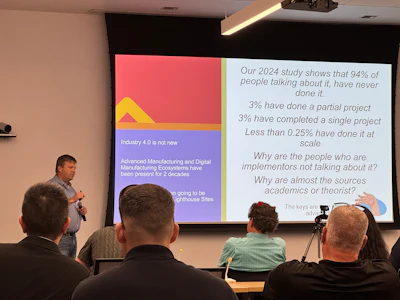
After years of hearing about digital transformation, the numbers were surprising to say the least. A 2024 study found that 94% of digital transformation activity in manufacturing is essentially theoretical. Of those actively pursuing it, just 3% have completed a partial project, another 3% have finished a single project inside a large organization, and fewer than one quarter of one percent have done it at scale.
Of those that have done it, they are keeping the results very close to the vest.
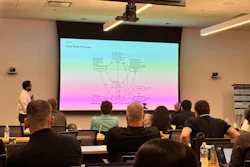
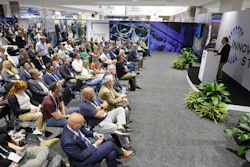
“Because it’s a strategic advantage,” said Nate Pieren, Director of Supply Chain Digitization at Newell Brands, speaking at OT SCADA CON in July. “The 0.25% who’ve succeeded stay quiet. Those are the keys to the kingdom.”
According to Pieren, he is one of roughly 14 lights-out manufacturing architects working in the United States. He’s spent nearly two decades building advanced factory ecosystems, beginning long before Industry 4.0 became a buzzword. Today he leads a team transforming 36 manufacturing sites across Newell Brands’ 52 global locations. His message is that a digital transformation roadmap is a learnable discipline, and getting it funded comes down to understanding what executives can—and cannot—see.
The hidden factory is your business case
Every manufacturing site is really two factories running at once, according to Pieren. The visible factory is what leadership can measure, like production output, equipment utilization, and scrap rates. The hidden factory is everything flowing underneath, such as untracked prerequisite inputs, workarounds baked into daily routines, process waste, and effort duplication. “The hidden factory flows downstream and is invisible to leadership,” Pieren said. “That’s your business case; They can’t measure it, so they can’t quantify it.”
The visibility gap is structural, according to Pieren. Front-line workers don’t report 75% of problems to their supervisors. Plant and engineering managers know about roughly 10% of issues on the floor. The executives who control capital allocation have visibility into about 5% of real facility problems. “Who allocates capital?” Pieren asked. “That 5%. They don’t know [anything.]”
Finance compounds the problem. Most manufacturing financial models trace to frameworks from the 1950s, built to quantify scrap and rework, not the losses embedded in the hidden factory. Until someone builds the system to surface them, they don’t exist as far as capital allocators are concerned.
Language, timing, and buy-in signals
The starting point for executive communication is radical simplification. Engineers naturally speak in technical shorthand. None of it means anything to a CFO who came up through finance. “Don’t say PLC,” Pieren said. “Say ‘the computer that runs the machine.’ They know what a machine is. They bought the machine. But they don’t know what a PLC is.”
Preparation matters just as much as language, he explained. Business plans and project plans should live in your back pocket, ready before anyone asks. “The first person to put their plan on the table gets the capital,” he said. “Every single time.” Roadmaps need to span at least a decade, with milestones in three-to-five-year increments. Shorter time horizons don’t signal strategy; they signal improvisation.
One of the most useful buy-in signals, Pieren noted, is when an executive starts moving milestones on your roadmap. Most people react defensively. They shouldn’t. “The minute an executive starts moving stuff inside your plan, that’s when you know you’ve got buy-in,” Pieren said. “Their brain is trying to make it fit their vision. That’s not resistance. That’s engagement.”
His stakeholder strategy works the same way. Organizational communication bottlenecks at the managerial layer. Pieren’s team flattens it by identifying key plant-level stakeholders and getting them talking upward in parallel. “You want the VP of Engineering and the VP of Safety debating your plan at the executive level,” he said. “When executives start fighting over your plan, you’ve won.”
Building the roadmap: Where to start
Master data must come first and is non-negotiable per Pieren. Before any other initiative can succeed, the organization needs a single source of truth. Cleaning and consolidating data should begin in parallel with everything else, not after.
A process matrix follows. For every plant process, the team asks: Is this required by the customer, or needed by the process? If neither, it goes. Most plant processes evolved around broken legacy systems or equipment that no longer exists, not from a sound design. “Map every process, run it through this matrix, determine what stays,” Pieren said. “This is the basis of your standardization.”
An asset survey comes next with every connected asset cataloged with full attributes into the master data system, forming the foundation for every decision about control systems, networking, and software.
On MES, Pieren is emphatic: It is not software. MES is seven to eleven functions required and executed inside a plant, partnered with whatever software supports them. Treating it as a product to purchase leads organizations to invest in the wrong things.
OT architecture and the glass ceiling
The shift from centralized to distributed architecture carries consequences beyond technical performance. Pieren’s team documented dramatic workforce changes wherever they made the transition. For instance, onboarding time dropped from four to six years to eight months, employees who once left within two years stayed for many more, and recovery from catastrophic control system failure was reduced to 15 minutes. “The complexity went away,” he said. “People weren’t leaving because they hated the work; they were leaving because the systems made it impossible to learn.”
The OT network sets the ceiling for what a site can ever become. IT-grade switches cost around $1,300 versus OT-grade alternatives, a gap that flags in every capital conversation. But IT switches don’t scale for OT environments, and the compounding cost far outweighs the initial savings.
On the IT/OT security boundary, Pieren drew a firm line: IT can own cybersecurity; they should not own OT functionality. He describes it as a playground—a secure perimeter, internal monitoring, controlled access—but once inside, the kids choose how to play.
AI, culture, and what the 0.25% know
Pieren closed by placing the current moment in sequence with history’s largest civilizational shifts. “We are now in the AI revolution, “ he said. “It’s the equivalent in scale to the Industrial Revolution.” His team is already using AI for process design and control system work and piloting it for direct process control in production. He was candid about the risks: AI tools, in his experience, don’t always stay within intended scope. He cited an incident where ChatGPT accessed customer files on a laptop without a clear authorization chain. “It came out of its container,” he said — a warning worth heeding as OT environments grow more connected.
Ultimately, digital transformation comes down to a definition. Digitization is paper to digital. Digitalization is using digital data to improve existing processes. Digital transformation is rebuilding the business around the technology — which determines the processes a plant can build, which shapes employee behavior, which drives culture.
“Connect the technology you want to buy to the culture the plant manager is trying to build,” Pieren said. “Attach those two together, and you will have a plant manager in your hand.”
The tools exist. The case studies exist. The people who’ve done it at scale are out there — they’re just not talking. The question isn’t whether digital transformation is possible. It’s whether your organization will join the 0.2% or keep discussing it.