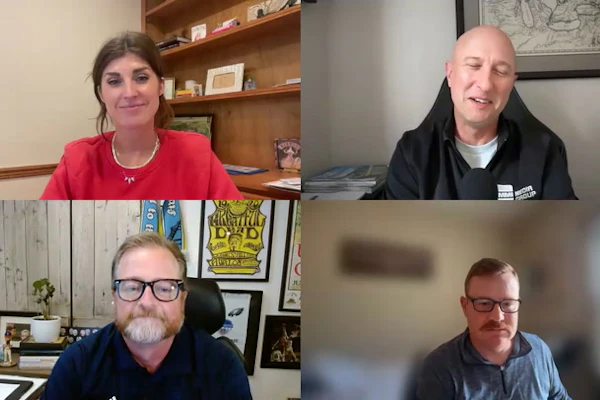
Sean Riley: Welcome to End of the Line, where PMG editors come together after a long week to chat about some of the interesting things that have crossed our desks.
I'm Sean Riley, Editor-in-Chief of OEM Magazine, joined as always by Liz Cuneo from Healthcare Packaging and Matt Reynolds from Packaging World.
It's just the three of us this week, but you both have a lot to talk about. You literally just got back hours ago from Las Vegas, where you attended GS1 Connect. I know it wasn't all fun and games. It’s a major event—I attended in 2023 when it was in Denver—and it's grown into quite a large gathering.
So with that in mind, Liz, what stood out from the healthcare side?
Liz Cuneo: It was definitely a bigger event than I expected, which was great to see.
On the healthcare side, there was a lot of discussion around the National Drug Code, or NDC, and the move from a 10-digit code to a 12-digit code. We heard from several stakeholders, including the FDA, which provided some interesting context on why the change is happening.
Essentially, the FDA expects the industry to run out of available NDC numbers within about eight years. Expanding the code from 10 digits to 12 digits dramatically increases capacity, so the change is really about ensuring there are enough identifiers for the future.
One interesting point the FDA made was that the new format should solve the issue for roughly 900 years. So while someone joked that we might need to revisit this again someday, it's safe to say that won't be our problem.
The FDA did a good job explaining the "why" behind the change and what the new requirements will look like. Where some tension emerged was around the "how." The FDA was very clear that implementation is largely up to manufacturers.
There were a lot of questions about the transition period, when both 10-digit and 12-digit NDCs will coexist. For example, what happens if products with 10-digit codes are returned after the transition period ends? Who absorbs those costs? How should companies handle inventory carrying obsolete codes?
The FDA's response was essentially that those are issues manufacturers will need to work through themselves.
Sean Riley: That sounds very government-like—"Here's what needs to happen. Good luck figuring it out."
Liz Cuneo: Exactly. That said, the FDA speaker was excellent. He was dynamic, knowledgeable, and provided a lot of insight into the timeline and regulatory considerations. We're hoping to bring him in for a webinar next year as part of a series focused on helping companies prepare for the transition.
We also heard from solution providers about how organizations should begin planning. They discussed system upgrades, software considerations, stakeholder involvement, and where companies should focus their efforts first.
The challenge is that while the change sounds simple on the surface, it's actually quite complex. Existing inventory has to be managed. Entire organizations need to align around the transition. And then there’s the scanning infrastructure.
Scanners across the supply chain will need to be capable of reading the new codes, and many companies are also evaluating how this aligns with the broader move toward 2D barcodes and additional data requirements.
So it's a significant undertaking. The FDA has provided guidance on what needs to happen, but the implementation details are largely in the hands of industry.
Sean Riley: And how much time do companies have?
Liz Cuneo: The deadline is around 2033, which sounds far away. But when you factor in a two- to three-year transition period, companies really need to have much of the groundwork in place by around 2030.
Considering the scale of the changes involved, that's actually right around the corner.
Sean Riley: Very interesting. I saw some of the videos you both posted from the event. Great work. Matt, I'm sure there was plenty more that you uncovered while you were out there.
Matt Reynolds: Yes. I’m actually between two events right now that I didn’t expect would relate to each other.
I was at GS1 Connect last year, and a major topic was Sunrise 2027. That initiative is focused on scanner compatibility and the idea that most retailers will have scanners capable of reading 2D barcodes or QR codes, in addition to the traditional 1D barcodes we’re used to seeing.
That’s a major threshold moment for the industry. Many retailers already have that capability, and brand owners are slowly coming around to the idea. Maybe not as quickly as GS1 or others would like, but they do seem to be more sophisticated on the topic this year than they were previously.
I expected to keep Sunrise 2027 in one mental bucket this week, and then next week I’ll be at the Packaging Recycling Summit, where I know EPR—extended producer responsibility—is going to be everywhere.
But it turns out EPR has already spilled over into GS1.
Sean Riley: That’s a lot of acronyms.
Matt Reynolds: It is alphabet soup, but it all connects. Just before GS1 Connect, GS1 published a free EPR data model. I saw it come through by email, but I didn’t pay too much attention to it at first. Once I got to the event, though, it became clear how much EPR is starting to subsume anything and everything related to packaging.
States are beginning to charge fees to brand owners based on the amount of non-recyclable packaging they put into the market. Oregon and Washington are already live, and companies have been reporting packaging data there for about a year.
California is expected to switch on soon, and when that happens, this is no longer just a regional issue. California is essentially a country of its own, and many brands are not ready.
We heard from Sysco, which is not exactly a brand owner but is a foodservice distributor and is considered a producer under EPR. They’re creating packaging and putting food into packaging, so they fall within the scope of these requirements.
A speaker from Sysco, Elsie Edie, talked about how she began looking into this about two years ago. She had some extra budget and started exploring how GS1 identifiers could help the company understand and organize packaging data in anticipation of EPR requirements.
That gave Sysco a head start. But once she opened the lid and looked at what was underneath, she realized how large the task really was. She described their first year of reporting in two words: hard and messy.
That seems to be what many brand owners are experiencing.
Before companies can report on their EPR obligations, they need highly detailed packaging data. In many cases, they need item-level information on every packaging component, including material type and weight, across every level of the packaging hierarchy—from the individual unit to the case, carton, and pallet.
Another challenge is that suppliers often use different terms for the same materials. For example, HDPE might be listed as “HDPE,” “high-density polyethylene,” or even “polymer_HDPE.” That creates a lot of inconsistent reporting and makes reconciliation difficult.
That’s why GS1’s new recommendations and data model were such a major topic at the event. We heard how Sysco and GS1 worked together to create a framework for organizing this data. It’s still hard and messy, but it gives companies a place to start.
For me, that created a bridge between GS1 Connect and the Packaging Recycling Summit. I already knew the summit would be focused heavily on EPR, but now it’s clear that EPR is on everyone’s mind across the packaging industry. It’s keeping a lot of readers up at night.
Sean Riley: That’s a fascinating connection. Good on her for being proactive.
Matt Reynolds: Yes, and she recognized that the GTINs and other GS1 identifiers are already there. The question now is whether brands will get ahead of the curve before the fees start showing up in places like California.
Sean Riley: And when is the deadline in California?
Matt Reynolds: I believe it’s January 2027.
Sean Riley: That’s coming up quickly.
Matt Reynolds: It is. And speaking of countries, Mexico is also moving in this direction. I don’t believe it has enacted requirements yet, but it was a major topic at EXPO PACK México. Procter & Gamble’s Theo Medellin, who will also be at the Packaging Recycling Summit, spoke there recently about how this is coming together.
California casts a different type of shadow, though. Brands are worried about SB 54 and SB 343, the truth-in-labeling law. Those are daunting, but they have a longer tail, with some requirements extending further out.
EPR, on the other hand, is coming very soon.
Sean Riley: Thinking about all these deadlines, it reminds me of the National Drug Code transition. A 2033 deadline sounds far away, almost futuristic, but we know how quickly these things come up.
It’s similar to DSCSA. That had deadlines for a long time, and now implementation is largely in the rearview mirror.
Liz Cuneo: Exactly. There was actually a session on DSCSA at the conference. The conversation has shifted from achieving compliance to getting value from the data infrastructure that’s now in place.
The industry has largely met the requirements. Now the focus is on using that data for better visibility, better decision-making, and operational improvements.
It’s an interesting evolution. DSCSA dominated conversations for years, and now it’s becoming part of the foundation. The NDC transition feels like the next major initiative that pharmaceutical companies will need to prepare for.
Sean Riley: There’s always another deadline on the horizon. You’re allowed to lose your train of thought today, given that both of you had travel delays and got back very early this morning. It wasn’t all fun and shenanigans in Las Vegas—there were legitimate travel woes.
Thank you both for coming on and breaking down GS1 Connect for everyone. I think you’ve earned either a nap or another cup of coffee, whichever you prefer.
Thanks again to everyone for watching and listening.
Liz Cuneo: Thanks, everyone.