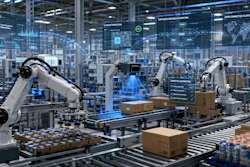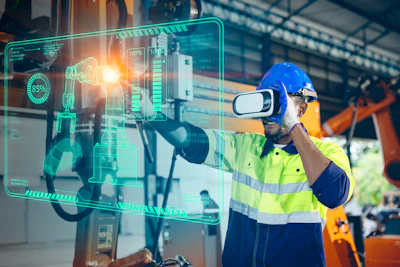
Vision Language Models combine visual understanding with reasoning to shift industrial inspection from pattern matching to structured judgment, capturing the tacit knowledge of retiring manufacturing experts while improving quality assurance in high-speed production environments.
- VLMs move beyond conventional machine vision by reasoning about defects rather than just recognizing pixel patterns, enabling evaluation of novel defect types and packaging substrates.
- Manufacturing faces a critical knowledge-transfer challenge as experienced operators retire, taking decades of tacit expertise that was never documented.
- Spatial AI integration with VLMs enables 3D inspection of complex geometries, providing quality decisions grounded in full geometric reality rather than 2D imagery alone.
- Digital twins create a feedback loop that improves accuracy while generating regulatory audit trails required by FDA, FSMA, and GMP compliance frameworks.
- VLMs are already deployed today in beverage lines, pharmaceutical packaging, and flexible pouch facilities, not a future technology.
Walk the floor of a modern packaging or process manufacturing facility and you will see an increasingly familiar tension. On one side, sophisticated automated lines capable of running at extraordinary speeds — filling, sealing, labeling, and palletizing with remarkable throughput. On the other, a dwindling population of experienced line supervisors, quality technicians, and process engineers whose judgment — built over decades — cannot simply be downloaded into a machine. Until recently, that gap seemed unbridgeable. Vision Language Models (VLMs) are beginning to change that calculus in ways that deserve far more attention than they have received.
What VLMs actually do
Conventional machine vision systems are powerful but fundamentally brittle. They are trained to recognize specific patterns under controlled conditions — a label misalignment of a certain tolerance, a fill level outside a defined range, a seal defect of a certain geometry — and they perform reliably as long as the world cooperates. Introduce a new packaging substrate, change a product formulation, or ask the system to evaluate a novel defect type, and performance can collapse rapidly.
VLMs represent a fundamentally different architecture. By combining deep visual understanding with the reasoning capabilities of large language models, they can look at a complex packaging line or process environment and do something classical vision systems cannot: reason about what they see. A VLM can evaluate a heat seal not merely against a pixel-level template but against an internalized understanding of what constitutes a sound, tamper-evident closure — drawing on material science standards, expert-annotated production video, and documented failure modes simultaneously. It can explain its findings in plain language, flag edge cases for human review, and update its assessments as new information becomes available.
In short, VLMs shift industrial inspection from pattern matching to structured reasoning. For packaging and process manufacturers, that distinction is not semantic — it is the difference between a system that identifies defects and one that understands them.
Capturing tribal knowledge
The retirement wave now moving through manufacturing represents one of the most significant knowledge-transfer challenges the sector has faced in generations. Senior packaging engineers, experienced process operators, and seasoned quality technicians carry within them a form of expertise that was never written down — the ability to hear when a filler is running off-spec, to catch a subtle film-tension irregularity before it causes downstream seal failures, or to know from experience which viscosity deviations matter in a given formulation and which do not.
VLMs offer the first credible mechanism for capturing this tacit knowledge at scale. By training on video footage of expert operators performing changeovers, process adjustments, and inline quality checks, a VLM can absorb the judgment calls that experienced workers make intuitively but rarely articulate. It learns not from a rulebook but from observation — much as a skilled line apprentice would. The resulting models encode not just what a defect looks like, but the contextual reasoning that determines whether it is consequential under current production conditions. This is not a replacement for human expertise. It is a mechanism for preserving and scaling it across multi-shift operations and geographically distributed plants.
Why spatial AI is the missing layer
Most VLMs, like most machine vision systems, operate on 2D imagery. For a significant share of packaging and process inspection challenges — container geometry validation, complex closure integrity, irregular fill profiles, and three-dimensional label conformance — flat images simply do not contain enough information to support reliable quality decisions. A surface deformation that appears minor in two dimensions may represent a critical structural compromise in a flexible package when evaluated in three.
This is where spatial AI becomes critical. By fusing 3D point cloud data, depth sensing, and photogrammetric reconstruction with VLM reasoning, inspection systems can evaluate complex package geometries with a fidelity that 2D approaches cannot match. A vision system examining a blow-molded container or a multi-layer flexible pouch can reason about wall thickness distribution, dimensional conformance, and closure integrity simultaneously — producing quality decisions grounded in the full geometric reality of the package. For manufacturers already investing in spatial computing infrastructure to support format changeovers and digital quality records, VLMs represent a natural evolution of that capability.
Digital twins as the ground truth engine
VLMs become substantially more powerful when they operate within a digital twin ecosystem. In packaging and process manufacturing, a living digital twin — one that maintains a continuously updated, high-fidelity model of a line, a filling system, or an entire plant — provides VLMs with precisely the kind of contextual reference they need to make reliable quality decisions across every SKU and format variant.
The feedback loop this creates is significant. When a VLM makes an inspection decision, that assessment can be logged against the digital twin, compared to the validated process specification, and reviewed against the historical record of similar production runs. Discrepancies can trigger model refinement. Confirmed defects can update risk models for upstream suppliers or downstream distribution. Over time, the digital twin becomes not just a reference but a ground truth engine — continuously improving VLM accuracy while simultaneously generating the audit trail that food safety, pharmaceutical, and consumer product regulatory frameworks require. For manufacturers operating under FDA, FSMA, or GMP compliance obligations, this traceability is not optional — it is the price of admission.
The deployment window is now
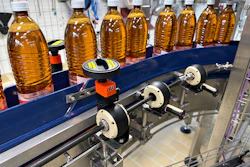
VLMs are not a technology to watch for 2028. They are crossing the industrial deployment threshold today, in high-speed beverage lines, pharmaceutical blister packaging operations, and flexible pouch converting facilities. The gap between where this technology is and where most industry coverage of it exists remains surprisingly wide — a misalignment that carries real costs for manufacturers trying to make informed capital investment decisions.
Plant managers and quality directors evaluating their AI roadmaps should be asking three questions about VLMs specifically: What tacit knowledge in our current workforce is at risk of being lost before the next generation of operators is ready? Where in our inspection workflow are today’s vision systems generating excessive false positives on acceptable variation, or missing subtle defects that reach distribution? And how do our digital twin and spatial AI investments connect to real-time quality and compliance decisions on the line?
VLMs are not the answer to every packaging and process AI challenge. But for the specific, high-stakes problem of quality assurance in complex, high-throughput production environments — where consumer safety, regulatory compliance, and brand integrity all converge — they represent the most significant capability advance in a decade, and one that the industry can no longer afford to underestimate.