FactoryTalk Orchestration is Rockwell Automation's software solution that connects disparate factory systems like robots, vehicles, and PLCs into unified operations using a low-code visual interface that doesn't require deep programming expertise.
- What it does: Connects autonomous vehicles, robotic arms, PLCs, and IT systems across the factory floor into coordinated operations using REST, WebSocket, and OPC-UA protocols
- Low-code design: Visual drag-and-drop workflow builder allows non-programmers and less-experienced workers to build automation sequences previously requiring seasoned engineers
- Proven results: Rockwell's Twinsburg facility achieved 70% improvement in drop-off zone space utilization and 50% reduction in material-handling space requirements
- Future features: Planned integration with Emulate3D simulation platform and AI-powered intelligent alerting to distinguish critical issues from nuisance alerts
Coordinating automation on a factory floor can take a massive amount of time, expertise, and, in some cases, expense. At Automate in Chicago this week, Rockwell Automation took aim at that problem with the launch of FactoryTalk® Orchestration™ software, a new solution designed to connect disparate systems into a single, unified operation.
“As manufacturers continue investing in automation and robotics, the opportunity is shifting from deploying individual technologies to coordinating them across the operation,” said Ara Surenian, Production Logistics Business Manager at Rockwell Automation. “This software is designed to help manufacturers move from fragmented automation toward more connected, autonomous operations.”
From acquisition to gap analysis
The genesis of FactoryTalk Orchestration traces back to Rockwell’s acquisition of OTTO, the autonomous mobile robot (AMR) company. Bringing OTTO’s vehicles into the portfolio was straightforward enough—what the acquisition exposed was a deeper challenge.
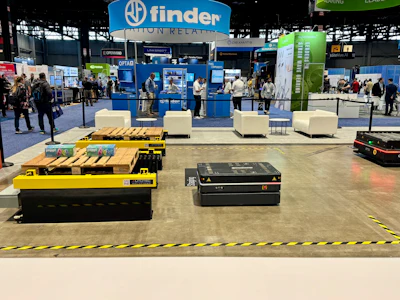
“You have autonomous vehicles, robotic arms, PLCs, and IT systems — how do you bring all those things together?” Surenian explained at the Rockwell booth. “If the objective is a truly autonomous manufacturing operation, everything needs to speak to each other in a coordinated way.”
FactoryTalk Orchestration is Rockwell’s answer. Built on the FactoryTalk® Optix™ platform, the software is communication-protocol agnostic, supporting REST, WebSocket, OPC-UA, and more. It connects to virtually any device or system on the plant floor and across the enterprise, then uses real-time production signals to automatically trigger and manage material-flow workflows.
Big workforce impact
Perhaps the most significant aspect of FactoryTalk Orchestration for manufacturers facing a workforce epidemic isn’t the technology itself—it’s who can use it. The software’s flow builder is a low-code, visual drag-and-drop environment that allows users to sequence workflow steps by picking nodes and connecting them. No deep programming expertise required.
That’s a meaningful design decision at a time when manufacturers are grappling with a widening skilled labor gap. Experienced automation engineers are retiring, and the pipeline of replacements isn’t keeping pace.
“What used to be a highly customized, bespoke application is now standardized and accessible to a less-experienced workforce,” Surenian said. He pointed to his own engineering team: “These guys are pure programmers — they don’t know anything about industrial automation. But within a very short period, they were able to build out workflows that would have previously required a seasoned automation engineer.”
Although the technology debuted at Automate, Rockwell Automation's Twinsburg, Ohio, manufacturing facility, is already running FactoryTalk Orchestration in production, enabling autonomous operations across key processes. The results are notable: drop-off zone space utilization improved by 70%, and overall material-handling space requirements decreased by 50%. Rockwell is now rolling the solution out to additional manufacturing facilities worldwide.
Built for future expansion
The platform is designed with extensibility in mind. Looking ahead, Rockwell is working on deep integration with Emulate3D, its simulation platform, so manufacturers can import a digital twin of their facility and run full day’s production schedules as a simulation before committing—all from within FactoryTalk Orchestration. Early testing is complete, and a full demonstration is expected at a future Automation Fair event.
There’s also a roadmap item around intelligent alerting—using AI to contextualize alarms so operators can quickly distinguish critical issues from nuisance alerts. For manufacturers navigating an increasingly complex automation landscape, FactoryTalk Orchestration offers what has been missing: not just more automation, but the connective tissue to make it all work together.