Despite repeated claims that the PLC is obsolete, manufacturers continue to rely on programmable logic controllers because they prioritize proven reliability, deterministic performance, and multi-decade lifecycle support over newer AI-native controllers that lack clear ROI and raise concerns about data ownership and safety certification.
- The PLC has been declared dead since 1998, but it survived similar disruptions from PC-based control, programmable automation controllers (PACs), and soft PLCs by absorbing real innovations while maintaining its core reliability.
- Major control vendors like Siemens, Rockwell, and CODESYS are deploying AI primarily at the engineering desk and operator interface, not replacing the runtime controller itself.
- End users cite three main barriers to AI-native controllers: data ownership concerns (unwillingness to hand proprietary data to vendors), unproven ROI (no clear business case yet), and safety certification gaps (AI cannot replace hardwired, deterministic safety systems).
- Manufacturers prioritize lifecycle support, upgradability, and the ability to maintain equipment for 20-50 years over adopting cutting-edge technology, making them naturally risk-averse to unproven AI controllers.
- The real enabler of AI adoption is clean data interfaces (MQTT, OPC UA, APIs) that let manufacturers adopt AI at their own pace and risk tolerance, rather than welding it into the controller itself.
The first time I can find the programmable logic controller (PLC) declared dead was 1998. A trade magazine asked whether your desktop PC would run the machine on your floor, and the people it quoted did not hedge: The PLC was finished, software on commercial hardware would take over, and the boxes that had run factories since 1968 would fade out. The claim came back with the programmable automation controller (PAC) in the early 2000s. And it is back again now, with a new name.
A recent announcement from Vention intrigued me. When the company launched its MachineMotion AI controller, it said we were entering a “post-PLC era” with one device running motion, vision, robotics, and onboard AI, marketed as the end of the PLC. It is a serious pitch from a well-funded company at a time when everyone is considering how AI will affect or disrupt their business.
I asked end users who write specifications, the integrators who deploy the machines, and the controls vendors building the technology if this is what anyone actually wants. The short answer is that AI is here and real, but I don’t see it putting the PLC out of its misery any time soon.
Where the AI actually is
You can put a smart, AI-assisted HMI on top of a conventional, deterministic PLC and the operator gets every bit of the benefit. The AI-native controller bundles a thing customers want, a better operator experience, with a thing they are not asking for (yet), replacing the deterministic control that has to run for 20 years. You can buy the first without betting on the second.
Underneath the AI conversation is a plainer request I heard from end users and OEMs alike: Get the data out of the machine cleanly. Standard interfaces—MQTT, OPC UA, APIs, and now MCP servers, the emerging standard for connecting AI models to live systems—let a team pull machine data into its own dashboards and wire it to its AI models. That is the real enabler, and it is what gives teams options: Adopt AI at the layer that fits their priorities and their risk tolerance, on their own terms, instead of accepting it welded into the controller. The intelligence does not have to live in the machine. The interfaces to reach it already do.
The chicken or the egg?
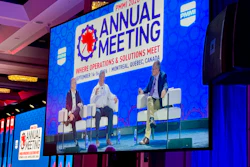
At a recent PMMI roadshow, I asked end users: Would you buy a machine controlled by AI today, and if not today, is it the future?
Joe Zembas, senior engineering project and capital leader at Procter & Gamble, was pretty clear that he would not put an AI controller on a line. His reason was that at your desk you reboot and lose a minute. On a running line you lose production, and that is not a bet a plant makes on faith. That is the same argument as to why the PLC hasn’t died every time its life has been threatened by a technological shift.
Steve Schlabsz, senior director of capital and engineering at Cargill North America, said he would be interested, but right now every bit of his company’s AI effort is aimed at decision support, not at running the machine. Between those two answers is the truth: The appetite is real in places, but it is unproven, and nobody wants to go first.
Rowdy Brixey, president/CEO of Brixey Engineering, whose firm inspects hundreds of machines a year, ended with a quotable comment: “The early bird gets the worm, but the second mouse gets the cheese. I want to be the second mouse.”
Acyr Borges builds servo-driven filling equipment as CEO of ProSys Fill, and he is no technophobe. He just starts where an OEM has to start: What does it do for my machine? His answer, for the next few years at least, is blunt. To his customers, telling them a machine has AI in the control would be a deterrent, not a selling point—not because the capability is worthless, but because the market has not proven it enough to trust it. Until “powered by AI” is something a buyer wants to see, it does not matter whether it saves money or gives their engineering team an edge. That is the gap every OEM lives in, between what is possible and what a customer will specify and stand behind.
Whose data is it?
The second reason the plants are wary is ownership. The end users I spoke with are not AI skeptics—several are running serious AI programs—but they are unwilling to hand a proprietary vendor control of their data, their models, or the intellectual property their own applications generate.
Nate Pieren of Newell Brands told me he would do a great deal with AI, but not on terms that tie him to a single vendor and put his data outside his control. Cargill is all in on AI but was recently forced to pull back from a vendor relationship once it became clear the vendor wanted to own the data and the IP from Cargill’s use cases. When a machine learns from your process, who owns what it learned stops being an academic question.
For a packaging OEM weighing an “AI-native” platform, that is the clause that belongs in the specification: What does the controller collect, where does it go, and who owns the model and motion path?
Where the vendors are putting it
CODESYS just won a Product of the Year award from a German trade magazine for an MCP server that connects AI to its development environment to generate and test PLC code by prompt.
Siemens ships a copilot that writes controller code and screens from plain language.
Rockwell built a generative AI Copilot into its FactoryTalk Design Studio, developed with Microsoft, that turns plain-language prompts into ladder logic and explains inherited code—and it is pushing a small, industrial-specific model to the edge and into its FactoryTalk Optix operator interface to give packaging operators AI-guided instructions.
Beckhoff, which has run logic, motion, and vision on one industrial PC since the 1990s, offers engineering-side AI, too.
Four of the biggest names in control, and their first serious AI products, all point at the same two places: the engineering desk and the operator screen, not the runtime. That is not the behavior of an industry that thinks the controller itself is about to be replaced.
“CODESYS has always focused on giving controls engineers the best tools,” said Markus Bachmann, president of CODESYS Corporation.
He is candid about the limits: AI is strong on clearly stated tasks and weak on vague ones, and the engineer still has to write the instruction and check the result. He is also seeing something telling—customers now asking about AI in their vendor security questionnaires, because feeding an AI your specifications raises a real question about who owns the information that AI learns.
What Vention concedes
To its credit, Vention answered the hard questions directly, and the most important thing it did was draw its own line. “Post-PLC,” the company told me, is accurate for motion, sequencing, and orchestration. It is “not yet true for certified machine safety, which remains hardwired to separate, deterministic hardware.”
Despite making the post-PLC claim, Vention agrees the PLC has not been replaced for the one thing a machine builder should care about most. On whether AI and real-time control can share a processor, Vention gave a specific answer—isolated CPU cores for motion, GPU inference passed to the motion loop separately—and Bachmann described the same method independently on the CODESYS side.
Vention was also straight about the state of it: Full commercial shipping began only in late 2025, and non-disclosure agreements meant it could not name a running customer or share a metric. That is an honest picture of an early product, and buyers should read it as exactly that.
Why this keeps happening
Step back, and the rhythm is obvious. The PLC was sold in 1968 by salesmen who avoided the word “computer” because plant managers simply did not want one.
In the 1990s, PC-based control was going to end it, and instead Rockwell and Siemens shipped their own software controllers and the category survived.
The PAC was going to displace it, and around 2008, an Automation World survey found PACs in about 5% of the applications that could use them while the PLC market kept growing.
CODESYS, the soft PLC that actually won, still calls its product a PLC. Siemens virtualizes the PLC and still calls it a PLC. Each wave carried something real, and each time the real part got absorbed into the thing it was supposed to replace.
There is a straight line from the disruptors who called the PLC dead and then disappeared to the AI control vendors today. Will they last, or will they be bought or out-featured by the big controls houses? History says the second. And the plants will do what they always do: adopt slowly, alongside the mixed-vintage equipment already installed.
Brownfield is most of what the industry runs. Talking to old equipment, keeping it repairable, sourcing parts—that is what owners worry about, more than whether the newest box can run a neural network.
The question under all of it
Almost every hesitation comes back to lifecycle. Plants stick with the PLC because it is deterministic, proven, and boring in the best way—no blue screen, no forced updates, no surprise downtime—and it runs on the same machine for decades. Obsolescence budgets are large and getting larger, and large end users increasingly specify a proven platform and pay more for support they can count on.
So, is the PLC dead? No. I would posit that it will never die. It will keep evolving, absorbing whatever in each wave turns out to be real, because it sits on exactly what manufacturers want: capital equipment that makes money for 20, 30, or 50 years, that stays supported and upgradable, that will not strand them on obsolescence or a vanished vendor. They are not buying the shiniest mousetrap or the fastest throughput. They are buying the partnership with an OEM and the ability to support, maintain, and update existing equipment across a multi-decade timespan.
AI cannot be ignored. It is here, and the appetite is real—for productivity, decision support, training, and simpler operator screens. Simplicity over complexity was the loudest signal in every room. What is not here yet is proof: clear ROI and a clear picture of how AI sits next to the safety architecture. When that arrives, the appetite may turn into mass adoption. Until then, the smart money is watching the pilots closely and letting someone else be the early bird.
Take the “post-PLC era” with the skepticism it deserves—but aim that skepticism at the marketing, not the mechanics. The underlying engineering is real; isolating a real-time core and running inference alongside it works. What does not hold up is the revolution the phrase implies. Real constraints, like data ownership, lifecycle, and the unwillingness to be first, make an AI-native controller a hard no for most manufacturers right now, and this industry moves notoriously slowly. The front-runner on AI is comfortably a decade ahead of where most of the plant floor will be.
The people marketing a “post-PLC era” are probably smart enough to know all of that. The phrase may be less a prediction than a way to get attention, to get people talking—which is exactly what this article is doing. I intend to keep following it, and to keep asking the question, at PACK EXPO and beyond.
Nikki Gonzales is Director of Business Development at Weintek USA and co-founder of OT SCADA CON, a conference dedicated to operational technology, SCADA, and industrial cybersecurity. She is also the founder of Automation Ladies, a media platform and community dedicated to elevating diverse voices in industrial automation.