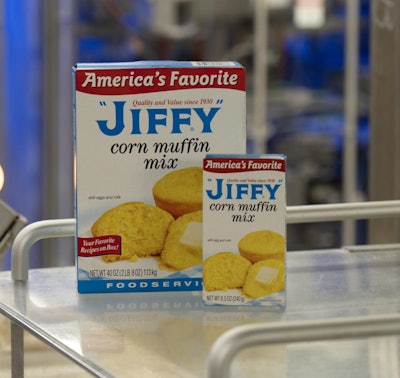
Jiffy Mix replaced 18 legacy packaging machines with five compact cells using flexible film pouches and vertical form/fill/seal technology. The modernization doubled output while occupying half the original floor space.
- Five packaging cells replaced 18 legacy machines that had operated since the 1950s
- Each cell includes three auger fillers, three baggers, three checkweighers, one cartoner, and one case packer
- New flexible film pouches feature easy-peel opening formulated specifically for consumer convenience
- Modernization took five years to complete, with the final cell operational by August 2024
- New cells produce the same volume as legacy equipment while occupying approximately half the floor space
Chelsea, Mich.-based Chelsea Milling Co., a fifth-generation family-owned business since 1901, is best known for its iconic JIFFY brand of prepared baking mixes. The firm recently completed a massive modernization of its packaging operations that focused on replacing the many ”double packaging” machines that were responsible for forming the primary packaging. These operated by wrapping a paper liner around a mandrel, forming a paperboard blank around the liner, and then sending a lined carton to the filling machinery. Since the 1950s, 18 of these machines had served the firm well. But about four or five years ago it was clear that some serious modernization was due. Getting it right was going to be tricky, says Justin Hubbard, senior project engineer at Chelsea Milling Co.
“September to December, our busiest time of the year, is when our lines run flat out 24 hours five days a week,” says Hubbard. “Because we're the only factory in the world that makes Jiffy Mix, we had to come up with a plan to essentially duplicate the 18 lines of production without interrupting overall throughput.”
Also complicating the modernization plan was the fact that the firm had never in more than a century laid off a single employee. Management was determined to keep that record clean. So the whole plan had to revolve around attrition as older employees were approaching retirement age. And then, to further complicate things, just as the first new line was about to be installed, Covid struck. Who could forget the impact that had on machine delivery schedules around the world?
Nevertheless, the team at Chelsea Milling Co. persevered, and by 2021 it had installed what it refers to as a pilot line. Anchored by auger fillers from Spee-Dee over vertical form/fill/seal systems from Triangle Package Machinery Co., the pilot line was a highly useful way to get a foot in the door of the future. “It was a way to get some kinks worked out from an engineering standpoint and to also begin the training and familiarity that our operators and mechanics needed to have,” says Hubbard.
Five packaging cells
The pilot line idea proved to be a good one. Based on the learnings it provided, the firm proceeded to install what it calls packaging cells. There are five of these. Each is anchored by three Triangle baggers, and each bagger sits beneath its own Spee-Dee auger filler. In each cell, three parallel conveyors take freshly pouched product through three Spee-Dee checkweighers. All three parallel conveyors then drop pouches into a bucketed conveyor running at a right angle. This conveyor feeds a single R.A Jones cartoner that feeds a single Massman Automation case packer. So altogether the five cells comprise 15 auger fillers, 15 baggers, 15 checkweighers, five cartoners, five case packers, and five Ryson spiral conveyors that take cases to an overhead conveyor leading to remote palletizing. Two of the five cells also include a shrink bundler from EDL, also a Massman company. This bundled format appeals to consumers who want to purchase cartons in groups of six right off the shelf. It is one of these cells, Cell 2, that we’ll look at here in detail. It’s dedicated to the 8 1/2-oz format. At the heart of the modernization was the installation of a total of 15 paired auger fillers/vertical baggers like the pair shown here.Kondracki Group
The powdered product is delivered from the floor level up to three overhead surge hoppers by way of a Chain-vey Tube Drag Conveyor from Modern Process Equipment. The surge hoppers hold up to 400 lb of product, and each one feeds the 16-gal hopper of one auger filler.
Like most auger fillers, the ones at Chelsea Milling Co. use a servo-driven motor to rotate an auger screw that measures and dispenses a specific volume of product from the hopper. The process is electronically controlled for accuracy, with the motor accelerating to a selected speed, rotating a precise number of times, and then decelerating for a repeatable fill each cycle. Chelsea Milling Co. opted for split hoppers, which are machined from stainless steel and then hinged. This makes it easy to swing open the hopper for easier access during cleaning. This feature, says Hubbard, was a key attraction as he and his colleagues evaluated auger filling systems. “You just turn five knobs and the whole hopper swings wide open,” he adds.
Beneath each auger filler is a Triangle vertical form/fill/seal machine that encloses the powdered product in roll-fed flexible film. “We did a project with Triangle some time ago for a five-pound format, so being familiar with them and the fact that they have a good relationship with Spee-Dee made them an attractive option. We also saw some advantages from a controls standpoint since both the baggers and the auger fillers feature controls from Rockwell. That made it easy to integrate everything together from an electrical panel and controls standpoint.” Orbi-track carton feeder puts erected cartons into position so that bags of product can be pushed into cartons.Kondracki Group
Flexible film considerations
The firm also paid close attention to the composition of the flexible film feeding into the Triangle baggers. “As the new machinery was coming in, we specifically formulated a pouch material with our vendor that would give consumers an easy-peel opening,” says Hubbard. “It involved considerable testing and research.” The resulting material is supplied by Eagle Flexible Packaging, which describes it as a peel-able HDPE co-extrusion.
Bags drop from the three Triangle machines onto three parallel incline belt conveyors, each of which leads to a Spee-Dee checkweigher. Each checkweigher constantly sends feedback through the bagger and to the filler so that the filler can modify its fill amounts automatically if need be.
Once past the checkweigher, the bags pass under a conditioning roller that flattens them slightly and then transition onto the infeed belt of the Jones cartoner. Jones calls it a smart belt because it gaps the bags in such a way that they are spaced perfectly when they arrive a short while later at the rotary vane transfer that drops them into the cartoner’s infeed buckets. These buckets run perpendicular to the three conveyors feeding them and lead to a station where each pouch is pushed from its bucket and into a carton that has been picked and erected by the Jones Orbi-Track carton feed. Carton tops are tucked and closed with an assist from a Nordson adhesive dispensing unit and then bags are pushed into cartons through the bottoms. After the flaps are tucked and the cartons closed, the cartons pass a Domino laser coder for date coding. Cartons exit pass through a metal detector before making a turn leading to the case packer. Finished cases or trays then travel by way of a spiral conveyor that takes them to an overhead conveyor leading to the warehouse.Kondracki Group
Finished cartons are conveyed to a “waterfall” guide rail that causes them to drop from the cartoner discharge conveyor onto a separate takeaway conveyor. In the process they’re turned 90 deg so that now each carton stands upright on its bottom.
Accumulation conveyor
Next is a Nercon 15-lane accumulation conveyor where cartons can accumulate for about four minutes should any of the downstream equipment go down momentarily. On the other side of this accumulation section is a diverter that sends cartons down one of two paths. If shrink bundling into six-carton bundles is called for, cartons are conveyed through a Fortress metal detector and then into a shrink bundler from EDL; bundles then proceed to the case packer. When shrink bundling is not called for, cartons are diverted to a separate Fortress metal detector and conveyed directly to the Massman case packer.
Both wraparound cases and open-top trays are produced on the case packer. Both cases and trays hold 24 cartons when cartons bypass shrink bundling. When cartons are bundled, cases and trays get four six-carton bundles. Changeovers on the case packer are streamlined by the use of electronic position indicators from SIKO. Corrugated case blanks are picked from a magazine feed and placed in a station so that 24 collated cartons can be pushed into the wraparound case.Kondracki Group
As for speed, four of the cells are all capable of running the 8.5-oz carton at 80/min. Cell 5 is designed to run either 8.5-oz or 40-oz formats, and this required a Jones cartoner whose buckets are on a 9-in. rather than a 6-in. center line. So speeds are slightly lower on Cell 5.
Before exiting the case packer, each case runs past four Domino print heads, two on each side. “It’s a single ink-jet system with four print heads, so on both sides of the case or tray we do the best-by date plus product information and bar code for our case sortation system out in the warehouse,” notes Hubbard.
A Ryson spiral conveyor now takes cases to an overhead conveyor that brings them to the warehouse. It, too, has been transformed by the addition of new Alvey palletizing equipment from Honeywell Intelligrated and stretch wrapping equipment from Lantech.
The modernization project took about five years to complete, with the final Cell swinging into operation in August of 2024. Hubbard and colleagues are greatly pleased not only by the increase in efficiency but also by how compact the new packaging lines are. “Essentially the 15 weighing/bagging lines now produce as much volume as the 18 lines we replaced while occupying about half the space.”