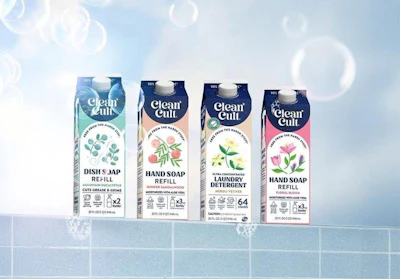
The cartons are made primarily from paper-based materials and are intended to function as refill packs that can be used alongside the company’s reusable aluminum containers.
ThePackHub
These innovations highlight the significant progress being made in adopting paper-based solutions, driven by both functionality and sustainability. The breadth of applications,from tech devices to food, drinks, and cosmetics, demonstrates the versatility and growing demand for paper-based packaging as brands seek to reduce their environmental impact.
Clean Cult introduces paper-based cartons for household cleaning products
Clean Cult, headquartered in New York, United States, is packaging its range of household cleaning products in paper-based cartons as an alternative to conventional plastic bottles. The packaging format is used across several product categories including laundry detergent, dish soap, and hand soap. These cartons are designed to reduce reliance on single-use plastic packaging commonly used for liquid household products. The cartons are made primarily from paper-based materials and are intended to function as refill packs that can be used alongside the company’s reusable aluminum containers. In this system, consumers purchase the liquid product in the paper carton and transfer it into the refillable container for everyday use. The packaging design focuses on reducing plastic consumption while maintaining compatibility with liquid product formats. Liquid detergents and soaps typically require packaging that can provide structural strength and resistance to moisture or leakage. Paper-based cartons used for liquid packaging generally include barrier layers that help prevent the absorption of liquids into the fiber structure and maintain product integrity during storage and transport. This format is commonly used in beverage packaging and is increasingly being adapted for household products.
The cups are designed for a 3.7 fl oz serving size and are being distributed across multiple channels, including national airlines, quick-service restaurants (QSRs), and convenience retail environment.ThePackHub
Everest's FSC-certified paper ice cream cups replace plastic formats
BioPak, based in Sydney, Australia, in collaboration with Australian ice cream company Everest, headquartered in Melbourne, Australia, has introduced a nationwide rollout of FSC-certified paper ice cream cups intended to replace conventional plastic formats in food service applications. The innovation centers on the use of renewable, Forest Stewardship Council (FSC)-certified paper as the primary material, aiming to maintain comparable structural integrity and performance to plastic alternatives while shifting material sourcing towards certified fiber. The cups are designed for a 110 ml (3.7 fl oz) serving size and are being distributed across multiple channels, including national airlines, quick-service restaurants (QSRs), and convenience retail environments. In addition to the cup itself, the companies have developed an integrated birchwood spoon solution, also FSC-certified, which is engineered to fit within the lid of the cup in a compact, “dixie-style” configuration. This design removes the need for separately packaged plastic spoons, potentially reducing auxiliary material use and simplifying logistics in food service operations. The spoon-in-lid format also addresses space efficiency and handling convenience during transport and consumption. The overall system reflects a shift towards fiber-based packaging formats combined with integrated accessories, with an emphasis on maintaining usability standards while altering the material composition and supply chain inputs.
Th25.4 fl oz bottle is composed of approximately 94% recycled cardboard.ThePackHub
Jordan Olive Oil introduces paper-based bottle for olive oil packaging
Jordan Olive Oil, based on the island of Lesbos, Greece, has introduced a paper-based bottle for its olive oil, designed to reduce packaging weight and associated carbon emissions compared to traditional formats. The 750 ml (25.4 fl oz) bottle is composed of approximately 94% recycled cardboard, forming a rigid outer shell, combined with a thin inner liner made from a recyclable mono-material plastic that provides a barrier against oxygen and moisture to preserve product quality. The total weight of the packaging is approximately 83 g (2.9 oz), significantly lower than a typical glass bottle of similar capacity, which may weigh around 440 g (15.5 oz). The bottle design can result in up to 84% lower CO₂ emissions compared to glass alternatives and uses 77% less plastic than conventional PET bottles, although such results depend on system boundaries and disposal conditions. To address the higher viscosity of olive oil compared to wine, the company has developed a dedicated pouring spout that enables controlled, drip-free dispensing, integrated with a lid made from biodegradable and recyclable plastic.
Fill out the form below to request more information about Clean Cult Introduces Paper-based Cartons, Everest Launches Paper Ice Cream Cups, and Jordan Olive Oil Designs Paper Bottle
The Packaging Recycling Summit (PRS) is the premier U.S. conference for strengthening packaging circularity. In 2026, PRS is transforming into a fully immersive experience where attendees will solve problems, forge partnerships, and explore technologies that are reshaping packaging recovery. Directly connect with sustainable OEM’s at this highly coveted event.