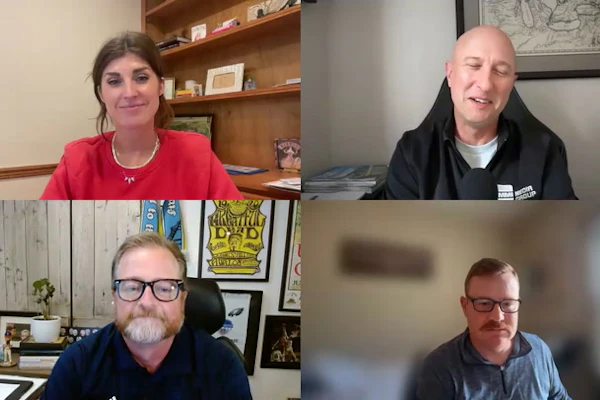
Derrick Teal: Hello, and welcome to the End of the Line podcast, the podcast/video where the editors of PMMI Media Group get together and talk about the latest happenings in the processing and packaging industry. I’m Derrick Teal, editor of—well, what am I editor of? ProFood World. Joining me are Liz Cuneo, editor-in-chief of Healthcare Packaging; Sean Riley, editor-in-chief of OEM Magazine; and Matt Reynolds, editor of Packaging World.
As we were getting together and discussing things to talk about on the show, a lot of us really had nothing. But Liz, I think you had something, right?
Liz Cuneo: I do have something. Yes. Thank you, Derrick. I had a pretty interesting discussion this week with Dan Felton from the Flexible Packaging Association. We talked about packaging policies’ role in public health preparedness.
It was an interesting topic. He emailed me about it, and healthcare packaging is not the first thing that comes to mind when you hear “public health preparedness.” But in talking to him, it really is part of preparedness policy.
If you think about preparedness in terms of having enough medicine or medical devices for a population, you do think, “Okay, we need the packaging that can bring these products to the patient safely.” Any disruption in raw materials, converting capacity, or packaging deliveries can delay these essential healthcare supplies.
We talked about how packaging needs a place in the broader conversation about supply chain resilience. This is really piggybacking on policies coming out, like EPR or things that restrict chemical uses, like PFAS, cutting out certain materials.
When you really dive into that, it has a pretty big impact on the packaging, the product, and the whole supply chain.
We talked about those consequences and how switching materials affects the package, equipment compatibility, product protection, and distribution. In the case of medical devices and pharmaceuticals, we talk about sterilization. Will that new material hold up during the sterilization process? Obviously, that’s super important and something else to think about.
When we talk about EPR programs and recycled content mandates, policymakers really need to account for the timelines involved in everything I just mentioned, including sterilization and equipment compatibility.
It’s an interesting conversation. We talked a little about how long some of these changes take. Twelve to 18 months seems to be the minimum for the industry, and sometimes three to five years, depending on what material change is happening and how viable it is. Do we have the material ready? Do we have enough?
Making these switches and implementing policies that demand more recyclability is tough, with big implications for the industry.
Derrick: When you’re talking about making changes, how big of an impact does the current economic climate have? You say there’s such a long lead time with changing a package, but do current costs impact that? Or are you locked into a supplier when you’re making these assessments?
Liz: I think people could be locked into a supplier. But a bigger issue is that you’re locked into that package because of regulations. You’ve already shown and proved that the package is what you say it is.
Once you make a change on the healthcare side, it’s a really big deal. You have to get it certified—I can’t think of the right word—but you kind of start over on the process.
You can’t just come up with a healthcare package and say, “Yay!” There’s tons of testing that needs to be done. There’s tons of filing and proving that the package can do what you say. Making any change really throws that whole process off and starts it over. That’s why it’s such a big deal.
It sounds simple, right? Just make it a recyclable plastic. But you really have to prove that it performs the same way under a series of tests and that it can still be sterilized. That’s why it’s a bigger deal, time-wise, to approve that.
Matt Reynolds: Yeah, and sterility is one thing, but there’s also efficacy in general and shelf life.
I haven’t pored through SB 54 in California. I know that tends to be held up as one of the stricter EPR laws. But among all of them, I think there are frequent carve-outs for medical devices and pharma because of the different circumstances for safety.
Like you said, sterility and efficacy are the most important things. That thing has to work. Safety is huge. It’s got to be safe, and it’s got to last long enough. While EPR is definitely going to have a big impact on our packaging landscape, I think the more careful-minded crafters of EPR laws are aware that some things take time.
Liz, your industry notoriously takes a little more time. There’s a ceiling and a floor for those factors of making sure that the medicine or medical device is safe and sterile. When they’re inserting a Bo Jackson-style metallic hip, it’s got to be sterile. There’s no wiggle room in the way that some other industries might face.
In the middle is your industry, Derrick—food. There are some carve-outs, particularly for smaller food companies that don’t have the scale. The fewest carve-outs probably end up with more of the consumer goods, like home cleaners.
There is a sliding scale, but it’s unquestionable that EPR is going to ripple across all industries with packaged goods.
Liz: Yeah, we talked about some of those exceptions—exemptions, I should say. While it might not be mandated now, you can kind of see the writing on the wall. In five or 10 years, we might have to switch our attention to that.
Derrick: And now for something completely different. Sean, when we were chatting earlier, you said you saw something related to cybersecurity that caught your attention.
Sean Riley: Yeah, actually, I did a podcast, which seems very meta, talking about a podcast on a podcast. But we’ll do it anyway.
I did it with our colleague Andy Lomasky of PMMI. He’s our IT and cybersecurity expert. Maybe this is something everybody knew, but it was pretty eye-opening to me. We all know about the cybersecurity training we’ve gone through: phishing, don’t open emails, ransomware, and all the bad things that can happen.
At the end of the day, if something happens, your computer locks up and it can be fixed. You give it to IT, and they’re going to fix it. You’re going to get scolded. It’s going to be a hassle. Maybe it’s bad enough that you get fired, but it’s not the end of the world.
What we were getting into was something like ransomware jumping from the front office—somebody opens an email in the marketing department—and it jumps into the OT part of operations. Now it’s on a packaging line.
I’m not naive. I’m aware of that as a possibility. Now you have HMIs spitting out error messages because the servo they’re connected to is completely encrypted.
It’s a pretty big deal. It shuts down the line. With throughput and speed being so important, that’s a big deal, no matter what industry this is happening in.
But what Andy pointed out, which I found interesting, is that it gets worse. After you solve the problem, the attack has ended, and you get the line back up and running, you have this software that’s kind of all over the place.
You’re not just starting from the beginning of a line because it shut down in the middle of it. You have to get everything you had documented to make sure your servos are in the same place they were supposed to be.
Physically, they’re in the same place, but spinning-wise, they’re not in the same place they were when the line froze. You don’t know what caused the freeze to begin with. Sensors could be picking up differently than before. Tolerances may be exceeded. Safety systems, things like that.
Everything is completely out of line, and you have to get it back to factory settings. But you might not know what settings you had.
Matt: yea, factory settings are basically a blank slate, a tabula rasa. Those settings had been honed over years to extremely tight specifications. To start over would be a nightmare. So you’re saying it’s not just the event itself; it’s the recovery that takes longer than expected?
Sean: Yeah. You have to get with your designer. From a design standpoint, you have to design in segmentation to make sure everything can’t talk to everything.
You would think you want everything talking to everything, but in this day and age, you don’t. You want certain segmentation that would block that from happening.
Our industry has finally started to accept remote access and remote monitoring. But if you leave that open all the time, it’s a free-for-all. Those things can jump in there, so you have to shut them down.
From a CPG standpoint, you want to make sure your OEMs are doing those things. I found it interesting. He said the best thing you can do is make sure you document everything. But if you have lines that are 20 or 30 years old, you have to start over and document them now so you have that information in the event something happens.
It’s like preventive maintenance. You’re doing it now so that, if something happens, you have all your ducks in a row. Andy’s on the ball. It was something I wouldn’t have thought of. I just thought, “The line gets shut down. We fix it, click the switch, and it goes back up.”
Matt: Yeah, it’s getting those settings back. And, of course, the person who most likely spent years honing and crafting the exact right settings and specifications just retired. So, good luck.
Sean: Yeah, exactly.
Derrick: That’s the problem you’re seeing down the line. You have people coming in who might be great digitally, but when it comes to the mechanical side, they might not be trained or have that experience. Somebody can listen to a machine and say, “Oh, this is what’s wrong with it,” then go in and fix it or get it calibrated properly again. When you’re talking about going back to square one with the machine, if you’re talking about 20 or 30 years ago, it’s paper documentation. I don’t know that any of those original settings would be on a computer somewhere. Maybe they would be, but maybe not.
Matt: Some old version of an Excel document that hasn’t been updated and probably won’t even run on a new computer.
Derrick: Right. When you have this OT machine, it’s Windows 95 or something like that.
Sean: I was going to say that, too. That was another thing he said in passing: How many of those operating systems are so antiquated that you wouldn’t even think they would still work, and you’re trying to repair them?
Derrick: Yeah, it’s a very difficult situation.
Sean: So don’t open any emails.
Derrick: Right. I think all of us have run into the problem where we try to interview somebody at a CPG, and the security settings they have cause it to get bounced back. They won’t even accept a Zoom call or a link to Zoom from a work account. So, is there anything left to talk about?
Matt: Hey, I was traveling this week. I’ve got a few nuggets.
Sean: What have you got?
Liz: Where were you?
Matt: I was spending the big bucks on a hotel in Midtown Manhattan to cover a subsection of a larger supply chain show. It’s called the E-commerce Packaging and Labeling Expo. It was at the Javits Center and co-located with a white and private label show.
A lot of packaging isn’t coming from the big brands and CPGs. Even on the healthcare side, Liz, I learned about Fresenius Kabi. It’s sort of a white-label version of pharma that sells directly to hospitals, as opposed to Pfizer, which has drugs that are marketed to us on Super Bowl Sunday and every day in between.
Liz: Is white label the same as private label, but that’s what they call it in healthcare? Or does it mean something else?
Matt: I would say white label and private label are similar. A white-label product would come from a contract packager or contract manufacturer of a certain style of things, say juices or nutraceuticals.
Sean: Okay, because I didn’t know either.
Matt: They make a product, and anybody can come and put their brand name on it, put their face on it. It tends to be their own product, or a single product sold in New York, LA, and everywhere in between, but it has a different local flair or somebody else is selling it.
There are a lot of emerging brands in that area. They try to put their own spin on it. Sometimes they have their own formulation; sometimes it’s an off-the-shelf product.
I ended up stumbling across a really interesting supply chain discussion that became a packaging discussion. It was from none other than Nestlé Nutrition and Health.
I’m going to butcher the name, but her name is Erica [surname unclear]. I apologize about the name.
She’s with Nestlé, and a big part of her job is sitting across from brand teams and telling them which packaging ideas are going to make money and which might incur risk or get them into trouble.
One of her questions was about forecasting. On the supply chain side, everything is about forecasting: What’s demand going to be? Demand planning.
Her first point was that maybe your inventory issue isn’t actually a forecast mistake. If you have stockouts or more inventory than you want, both are bad situations. You want to thread the needle, feed demand, and hold as little inventory as possible without the dreaded stockout.
But maybe that inventory issue is a matter of too much complexity.
Here’s an example she gave that I keep thinking about. Imagine Nestlé Nutrition and Health has three flavors of a health drink: strawberry, chocolate, and vanilla. But they have four pack counts. Not only that, they have three distribution centers where they’re stocking them: one in Milwaukee, one in New York, and one in Phoenix.
Once you do the math and multiply the different SKUs, pack counts, pack styles, and places, that gets to 36 what you would call “inventory positions.”
It’s more than the SKUs themselves. It’s chocolate, strawberry, or vanilla, but is it in a two-pack or a four-pack? And is it in Milwaukee or Phoenix?
The number of inventory positions for even three products can really pile up quickly.
She’s not blaming the people who made these forecasts. Each probably made sense in its own market: “This is how much demand we’re going to have. This is how much we’ll need in Milwaukee, and this is how much we’ll need in Phoenix.”
But the brand teams are myopic. They only see what’s happening in their region.
How do you get a brand team to come around to the idea that maybe we should dial back the complexity? We should have fewer SKUs, fewer pack sizes, and rein in SKU proliferation.
For those working on the packaging side, it’s worth thinking about how much financial benefit this extra variety, this extra SKU, is going to bring you. She puts this into P&L dollars-and-cents terms. Are you going to be adding risk for stockouts or holding too much inventory in a location?
Let’s say something’s just not selling in Milwaukee. They don’t like chocolate in Milwaukee for some reason. If it’s not selling there, you’re preparing yourself to fail by carrying all this inventory.
It was an interesting talk. I wasn’t expecting supply chain and packaging to have that kind of handshake. But the handshake, the tension, the push and pull between those two elements is really complexity.
Brand owners or brand design people want variety for everybody, from the two-ounce to the 14-ounce and every size in between. They want to hit every market and sell to every potential market. But that complexity creates supply chain problems that are actually a greater risk than not being able to sell that two-ounce bottle to that one small market in Milwaukee, if that makes sense.
Derrick: It makes complete sense, at least from my perspective. If you’re a manufacturer or CPG, you want to make sure everybody wants your product, so you want to tailor it to the specific wants of that area. At the same time, if you’re looking at operational efficiency, it’s much more efficient to have one giant facility that cranks everything out.
Having a production facility locally and producing it there might make more sense to get that regional flavor correct. But in terms of operations and supply chain, it’s not more efficient, or not efficient at all. I can see that, especially if you’re talking about different pack sizes. I think that’s the big problem food and beverage manufacturers have: trying to hit those specific flavors and marry that with operational aspects that don’t jibe with one another.
It’s an interesting problem, and I think it’s more of a problem for larger companies that are trying to hit everything and make everybody happy.
Matt: It’s definitely a problem for the most sophisticated companies, not the least. It’s a problem where you have whole supply chain teams on one side and packaging and brand manager teams on the other. It’s a tension that’s always going to be there. The optimized answer is obviously somewhere in between.
You want to sell the most units to the most people, but on the operational side, you want to “Henry Ford-ify” your operations as much as possible.
How much variety? Variety adds complexity. Complexity adds risk. Striking that balance is the name of the game for somebody like Erica.
I’m hoping I can convince her to join us at the Packaging World Forum next June in Chicago to have something similar, with brand owners and brand designers in the room to hear her trials and tribulations on the complexity side. I think the brand owners need to hear it.
Derrick: Well, maybe she’ll be at PACK EXPO in just a couple of weeks. It’s October 2 as we’re recording this. It’s coming right up.
Matt: Yeah, we’re already making appointments, and the emails are coming in.
Derrick: Aren’t we all? October happened, and my appointment book immediately started to fill up.
Matt: Summer is definitely over. The slow, lazy days of summer are long past at this point.
Derrick: Yeah, that’s why you’re indoors.
Matt: True. That’s right. We’ve had about three straight days of rain in Chicago. I was in New York, so I didn’t get to see it. But whatever was left of Hurricane Polo has made my backyard a muddy mess. That’s why I’m indoors.
Derrick: Very good. Well, unless anybody has anything else?
Sean: I think we’ve said it all.
Liz: And then some.
Derrick: Well, thanks, everybody, for listening to or watching this End of the Line podcast or video, however you prefer to consume your media. We will catch you next week.