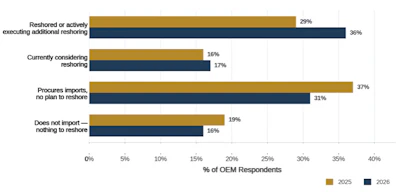
Reshoring momentum is accelerating with 36% of OEMs actively reshoring production and 63% planning US capital expenditures in 2026-2027, driven by geopolitical risks, improved operational benefits like faster delivery and cost savings, though policy uncertainty and workforce shortages remain significant barriers to sustained growth.
- 36% of OEMs have reshored or are actively reshoring production in 2026, up from 29% in 2025, with 63% planning US capex for 2026-2027
- Geopolitical risk cited by 53% of contract manufacturers as reshoring driver, more than doubling from 24% in 2025
- Operational benefits include 70% improved speed to market, 65% better on-time delivery, and 60% logistics savings among reporting OEMs
- Policy uncertainty is the primary challenge for 57% of OEMs, making long-term capital commitment difficult despite strong reshoring interest
- Workforce shortage is critical: 66% rate hiring technicians and welders as very difficult or crisis-level, requiring investment in vocational schools and internal reskilling programs
Reshoring is finally starting to make inroads among U.S. manufacturers.
The 2026 USA Reshoring Survey, conducted by the Reshoring Initiative and Regions Recruiting, surveyed 249 manufacturers—118 original equipment manufacturers and 131 contract manufacturers—and found that 36% of OEMs had either reshored production or were actively engaged in additional reshoring in 2026, up from 29% a year earlier. On the contract-manufacturing side, 32% of CMs said they were currently quoting reshoring projects, roughly double the 16% reported in 2025, and 79% said at least some customers had discussed reshoring in the prior year.
Even more consequential for equipment builders: 63% of OEMs told the survey they are planning U.S. capital expenditures in 2026 or 2027 to support reshoring or other domestic expansion. Whatever the near-term policy environment looks like, two keys are driving the capex pipeline.
1. Geopolitics has caught up to tariffs. Among CMs, 53% cited geopolitical risk as a reason customers are reshoring to domestic suppliers—up from 24% in 2025. Sixty percent said customers importing from China or Taiwan were at least discussing de-risking, although only 19% reported active transitions. The story downstream is one of broad conversation and narrow execution.
2. The operational case has firmed up. Among OEMs reporting impacts, 70% cited improved speed to market, 65% better fulfillment or on-time delivery, and 60% logistics savings—the operational benefits reshoring is delivering beyond tariff and geopolitical risk reduction. Use of Total Cost of Ownership analysis to compare domestic and offshore sourcing also rose, from 30% of OEMs in 2025 to 40% in 2026, an indicator that reshoring decisions are getting more analytically rigorous.
On the opposite side of the coin, there are two strong headwinds.
1. Policy uncertainty, not tariffs themselves. Fifty-seven percent of OEMs named it as their primary challenge in the current U.S. trade-policy environment; market pricing impact was a distant second at 15%.
"Manufacturers can adjust to known costs and opportunities. What is much harder to manage is a moving target," said Harry Moser, founder and president of the Reshoring Initiative. "The survey shows that reshoring interest and investment are there, but companies need greater predictability to commit capital and develop supply chains for the long term."
Price competitiveness is still the binding constraint downstream: 94% of CMs said price is the primary reason they lose orders to imports.
2. Workforce is the second binding constraint. Sixty-six percent of respondents rated hiring technicians, welders, and machinists as very difficult or at crisis levels; 60% rated maintenance and repair technicians the same. Manufacturers are responding through trade and vocational schools (61%), internal upskilling and reskilling (58%), and community colleges (51%).
"Everyone's rightly focused on the skilled trades gap, and we're seeing it just as sharply in leadership," said Kathy Nunnally Anemogiannis of Regions Recruiting. "At the end of the day, it always comes back to execution. In the case of reshoring, it's the HR, operations, supply chain, and engineering leaders who turn an investment plan into an optimized and highly profitable production facility."