A packaging machinery CEO spread his charts across my table and asked: “I can't get my sales to line up with my engineering resources. Either we have too much work, and I'm paying overtime, or not enough and I'm paying people to sit around. I'd really like more predictable revenue.”
A plant runs only as fast as its constraint. His constraint wasn't engineering. It was predictable sales in an unpredictable market. Why do some companies master that constraint while others fight it every year?
If you've read my articles this year, you know the pieces: free engineering on quotes, training that fades, and buyers screening vendors with AI. With new AI tools pitched every week, keeping up can feel like plugging holes in a dam. Here's a way to see how the pieces fit, score yourself, and know your next move.
Capability, discipline and four leaders
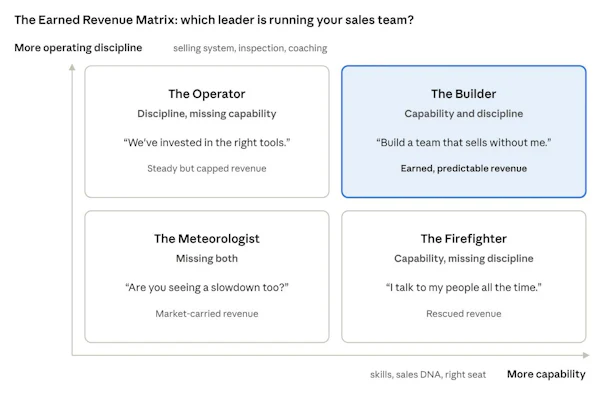
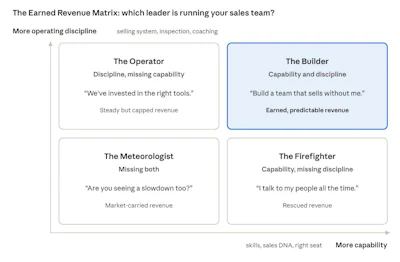
Predictable revenue takes two things. Capability is the selling team: the skills of managers, regional sales managers, salespeople, and sales engineers. Operating discipline is the line and its maintenance: a defined selling system and a management rhythm of weekly inspection and coaching. When revenue misses, the instinct is to blame the salespeople. In my experience, it's more often the structure around them. Skills only grow, and stay, when that structure is in place. How leaders think about selling decides how much of each they build. Together, they form the Earned Revenue Matrix, and each quadrant shows what's missing.
Market-carried revenue rises and falls with demand. Earned revenue is growth your team produces on its own, the kind you can predict.
Each pattern starts with a belief. Whatever leadership believes about buying, it will tolerate in its selling system. PMMI members build equipment they're rightly proud of. Believe a great machine sells itself, and nobody inspects the pipeline.
The Meteorologist: missing both. When the pipeline thins, they call peers: “Are you seeing a slowdown?” That's a smart habit. It only limits growth when the question stops being “What could we change?” The sales process may sit in a binder, installed but never commissioned. Revenue: market-carried.
The Firefighter: missing discipline. “I don't need a formal management process. I talk to my people all the time.” The best people are tired. Deals close late, sometimes outside their lane, and engineering pays. Nobody asks why the plant keeps catching fire. Busy is not the same as productive. Revenue: rescued.
The Operator: missing capability. “We've invested in the right tools, so the results will come.” There's a CRM, a weekly email asking everyone to update it, an AI tool, and a sales process. The parts are dating, but they aren't married yet. Revenue: steady but capped.
The Builder: capability and discipline. “My job is to build a team that sells without me.” They arrive early, as advisors who know each client's long-term goals and help shape the budget. They line up support for each seat: a recruiter they meet regularly; assessments before hiring or promoting; a candid peer group; and an outside coach who reinforces habits so the team practices on each other, not on clients. As James Clear puts it: “You do not rise to the level of your goals. You fall to the level of your systems.” Revenue: earned.
Find your quadrant, then check it
Score yourself honestly: have leaders and a few salespeople pick a quadrant privately, then compare.
Then check your numbers:
• Meteorologist: How consistently do you set targets and hit them? If one hot product, big order or customer made the year, could you repeat it? First move: commission the binder, then assess each seat.
• Firefighter: Two or three people carry the number. First move: turn instincts into three standards and inspect them weekly.
• Operator: Activity and turnover are up; close rates haven't moved in a year. First move: assess each seat, then coach skills, not CRM updates.
• Builder: You hit targets consistently, outgrow the industry and start earlier with decision-makers. The pipeline is bankable. First move: keep reinforcing, especially when the market turns.
Builder isn't a diploma you frame. It's a standard you maintain. Intel's Andy Grove put it bluntly: “Only the paranoid survive.” The hiring market shows why. Our assessment benchmark of 20,072 manufacturing salespeople puts the average at the 45th Sales Percentile.¹ Reaching decision-makers scores 42%; growing existing accounts, 31%. That's a fair picture of the pool you hire from. Coachability scores 81%, so the gap can close, but only if you keep closing it.
How each seat moves to the upper right quadrant
If you're the CEO or president: Before approving the 2027 plan, ask for your close rate on quotes and how many open quotes have a met decision-maker. If no one can answer, that's your first move.
If you own or invest in the company: Ask how much of last year's growth was earned, how much came from three customers, and how much depends on one person. ITR Economics expects a serious downturn in the 2030s. Market-carried revenue is usually the first to vanish.
If you lead sales: Every Monday, check three deals for a pain tied to the client's long-term goals, its dollar cost, a met decision-maker and a known budget. Before rescuing one, ask, “What would you do next?”
If you're a regional sales manager or salesperson: Start with your customers. PMMI research found 89% of OEMs offer conversion kits; only 48% of end users use them. Whatever you sell, where is your version of that gap? Ask top accounts about three-year plans before they become RFQs. Get to the person who signs the check: as I wrote in the Fall, close rates run 11–13% when nobody qualifies before engineering quotes. That's hope, and last time I checked, you can't buy groceries with hope.
I've been the other three quadrants. Along the way, I learned that chasing the number is a reliable way to miss it. The Earned Revenue Builders I know start somewhere else. They fall in love with helping clients reach their goals and build the system on top of that. Revenue tends to follow. That CEO's charts line up when sales runs like a line at rated speed, and that starts with one Monday meeting in January.