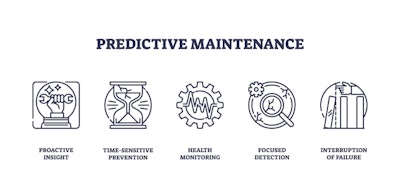
Packaging OEMs can embed predictive maintenance into equipment by starting with existing machine data, identifying failure modes, and deploying intelligence into controls to detect problems before they cause downtime.
- Start with known data already in PLCs like temperature, vibration, and pressure readings to identify detectable failure modes without redesigning machines
- Map failure signatures by correlating sensor data with actual component failures, then use these patterns to create predictive alerts
- Prioritize high-impact components that halt production when they fail, as early detection directly protects throughput and minimizes unplanned downtime
- Deploy predictive logic in existing PLCs for new equipment or use secondary intelligent devices for legacy machines to avoid disrupting core controls
- Predictive maintenance is an ongoing effort that improves over time as field data accumulates and machine signatures become clearer
Predictive maintenance is one of the more widely discussed opportunities in packaging automation, yet many OEMs remain unsure how to dive in. While the industry has embraced PLC-based controls, small machine improvements, and minor sensor upgrades for decades, the deeper challenge lies in turning raw machine data into reliable early-warning indicators of failure. For packaging OEMs looking to differentiate their machines and reduce service burden, embedding intelligence into equipment at the design stage is achievable.
Start with known data
For most OEMs, the predictive maintenance journey begins with an inventory of the data already available. Early-stage development often involves collecting raw machine data, such as temperatures, vibrations, currents, pressures, cycle counts, and other readings already present in their PLCs. These signals provide the foundation for identifying what failure modes can be detected without redesigning the machine.
Packaging machinery typically generates far more data than machine builders realize. A simple motor can reveal degradation long before it fails if its vibration and temperature data points are captured and interpreted. A heat-seal bar that historically requires replacement every six months inherently provides a built-in benchmark. A conveyor drive that always requires alignment at predictable intervals offers similar insight.
OEMs with long-running machine platforms already possess years of documented failure patterns. Even when this information exists only in service reports or operator observations, it provides strong guidance for determining where to focus initial predictive maintenance development. In many cases, early wins come from monitoring components that are already known problem points.
Identify failure modes
A common misconception is that predictive maintenance begins with choosing sensors. In practice, the reverse approach is more effective. It’s better to start with known failure modes and then determine which data indicate those conditions.
For example, a packaging machine’s motor bearing failure typically presents as a combination of rising vibration and elevated temperature. Neither signal alone provides a complete picture. Together, however, they form a recognizable pattern. Many failure modes in packaging systems follow similar patterns.
Initially, these patterns can be mapped manually by correlating sensor readings with actual failures. Engineers can document the signature of a fault by reviewing sensor logs at the moment a component fails. Over time, these signatures form the basis of alerts that can warn operators of developing issues before they become critical.
This signature-based approach scales smoothly as additional sensors are added. Even though advanced systems may include ten or more sensors, not all signals are required for every fault condition. For each failure mode, only the relevant subset of sensors contributes to the signature. This keeps the predictive model manageable during early development stages.
High-Impact Components
In packaging environments, certain components carry higher operational risk than others. OEMs often find value in focusing initial predictive maintenance efforts on components that, if they fail, halt production entirely.
Even if monitoring these components requires additional sensors or controller logic, the return on investment is clear. Early detection of their degradation directly protects throughput and minimizes unplanned downtime.
While some critical components are straightforward to monitor, others may be more difficult to monitor. Nevertheless, the operational repercussions of their failure justify the added development effort. OEMs often find that predictive maintenance is not just about starting with what is easiest. It is also about addressing what matters most to the system’s reliability.
Predictive intelligence
As OEMs incorporate more sensors and collect more data, predictive maintenance naturally evolves into pattern recognition and advanced analytics. Modern packaging systems increasingly benefit from machine-learning models capable of interpreting sensor signatures that are difficult for conventional logic to decode.
In large or distributed systems, engineers already deploy cloud-based AI models that analyze data at scale and return predictive indicators back to the local machine. Edge controllers running Linux or Python environments can host certain versions of these models, enabling real-time inference on the machine without requiring constant cloud connectivity.
This hybrid approach provides a future pathway for packaging OEMs as their sensor strategies evolve.
Once predictive logic is developed, OEMs must determine how to deploy it. In many packaging systems, intelligence can be embedded directly into the existing PLC alongside standard machine controls. This is often the preferred strategy for new equipment, where control architecture is already under OEM management.
However, for machines already in the field, modifying the PLC program may be impractical. In these cases, a secondary intelligent device can be added in parallel. This external controller can monitor added sensors, extract data from the existing PLC, or “listen” to the machine’s registers without interfering with core machine logic. This makes predictive upgrades feasible even for equipment with legacy controls.
Some OEMs also integrate a data-collection device that mirrors PLC readings, adds new sensors, and communicates upstream to customer maintenance platforms. Whether embedded or parallel, the architecture should match the customer’s operational requirements.
Predictive communication
Developing accurate predictive indicators is only half the challenge. OEMs must also determine how insights will be delivered to maintenance personnel to drive timely action.
For smaller installations or standalone machines, the local controller may send email or text alerts directly to maintenance teams, notifying them when indicators approach critical levels or when a component is trending toward failure.
For larger customers, IT departments play a central role. Predictive maintenance data may need to be integrated into ERP systems or company-wide maintenance management systems. OEMs must work with customer IT teams to define workflows that ensure predictive alerts reach the appropriate people.
The right output path depends on the customer’s infrastructure. Regardless of approach, the goal is to provide actionable, timely information quickly.
An ongoing effort
Perhaps the most important lesson for packaging OEMs is that predictive maintenance is not a one-time feature. Machine builders often refine their predictive maps as new field data becomes available, unexpected failures occur, or machine designs evolve. Some OEMs begin with only a few sensors and expand over time, while others add intelligence from the start.
The long-term opportunity is substantial. As more sensor data is collected, machine signatures become clearer, and OEMs gain deeper insight into how their equipment behaves under real operating conditions. Over time, predictive intelligence becomes more woven into the OEM’s product strategy.
For packaging OEMs, embedding predictive maintenance into machinery is increasingly becoming a core expectation from end users seeking higher uptime. By starting with available data, identifying failure modes early, focusing on high-impact components, building sensor-based signatures, and integrating intelligence into existing controls, OEMs can deliver meaningful predictive capabilities.
As sensor density increases and data volumes grow, machine-learning-based models will further extend these capabilities. It still begins with basic steps and recognizing that predictive maintenance is an ongoing development effort.
Corey Foster is the Director of Automation Sales & Application Engineering and Michael Ecklund is a Technical Specialist at Valin Corporation.