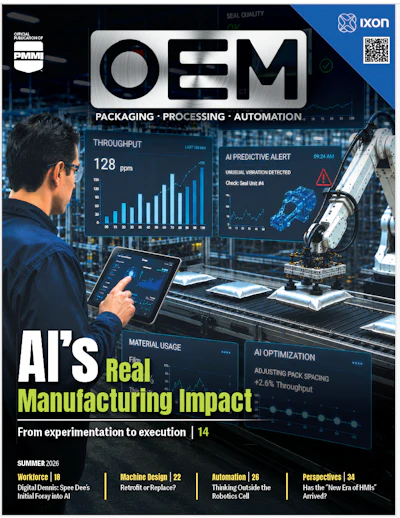
AI in packaging equipment has shifted from experimental pilots to solving real operational challenges at scale. OEMs must now focus on five key areas: knowledge transfer, predictive maintenance, machine vision, compliance automation, and data transparency to build lasting competitive advantage.
- Tribal knowledge transfer: AI systems now capture undocumented expertise from experienced operators and deliver context-aware guidance directly on the production line.
- Predictive maintenance evolved: AI models moved beyond simple alerts to continuously learning systems with explainable AI and prescriptive recommendations for optimal intervention.
- Machine vision accuracy: Deep learning advances achieved over 99% defect detection rates while reducing false rejects and adapting to new products without reprogramming.
- Compliance automation: AI aggregates data and auto-completes sustainability and regulatory questionnaires, offering low-risk, fast ROI for hesitant companies.
- Data transparency breakthrough: New secure AI architectures enable locally controlled data collection with selective sharing, unlocking value while addressing cybersecurity concerns.
When AI officially moved from a science fiction lover’s dream to a real-world reality, PMMI quickly researched the new advancements and produced the 2024 white paper, "The AI Advantage in Equipment: Boosting Performance and Bridging Skills Gap." Less than two years later, interviews with OEMs, CPGs, AI vendors, and integrators for a follow-up white paper, Building an AI Advantage in Packaging Equipment, reveal a stark shift: AI is no longer about proving concepts. It’s about solving specific operational, workforce, and compliance challenges at scale.
Five areas in particular stand out for making the most significant strides:
Turning tribal knowledge into digital assets
The biggest leap since 2024 has been in AI-powered knowledge transfer. Two years ago, companies discussed the idea; many are actively deploying it in 2026. AI is being used to capture undocumented “tribal knowledge” from experienced operators and technicians. Generative AI systems can quickly record manuals, service logs, work orders, and even voice notes, then deliver context-aware guidance directly to operators on the line.
Predictive maintenance
While not new, predictive maintenance is much more intelligent and trusted by OEMs and their customers.
AI models have moved beyond simple threshold-based alerts to continuously learning systems trained on real machine data. New developments, including explainable AI, richer sensor integration, and the move toward prescriptive maintenance, are enabling systems to not only predict failures but also recommend specific corrective actions and optimal intervention windows.
Machine vision
Advances in deep learning have increased defect detection rates to over 99%, while greatly decreasing false rejects. AI vision systems now can detect subtle irregularities that traditional sensors miss and can adapt to new SKUs without extensive reprogramming. When combined with robotics, vision systems facilitate flexible picking, inspection, and quality assurance in fast-paced environments.
Automating the administrative burden
Environmental, social, and governance have collectively created an administrative bottleneck for packaging companies. AI systems are now being deployed to aggregate data, auto-complete compliance questionnaires, and ensure consistent, audit-ready responses across customers and regions to meet sustainability reporting, material disclosures, and evolving global regulations.
Administrative tasks offer smaller or hesitant companies “low-hanging fruit” for AI adoption. It delivers fast ROI with limited operational risk.
Data transparency is finally falling into place
After years of cybersecurity and IT concerns, data transparency is slowly catching on in packaging and processing.
New AI architectures allow secure, locally controlled data collection with selective data sharing, easing security fears while unlocking value. AI-driven data platforms can automatically classify, organize, and contextualize information across operations, turning raw data into actionable insight.
This matters because every other AI application depends on it. Predictive maintenance, compliance automation, and knowledge transfer all perform better when data is structured and accessible.
What This Means for OEMs
Taken together, AI in packaging equipment has quickly shifted from isolated pilots to interconnected systems that enhance performance and usability.
The takeaway for OEMs is straightforward: customers are no longer asking if AI belongs in their operations; they’re asking how fast it can be deployed, how well it integrates, and who is accountable when it’s running. OEMs that align equipment design, data strategies, and partnerships around these five AI advances will be best positioned to help customers and themselves build a lasting advantage.