Even well-developed specifications rarely survive a project unchanged. Evolving product designs, new packaging formats, shifting operational needs, and business priorities all push requirements to move after work is underway. The difficulty, participants at a PMMI Vision 2030 Discovery Session say, is understanding what each change sets in motion and managing it in a way that works for both parties.
According to PMMI's From Specs to Success: Aligning OEMs and CPGs Operations white paper, a recurring concern was the gap between how a change appears to the party requesting it and what it requires from the party implementing it. A modification to packaging material, equipment configuration, or operating requirements can look contained while affecting machine design, component selection, engineering resources, and scheduling.
One roundtable describes how a seemingly minor equipment change could require an OEM to revisit completed work or re-enter an engineering queue, creating delays well beyond the physical work involved. In another, a participant recounts a project in which switching from paper to plastic cups created equipment-feeding difficulties because the machine had been configured for the original material.
"I just lost three, four weeks. It's such a simple change," one session participant says.
When asked what process would make a mid-project change fair and fast for both sides, participants pointed first to communication. Early communication from whoever initiates the change was the most frequently selected priority, chosen by 74% of respondents. Participants emphasized raising changes when they become known, rather than waiting until the implications are unavoidable.
Communication alone, however, does not settle how a change should proceed. An impact assessment document with a specified turnaround time was the second-most selected approach, at 56%. Roundtables discussed documenting what would change from the existing specification, identifying the cost, timing, quality, and performance consequences, and defining a response time for reviewing the request.
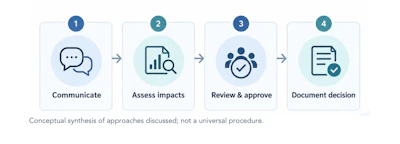
Together, the findings point to a distinction between requesting a change and approving one. Participants described a sequence—communicate, assess impacts, review and approve, and document the decision—while cautioning that the right process depends on the nature of the change, the project stage, and the organizations involved.
For OEMs and end users, shared visibility into both the request and its consequences gives CPGs a clearer view of how evolving requirements affect commitments, and gives OEMs an opening to explain technical and scheduling impacts before revised expectations are locked in.
SOURCE: 2026 Securing the Line: Managing Cybersecurity in Packaging and Processing Operations
For more insights from PMMI’s Business Intelligence team, find reports, including From Specs to Success: Aligning OEMs and CPGs Operations, Securing the Line: Managing Cybersecurity in Packaging and Processing Operations, and The Formulation Effect: Impacts on Food & Beverage Production at https://www.pmmi.org/business-intelligence.
Download the FREE report below.