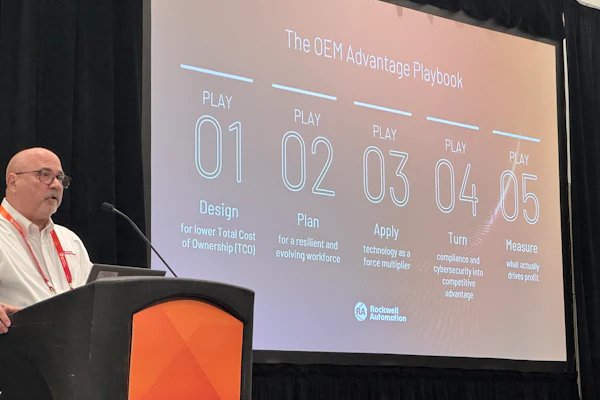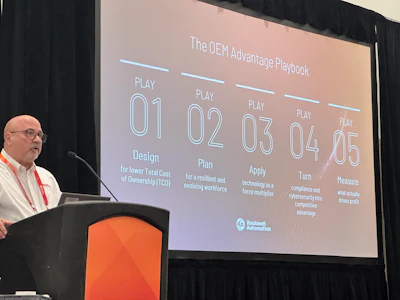
Higher performing OEMs differentiate themselves through five repeatable plays: designing for lower total cost of ownership, planning for a resilient workforce, applying AI and technology strategically, turning cybersecurity into competitive advantage, and measuring metrics that actually drive profit. The key is building machines and teams that recover quickly from downtime, turnover, and regulatory changes rather than simply optimizing for peak performance.
- Average downtime costs OEMs $3.6 million and 40 hours per event, making recovery design critical
- 35% of OEMs cite employee turnover as their top barrier to success; operators now stay about 1 year versus 10-15 years historically
- Leading OEMs use AI and machine learning to predict problems rather than react to them, with 77% calling these technologies critical to equipment design
- EU cybersecurity deadline January 2027 will prevent non-compliant machines from leaving the dock in Europe
- Most OEMs track production KPIs (35%) but miss quality metrics; leading performers measure contextualized data models that work across vendors
Every machine builder has heard at some point, "We've done it this way since . . ." According to Justin Garski, manager, Rockwell Automation's OEM packaging and CPW, that mindset is now one of the clearest dividing lines between leading OEMs and those that follow.
"When I think about places that are struggling, they're stuck in their old ways," Garski told attendees during the OEM Viewpoint: What do Higher Performing OEMs Do Differently? session at the Automation Fair. His colleague and fellow presenter Joseph Biondo, senior program manager for OEMs/machine builders, pointed out how quickly the clock now moves. After a recent AI project, he said, the reaction was "that's old, we did that in August."
The session drew on a study of 500 OEM leaders and revealed what separates the OEMs that shape their markets. The answer comes down to resilience, and the presenters condensed it into five repeatable plays.
Play 1: Design for lower total cost of ownership
The study puts the average downtime event at 40 hours and $3.6 million. Garski, a former field service engineer, said the 40 hours isn’t hard for him to believe, and the audience agreed. He cited an example where the morning after a shutdown, the backup batteries everyone ignored were dead, the machine wouldn't start, and the end user called the OEM. Most of the first day is spent troubleshooting over the phone while service debates the cost of a last-minute flight to address the problem. Eventually someone books a last-minute flight, and a day and a half is gone before the line runs again.
The solution is to build recovery into the machine from jumpstreet. That can look like on-machine wiring a technician can't easily get wrong and drives that configure themselves when swapped. It also means emulation and simulation, which let builders compress months of rare fault conditions into a digital test. Biondo compared it to buying a car. A race car wins on peak performance but needs premium fuel and constant tires, while a well-matched daily driver wins over its lifetime.
Play 2: Plan for a resilient and evolving workforce
When the speakers asked who was finding engineers harder to hire, nearly every hand in the room went up. The study found 35% of OEMs cite employee turnover as their top barrier to success. The bigger number is that operators now stay about a year, compared with 10 to 15 years historically.
The skills gap also continues to widen and grow. Biondo described a customer who called an engineering house with "60 Rockwell programmers." When the customer asked how many knew independent cart technology and advanced motion, the answer was one, and he was always booked.
Builders are responding by designing for operators who may have been working in the service industry last week. That includes small language models trained on machine documentation that suggest where to look when a fault appears. It doesn't have to involve AI, though. Garski praised one changeover design he saw at PACK EXPO International, where every setup axis lights up red, and the operator moves each actuator until its light turns green and its brake locks. In short, this means no hand cranks and no tribal knowledge required.
Play 3: Apply technology as a force multiplier
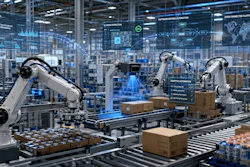
Leading OEMs are moving from asking what happened to asking what's coming next. The study found 81% of respondents say their challenges are accelerating technology investment, and 77% call AI and machine learning critical to equipment design and quality.
Examples ranged from drive-level AI that flags bearing and balance problems on large rotating loads, to partner tools that forecast production rates for the next three hours. Garski compared the underlying work, contextualized machine data, to "laying the plumbing in a subdivision before you build a house." You may not know yet what you'll build, but the foundation has to come first.
Play 4: Turn compliance and cybersecurity into competitive advantage
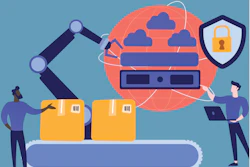
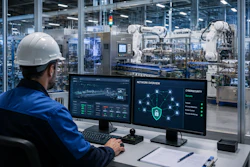
Biondo said the EU's January 2027 deadline is "coming down like a freight train." Machines that don't meet the new cybersecurity requirements won't leave the dock in Europe. He compared it to where machinery stood on safety decades ago. A machine full of CE-marked components isn't automatically compliant, just as a machine full of safety products isn't automatically safe. What counts is how the components are applied, especially in network segmentation.
Garski connected the issue back to the labor shortage. Secure remote access is how OEMs will keep supporting machines in the field, he said, "because we don't have enough warm bodies on airplanes to go fix stuff." The obstacle is a long-standing IT culture in which "no one ever got fired for saying no."
Play 5: Measure what actually drives profit
Production KPIs are the most commonly tracked area, at 35%. In an audience Q&A, the presenters addressed why quality ranks last among performance KPIs. They said plant dashboards show parts per hour, not good parts per hour.
OEE has its own issues as a measurement. For example, a case packer can look terrible on paper when the real problem is a jammed palletizer downstream. Finding a way to create and deploy consistent, contextualized data models that work the same way across vendors lets OEMs defend their machines and compare plants.
The presenters advised starting small. Track whether the machine is running, faulted, or blocked. "We don't have to land on Mars yet," Garski said.
Leading OEMs have accepted that downtime, turnover, and regulatory change are and will happen, and they have built their machines and teams to recover quickly. In a market where this past summer already counts as old news, that preparation is a real competitive advantage.