The full breadth of the manufacturing skills gap crisis doesn’t show up as a line item in a report. Instead, it hides in longer onboarding and slipping commissioning schedules. It shows up when a maintenance team waits on the one technician who knows the legacy line, and when an automation project never delivers the capacity it promised.
“If we do not close the gap, the realistic outcome is that companies will own technology they cannot fully use,” says Greg Magdanz, VP of OEM & Robotics at Schneider Electric.
That framing matters for OEMs. The competitive divide, Magdanz argues, “will not simply be between companies that bought automation and companies that did not. It will be between companies that developed their people alongside the technology and companies that treated workforce development as an afterthought.”
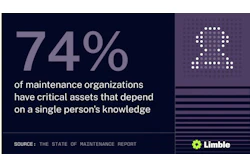
The numbers suggest the industry sits closer to the second group than it would like. About 74% of companies report acute skilled-worker shortages, according to PMMI research, and more than half of advanced manufacturing workers will need upskilling by 2030. The job itself is also changing. Roles that once needed one main skill now draw on automation, data, connectivity, energy management, and cybersecurity, on top of knowing the process itself.
The knowledge that never made the manual
PMMI surveyed 136 end users and OEMs for its Inside the Workforce Gap report. It found that headcount is only part of the problem. The bigger risk is undocumented skill loss as tribal knowledge leaves with retiring operators.
Magdanz describes that knowledge as “the workaround an experienced technician knows, the sound that tells an operator something is beginning to fail, or the intuition that comes from seeing the same process run thousands of times.”
The report found growing interest in practical, near-term fixes: HMIs built into the machine, short task-based training videos, QR-linked documentation and predictive maintenance tools. Those design decisions fall squarely on OEMs and their automation suppliers. Magdanz points to operator interfaces that say what to do next, not just that something failed; digital twins that let new engineers program and test before a physical machine exists; and standardized, reusable code that makes equipment easier to support across sites and shifts.
Open, software-defined architectures matter too, he says, because “employees should not have to learn an entirely different proprietary environment every time a component changes.”
But he draws a firm line on how far technology should go. “Technology should not replace mentorship. It should scale mentorship,” he says. “The line is crossed when we treat AI as the expert rather than as a tool serving the expert and the operator.”
Three horizons at once
Better machines can shorten the learning curve, but they can’t produce the learners. That is where PMMI’s strategy comes in. It works on three time horizons at once:
promoting packaging and processing careers to attract new talent
supporting education programs with curriculum that reflects how the industry actually runs
training employees already on the floor to keep up with changes in equipment, connectivity and energy management
The PMMI Foundation, the association’s charitable arm, drives the first two. Its 2025 numbers show how wide the effort reaches:
More than 70 programs across North America were supported through the PMMI U Skills Fund. That included over $600,000 in matching funds and $1.2 million in combined industry investment in packaging education and training.
More than $168,000 in scholarships went to students in packaging, processing, engineering, automation and related fields.
More than 1,000 students attended PACK EXPO Southeast and PACK EXPO Las Vegas with Foundation travel support.
More than 19,000 students were engaged at the SkillsUSA National Leadership and Skills Conference through a dedicated Packaging Pavilion.
23 co-branded SparkForce summer camps gave more than 500 students hands-on time in advanced manufacturing environments.
36 FIRST Robotics Competition teams and 10 FIRST Tech Challenge teams were sponsored to attend the FIRST Championships.
What ties these together is exposure. Many students never come across packaging and processing as a career option. Those who do often have an outdated picture of factory work. Magdanz calls this the industry’s perception problem: “Younger workers expect to engage with AI, robotics, software, data, and connected technologies. … Manufacturing careers should feel advanced, purposeful, and attractive, because that is increasingly what modern industrial work actually is.”
More than a logo on a banner
In March 2026, Schneider Electric was named the PMMI Foundation’s Visionary Benefactor, the highest level of the Foundation’s Benefactors Program. The support goes to scholarships, education programs, workforce development initiatives, the Student Lounge at PACK EXPO and year-round student engagement.
What sets this apart from a typical sponsorship is that the company is on both sides of the problem. Schneider operates more than 20 factories and distribution centers in the U.S., employs more than 21,000 American workers, and has openings of its own to fill. By backing PMMI U Skills Fund curriculum, it helps shape the pipeline that will produce its own operators and integration partners, and those of its OEM customers. When it sponsors the Student Lounge at PACK EXPO, its engineers and HR staff are in the room. The investment is circular by design.
“This is not a workforce challenge any one company can solve alone,” Magdanz says.
What a brownfield plant teaches
Schneider’s own operations test the argument that people and technology have to move together. Its Lexington, Ky., plant was built in 1957. It modernized without replacing the building, the legacy equipment, or the workforce. The site added sensors, connected controls, remote monitoring, and predictive maintenance in small steps, and employees helped identify pain points and test new tools.
Training followed a 10-20-70 model: 10% formal education, 20% learning from peers and experts, and 70% hands-on experience. Leaders also had to manage pushback while teams built confidence. Mean time to repair (MTTR) fell 20%, energy spend dropped 26%, and manual paperwork fell 90%.
For OEMs and their customers, the lesson is less about the tools than the order of operations. “It is the difference between installing technology and actually being able to capture its full value,” Magdanz says.
How to know it worked
Magdanz offers three tests for whether today’s investments have paid off five years from now:
Workforce readiness: Are new hires productive faster, and can more technicians fix problems without waiting for one expert?
Operational performance: Are onboarding time, MTTR, commissioning time and downtime falling?
Pipeline health: Are more students entering packaging, processing and automation careers, and are they staying?
The most meaningful sign, he says, would be workforce development no longer being treated as a separate initiative. “It becomes part of every automation investment, with the technical implementation, training plan, change-management plan, and employee feedback process designed together from the beginning.”