Autonomous operations augment existing control systems by adding AI-powered reasoning and learning capabilities on top of traditional automation, enabling manufacturers to boost productivity by 30%, accelerate employee training by 60%, and capture critical tribal knowledge without replacing their current infrastructure.
- Autonomy augments rather than replaces automation, adding reasoning and learning to existing control systems
- Rockwell's Singapore plant achieved 30% output gains per employee and 60% faster proficiency for new workers through autonomous operations
- FactoryTalk Conductor uses AI agents to generate Logix code from plain language instructions, reducing engineering complexity
- Companies can choose their LLM provider—including on-premises open-weight models—to address data privacy and cost concerns
- Implementation strategy: Start with one high-impact area rather than transforming everything overnight
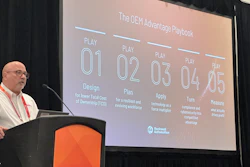
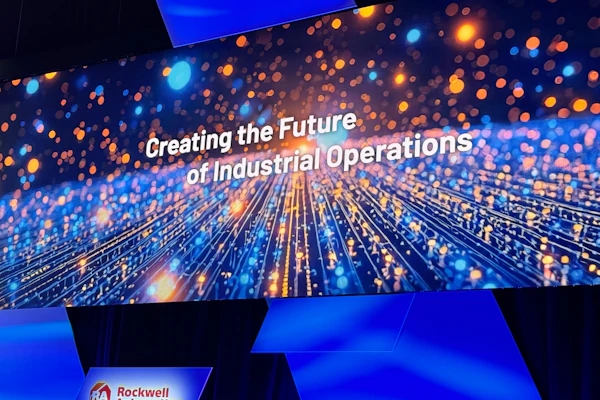
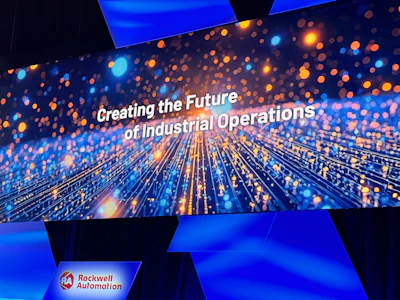
The second day of Automation Fair kicked off with a keynote making the case for autonomous operations with the caveat that companies won't need to replace their existing control systems to get there.
CEO Blake Moret kicked off the session by highlighting Rockwell Automation factories to serve as examples of where automation can take an operation. The company's plant in Singapore joined the World Economic Forum's Lighthouse Network this year. Output per employee there is up more than 30%, and new employees become proficient more than 60% faster. Early next year, Rockwell will break ground on a 1-million-square-foot plant in New Berlin, Wis. that will serve as its most advanced and largest plant.
On the OEM side, he mentioned Angelini Technologies, which builds high-speed hygiene and home care lines. Angelini has standardized on FactoryTalk Optix and also uses Emulate3D to test machines before they ship. One point Moret really wanted to emphasize was that while Angelini is using this technology now, builders have been able to commission lines remotely for years. It really took the COVID pandemic, when companies had no other choice, to realize they could use this option, and most have stuck with it.
CTO Cyril Perducat argued that autonomy doesn't compete with automation. "Autonomy is not replacing automation. Autonomy is augmenting automation," he said. In his view, controls will still run defined tasks safely, and autonomy will add reasoning and learning on top of them. Reasoning is for problems that involve more variables than a person can track, while learning means the system improves a little each time it runs.
Matheus Bulho, senior vice president of Software & Control, presented the product details, starting with FactoryTalk Conductor. Engineers type what they need in plain language, and the agents generate Logix code and Optix faceplates. The Conductor also works in Emulate3D and FactoryTalk View. Conductor will launch for design work, and Rockwell plans to extend it to operations and maintenance later.
Customers can choose which large language model Conductor uses and can be one their IT group already licenses, such as Anthropic's or OpenAI's. It doesn’t require one that Rockwell hosts but the option is there is a customer wants to use it. Companies concerned about data privacy or token costs can run an open-weight model like NVIDIA's Nemotron on-site.
Bulho also showed Logix SDA coordinating about 1,000 axes of motion on a single compute platform. He introduced the ControlLogix L10, a year after the L9, and announced a marketplace for add-on workloads for Logix and Optix.
Matt Fordenwalt, senior vice president of Intelligent Devices, talked about what Rockwell calls trusted content. Rockwell's lifecycle services group completes more than 5,000 projects a year, and the code, specifications, and FAT results from those projects are the material the agents are trained on. He said the system learns inside the customer's environment, so customers keep their data.
He also described the kind of knowledge Rockwell wants to capture, such as "the engineer who knows why a line behaves differently on a humid day." Most plants have someone like that, and most worry about what happens when that person retires; tribal knowledge walking out the door is often cited as the biggest issue in the workforce crisis.
Many OEMs already struggle to find programmers and keep losing operators within a year. If Conductor's agents can make up even part of that gap, that will matter more to builders than the L10. Rockwell hasn't shown that yet, and plenty of buyers will want proof first.
Fordenwalt wasn't promising overnight change. "The answer isn't to try to transform everything overnight," he said. He suggested companies find one place where autonomy pays off and begin there.