Imitation learning is moving artificial intelligence from software layers into machines themselves, enabling robots to learn tasks by observing human operators and adapt to real-world production variability without extensive reprogramming.
- Imitation learning uses a leader-follower setup where human operators guide robots through tasks while systems capture motion, force, and visual data for training.
- Training directly on production-capable hardware removes the lab-to-factory gap, allowing AI models to handle real-world variability like flexible materials and inconsistent infeed.
- Hybrid machine control combines deterministic systems for safety and motion with learning-based systems for task-level adaptation and variation management.
- Imitation learning reduces changeover time by replacing complex reprogramming with operator demonstrations, accelerating SKU transitions and lowering commissioning costs.
- This approach maintains safety and repeatability standards of traditional automation while enabling flexible handling of non-rigid items, mixed-SKU picking, and adaptive packing tasks.
Artificial intelligence has reshaped digital workflows regarding analytics, simulation, and the decision-making layers that sit above the machine. What’s changing now is where AI lives. It’s moving into the machine itself.
At NVIDIA’s GTC 2026 event, Universal Robots (UR), part of Teradyne Robotics, introduced its AI Trainer, a system designed to bridge the disconnect between how models are trained and how machines actually operate on the factory floor.
For packaging and processing OEMs, the shift is significant. AI is no longer just a software layer. It is becoming part of how machines are designed, controlled, and deployed—especially in environments defined by variability.
Closing the lab-to-factory gap
One barrier to industrial AI adoption has been the mismatch between lab-based training and real-world deployment. Models are often developed in controlled environments using hardware that can’t always reflect production conditions. UR’s approach aims to bring training closer to reality.
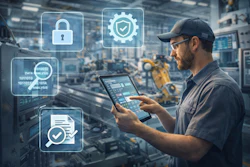
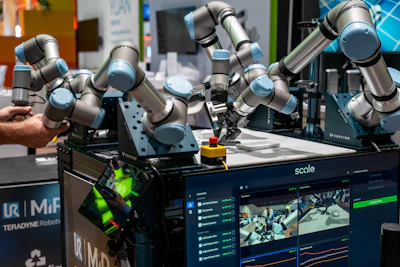
The AI Trainer uses a leader-follower setup, where a human operator physically guides one robot through a task while another mirrors the motion in real time. During this process, the system captures synchronized motion, force, and visual data, producing the multimodal datasets needed to train advanced AI models.
“You’re training on the same platform you deploy,” says Andrew Pether, Head of AI Partnerships at Teradyne Robotics. “That removes a lot of the friction that has historically slowed adoption.”
For packaging applications—handling flexible materials, adapting to inconsistent infeed, or managing SKU variation—that alignment matters. Training directly on production-capable hardware introduces the variability AI systems must ultimately handle.
A shift in machine design?
 Teradyne
“Instead of engineering a single optimal trajectory, OEMs can design machines that learn acceptable variations of a task within defined constraints,” Pether explains.
This leads to a layered control model, where deterministic control handles motion, safety, and compliance, and learning-based systems operate at the task level, adapting to variation.
The result is a hybrid machine that is both predictable and flexible.
For OEMs, this opens new design pathways, particularly in applications where traditional automation struggles with variability.
AI accentuates
Imitation learning is not a replacement for high-speed, fixed automation. It complements it.
“Applications with high variability but clear objectives are the best fit,” Pether says. “That includes picking non-rigid items, handling inconsistent presentation, and tasks driven by visual judgment.”
In packaging and processing, that translates to:
- Flexible packaging handling
- Mixed-SKU picking and placement
- Adaptive case packing
- Tasks requiring human-like inspection or adjustment
When trained on realistic production data, these systems can also manage variation in materials like paper-based formats or flexible films—areas where rigid automation often struggles.
Reducing the cost of change
One of the most immediate impacts is in changeover and commissioning.
Traditional automation requires reprogramming when products change. With imitation learning, that process shifts toward demonstration.
“Operators can demonstrate a task and refine it quickly instead of rewriting trajectories,” Pether says.
Mechanical changes still apply where needed, but software adaptation becomes faster and more intuitive—reducing downtime and accelerating SKU transitions.
Rethinking responsibility and validation
As AI moves into the machine, responsibility becomes shared.
OEMs define system architecture and safety boundaries. Integrators adapt systems to applications. End users often handle incremental training—such as introducing new SKUs.
“The advantage is accessibility,” Pether says. “You don’t need deep AI expertise on the factory floor to make improvements.”
Validation also evolves. Instead of certifying a single programmed path, OEMs validate a range of acceptable behaviors within defined limits.
“Safety, motion limits, and performance remain deterministic,” Pether explains. “Learning happens within those boundaries.”
This approach allows AI-driven systems to meet the same expectations for uptime, repeatability, and safety as traditional automation.
The convergence of digital and physical
The broader shift is not just about robotics—it’s about convergence.
Digital AI—trained on data and simulation—is increasingly paired with physical systems that execute tasks in real time. The result is a feedback loop:
- Data is captured during operation
- Models are trained and refined
- Performance improves on the same platform
This creates a continuous improvement cycle, where machines don’t just run—they learn.
For OEMs, the implication is clear: AI is no longer adjacent to automation. It is becoming part of the machine itself.