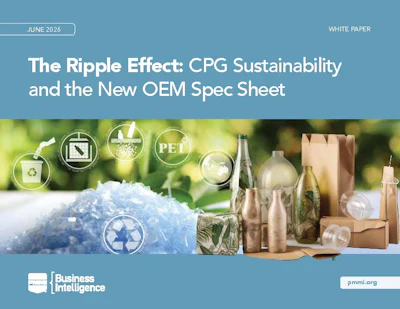
When a consumer picks up a recyclable pouch at a grocery store, they're likely not thinking about the packaging machinery that made it. But according to new research from PMMI Business Intelligence, that consumer choice, and the regulatory frameworks, retailer mandates, and ESG commitments that surround it, is now one of the most powerful forces reshaping how OEMs design and sell their machines.
The 2026 white paper The Ripple Effect: CPG Sustainability and the New OEM Spec Sheet documents how sustainability pressure originating at the consumer level is traveling upstream through the supply chain and landing squarely on OEMs. Based on a mixed-methods study of nearly 100 respondents, supplemented by 11 in-depth interviews, the report paints a picture of an industry in transition, with significant gaps still separating CPG ambition from OEM capability.
The pressure is already here

The report confirms that sustainability is no longer a future concern for either CPGs or OEMs; it's a present-tense operational reality. Over 82% of end users describe themselves as actively engaged with sustainability at some level, and only 16% characterize their approach as minimal or compliance-focused. On the OEM side, 69% say integrating sustainability capabilities into equipment design is now standard practice, and 64% report that end-user sustainability initiatives directly shape their design decisions.
What's changed is the source and velocity of that pressure. Consumer demand, retailer mandates from companies like Walmart, Target, and Costco, state and federal EPR legislation, EU packaging directives, and investor ESG requirements are all channeling simultaneously into CPG operations. As CPGs adapt by switching materials, reducing packaging weight, and eliminating secondary packaging, their equipment specifications change with them. OEMs are now part of the equation.
The capability gap is widening
The most striking data point in the report may be the trajectory of a single question asked across three PMMI surveys. When end users were asked whether packaging machinery limitations are preventing them from meeting their sustainability goals, 52% agreed in 2022 and 55% agreed in 2026. The number is moving in the wrong direction.
That widening gap reflects a mismatch between the pace of sustainable material adoption and the pace of equipment adaptation. PCR flexible materials have seen a 104% adoption increase in PMMI's materials tracking dashboard. Compostable materials are up 53% and bio-based bioplastics up 52%. Each of these shifts introduces new handling challenges—variability in material consistency, reduced structural integrity, or sensitivity to heat and tension—that existing equipment wasn't designed to manage.
OEMs consistently identify lightweighting and downgauging (cited by 55%) and smaller pack sizes (46%) as their primary design challenges. When asked to rank the single most difficult challenge for equipment performance, increased PCR content and smaller pack sizes tied at 21% each. As one OEM regional sales manager said, "[Recycled board] it's flimsier, it's lighter, it's not as rigid. And when you're trying to erect a carton and fold flaps, it can present certain challenges throughout that process."
Timing is the hidden problem
The report identifies a structural timing mismatch as a key source of friction. OEMs most frequently begin engaging with CPG customers at the line design and equipment specification stage, after material and format decisions are already made. Meanwhile, 82% of OEMs say early visibility into sustainability initiatives is important to their design planning process, but only 10% of end users currently loop in OEM partners at the corporate strategy or capital planning stage.
The consequences are predictable: late-stage engineering modifications, cost overruns, and missed opportunities to steer material decisions toward formats the equipment can handle. One OEM regional sales manager was direct about the fix: "The sooner you can get us involved, should there be any sort of redesign, the better. That way we can, one, be involved, but two, tell you what's going to work best with our equipment."
Regulatory complexity and the Asia blind spot
Regulatory pressure compounds the engineering challenge. Two-thirds of end users (66%) say sustainability regulations are already influencing their equipment decisions. For OEMs, the top EPR challenge isn't compliance itself but fragmentation. Fifty-five percent cite different rules across regions as their primary obstacle, and 46% describe regulations as unclear or still evolving. A significant 36% of OEMs have no formal system for tracking emerging sustainability legislation.
The EU is widely recognized as the dominant global standard-setter, cited by 75% of OEMs in international markets. But the report flags a potentially significant blind spot: Asia. Quantitative survey data placed Asia fourth among regions for regulatory stringency, with only 13% of OEMs identifying it as a high-influence market. Qualitative interviews told a different story. Multiple OEMs described Asian sustainability requirements as actively shaping their equipment decisions. Vietnam, the Philippines, Japan, and South Korea all have mandatory EPR frameworks, and China's national plastic reduction policies are accelerating. The report's conclusion is pointed: the gap between the 13% perception and on-the-ground reality is itself the risk.
What comes next
The report concludes with actionable guidance for both sides of the relationship. For OEMs, the priorities are clear: build material flexibility into equipment from the start, document performance data with sustainable materials proactively, develop modular upgrade paths for existing lines, and establish a sustainability data package — energy, waste, material certifications — ready to share before a customer asks. On certification, the message is urgent: register for platforms like EcoVadis now, not when a customer makes it a condition of sale.
For end users, the parallel imperative is earlier engagement. Share sustainability roadmaps with OEM partners before packaging decisions are locked in, include material compatibility requirements in RFPs explicitly, and build the operational trade-offs of material transitions into capital approval business cases rather than discovering them at start-up.
Both groups, the report notes, ultimately want the same things: standardized regulations and better early communication. The irony is that each side is waiting for the other to move first. That standoff is costly, and it's getting more expensive every year the gap between CPG ambition and OEM capability continues to widen.
"The Ripple Effect: CPG Sustainability and the New OEM Spec Sheet" is available through PMMI Business Intelligence at pmmi.org/research.