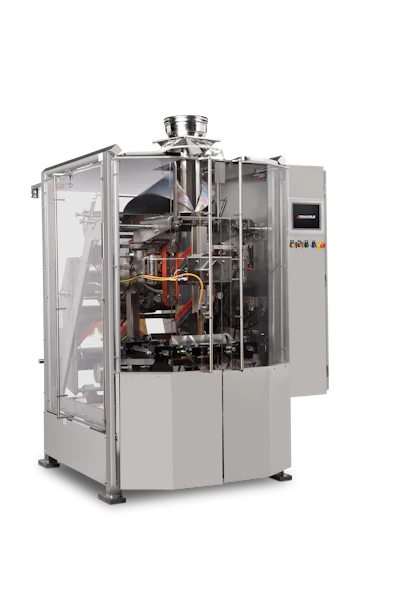
Triangle Package Machinery is the only vertical form/fill/seal manufacturer worldwide holding 3-A sanitary certification, which demonstrates through rigorous third-party inspection that equipment meets strict hygienic design standards for cleanability, inspectability, and pathogen prevention. This certification streamlines the qualification process for food processors and supports their HACCP compliance requirements by verifying that product-contact surfaces are free of voids, crevices, and dead zones where pathogens could hide.
- Triangle Package Machinery earned 3-A certification in 2010 and remains the only 3-A certified V/F/F/S manufacturer worldwide, successfully defending the certification through re-verification in 2022.
- 3-A Sanitary Standards certification requires hands-on Third Party Verification inspection by certified evaluators who physically examine equipment for welds, surface roughness, drainage geometry, and potential pathogen harborage points.
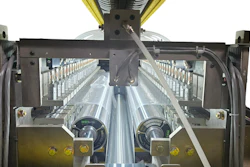
- The forming tube—in continuous direct contact with product—is the most demanding design challenge, requiring internal surfaces free of voids and crevices that can trap residue and resist cleaning.
- 3-A certification reduces biological, chemical, and physical hazards at the equipment level by preventing soil retention and microbial harborage, directly supporting processor HACCP compliance frameworks.
- For food processors, 3-A certified equipment streamlines bid specifications, accelerates FAT processes, and reduces time-to-production without requiring part-by-part compliance reviews.
When a food processor is qualifying a new packaging machine, the due diligence process is comprehensive: engineering drawings are reviewed part by part, hygienic design criteria are checked against internal specs, and auditors work through a machine component by component. For customers of Triangle Package Machinery Co., much of that is avoided as it is the only vertical form/fill/seal (V/F/F/S) manufacturer in the world to hold 3-A certification — specifically under the 3-A Sanitary Standard for Equipment for Packaging Non-Fluid Products (27-08). It’s a distinction the Chicago-based equipment maker first earned in 2010 and successfully defended through re-verification in 2022. But according to the people closest to it, the certification’s value runs deeper than a badge on a spec sheet.
“If we can extend the product zone requirements across the whole machine, it makes peace of mind easier for the customer,” said Kyle Wilson, director of engineering at Triangle.
What 3-A means
3-A Sanitary Standards, Inc. (3-A SSI) is a nonprofit organization whose certification program is built around rigorous, hands-on inspections, rather than paper audits.
“Equipment that carries the 3-A Symbol has been demonstrated to be in conformance with relevant 3-A Sanitary Standards,” said Eric H. Schweitzer, Director of Standards & Certifications, 3-A Sanitary Standards, Inc. “It has passed the rigorous 3-A SSI Third Party Verification inspection.”
That inspection is performed by a 3-A SSI Certified Conformance Evaluator (CCE) who physically examines the equipment: checking welds for pits or crevices, measuring surface roughness, verifying drainage geometry, and ensuring there are no dead ends or voids behind seals where pathogens could hide and resist sanitation. The program is closed by design, and a successful TPV (Third Party Verification) inspection is the only pathway to earning the 3-A Symbol.
How Triangle got there

Wilson said the process required meaningful changes to some equipment, but nothing that fundamentally rethought the machine’s architecture.
“It was about half and half,” he explained. “Most things that were modified only had finishing standards or joining techniques adjusted. The remaining parts received modified assembly instructions to use approved techniques, such as the application of silicone sealant.”
The tricky forming tube
To understand why full-machine 3-A certification matters—rather than certifying individual components in isolation—consider the forming tube.
In a V/F/F/S system, the forming tube is in continuous, direct contact with the product being packaged from the moment it enters the feed system until it’s sealed into a bag. For products like dry dairy powders, whey protein concentrates, or particulate foods, residue accumulation on interior surfaces over the course of a production run is a real and recurring challenge.
Schweitzer explained why the forming tube is one of the most demanding design challenges in a V/F/F/S machine. “Internal surfaces must be free of voids, crevices, and sharp corners that can trap product and resist cleaning. Drainage must be adequate. Surface finishes must meet the criteria that allow effective sanitation, whether CIP or COP. The geometry of the tube itself has to support cleanability, not just product flow.”
The 3-A TPV inspection evaluates the forming tube at that level of detail. Every component in the product zone is examined. “For a processor, knowing that the forming tube specifically has been evaluated as part of a complete system certification—not just the frame or external components—is meaningful,” Schweitzer says. “It means there are no unexamined product-contact points in the line.”
3-A as HACCP prerequisite
For food processors operating under HACCP plans and cGMPs, the implications of
Schweitzer draws a direct line between 3-A Standards and HACCP requirements. The 3-A Sanitary Standard for General Requirements (00-02) establishes equipment design prerequisites to ensure that product-contact surfaces are cleanable and inspectable. “By preventing soil retention, microbial harborage, and chemical residues through cleanable, drainable, and inspectable design, 3-A requirements reduce biological, chemical, and physical hazards at the equipment level,” he says.
In practical terms, that means the hygienic design of the packaging equipment isn’t just a supplier concern; it’s woven into the processor’s own hazard analysis. HACCP systems rely on the ability to verify hazard control effectiveness, and equipment that meets 3-A Standards provides the objective, verifiable criteria that those systems need to function.
The real-world payoff
Wilson is candid that 3-A certification hasn’t yet translated into a broad market differentiator, simply because awareness outside Triangle’s existing customer base remains limited. “I’m not sure it has helped us stand out from the competition yet as I don’t believe it is widely known,” he says.
But among the customers who do know, the operational benefits are concrete. The bid spec process moves faster. Sanitary requirement reviews are streamlined. FATs run more smoothly. “When everything is compliant, you don’t need to review part by part,” Wilson says.
For processors in regulated industries like dairy, pharmaceutical ingredients, or nutritional products, efficiency translates directly into faster time to production.
The certification also carries a forward-looking obligation. Triangle must apply for annual renewal, attest that no significant design changes have been made, and undergo a full re-verification TPV inspection every five years.
“Earning and maintaining a 3-A Symbol is, in and of itself, a demonstration of commitment to hygienic design,” said Schweitzer.
In a market where V/F/F/S manufacturers largely compete on throughput speeds, film compatibility, and footprint, Triangle’s 15-year commitment to 3-A certification represents a different kind of argument: one built not around what the machine can do, but around what its customers can trust about how it’s built.