Stewarts has leveraged 150 years of precision engineering expertise since 1874 to become a leader in perforation and packaging technology, combining vertical integration, customer collaboration, and advanced manufacturing capabilities.
- Founded in the UK in 1874 for textile pin technology, Stewarts pivoted to perforation and packaging when American textile manufacturing declined in the late 1990s
- Offers vertically integrated solutions including multiple perforation methods, embossing, and auxiliary equipment like slitters and rewind systems under one roof
- Uses application-driven product development with 3D modeling and simulations to validate designs before production, ensuring seamless customer integration
- Invests heavily in workforce development through apprenticeships and advisory roles at vocational schools, plus 100% employer-paid health insurance for team members
- Demonstrated responsiveness by redesigning equipment mid-project for American Custom Converting's sustainable paper mailer application, working overtime to meet urgent specifications
The next time you pull a paper mailer off your doorstep, hold it up to the light. If you look closely, you may notice something surprising: tiny, nearly invisible holes that allow the package to breathe just enough to seal cleanly at high production speeds without trapping air inside. The company behind those holes has been perfecting precision perforation technology since before most of today's packaging machinery builders existed.
 Stewarts
As American textile manufacturing expanded in the 1970s, Stewarts established operations in Simpsonville, South Carolina, then a hub of U.S. textile production. When that industry contracted in the late 1990s and shifted offshore, Stewarts made a strategic pivot: applying its deep expertise in precision pin manufacturing to new industries, including perforating, packaging and converting.
A vertically integrated advantage
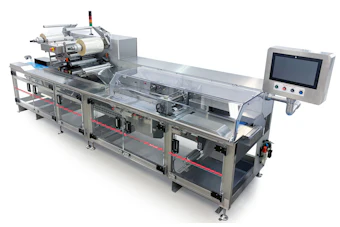
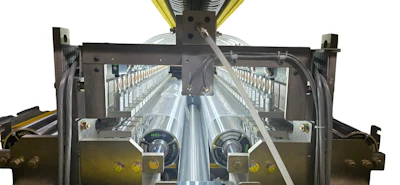
What distinguishes Stewarts of America from other suppliers in the perforation This unwinding unit, hot pin perforating unit and rewinding unit can be built from 100mm - 5000 mm working width.Stewarts
“This integration allows for tighter control of performance outcomes, faster development cycles, and the ability to tailor systems to highly specific customer requirements,” says Craig Jackson, Managing Director.
Product development at Stewarts is application-driven by design. Ideas originate from direct customer collaboration and long-term relationships. Once a need is identified, the engineering team evaluates solutions based on performance, manufacturability, and scalability. Often, 3D modeling and SolidWorks simulations are used to validate machine fitment within existing production lines before a single piece of steel is cut. Where applicable, systems can be virtually simulated prior to build, identifying integration issues early and ensuring seamless commissioning on installation.
As the packaging industry moves toward greater connectivity and data transparency, Stewarts is evolving alongside it. In more sophisticated machine platforms, the company has begun integrating enhanced data acquisition and communication capabilities within its controls software, positioning those systems for future connectivity with plant-level analytics. At the same time, it recognizes that a significant portion of its portfolio comprises auxiliary and bolt-on equipment, where simplicity and reliability take precedence.
“Our approach is to maintain a balanced strategy: Continuing to evolve toward greater connectivity in advanced systems while preserving the simplicity and durability our auxiliary equipment customers rely on,” says Jackson.
Joining the packaging community
 A typical perforating nip with a pinned roller against a brush anvil roller, with the material sandwiched between the two.Stewarts
The alignment extends to workforce development. Stewarts serves on the advisory boards of Greenville Technical College and the Golden Strip Career Center vocational school both located in Greenville, South Carolina, helping to shape programs that prepare the next generation of manufacturing talent. The company operates an apprenticeship program designed to bring promising candidates from those institutions directly into hands-on technical careers, pairing them with a seasoned team that includes retired engineers and machinists from major regional manufacturers.
That investment in people shows up in tangible ways. Stewarts is among the approximately 3% of South Carolina companies that provide 100% employer-paid health insurance, and it fully funds life insurance for every team member, benefits that Jackson views not as overhead, but as competitive tools for attracting and retaining the skilled talent a precision engineering operation requires.
When the spec changes mid-project
The real test of an equipment builder isn't just what they deliver; it's how they respond when things get complicated. For John Michaud, President of American Custom Converting (ACC), a recent project with Stewarts put that responsiveness to the test more than once.
ACC had identified an opportunity to perforate web materials for a sustainable flexible paper packaging product, the aforementioned paper mailer that millions of consumers now receive on their doorsteps, replacing traditional plastic. The application required precise micro-perforation: sufficient breathability to allow high-speed sealing without trapping air, yet tightly controlled enough to protect the contents.
The project began as an add-on: a perforation system to be integrated between A close-up of nipped material between a pinned micro-perforating roller and a brush roller.Stewarts
Then ACC's customer changed the specification.
Rather than treating the revision as a setback, Stewarts of America absorbed it. The machine was shipped back to Stewart’s facility in Simpsonville, where the team worked through the changes with an urgency that Michaud hadn't expected. "They worked overtime—guys came in off vacation, worked overnight—and within two or three days they shipped the machine back to us," he recalls. "They didn't even change the schedule."
The machine now runs extensible kraft paper at the speeds required by the major national retailer. Demand for the sustainable packaging product is so strong that supply of the specialty paper can't keep up; when material arrives, ACC runs it.
“They go above and beyond and are very easy to work with,” adds Michaud, calling Stewarts of America “a great company.”
Looking ahead
For Stewarts of America, the ACC project is emblematic of the model the company has carried forward through 150 years in business: solve a hard problem under pressure, build a relationship that extends beyond a single order, and apply foundational engineering expertise to whatever the market brings next. The company's growth strategy is measured and demand-driven, with ongoing investments in machining capability and digital infrastructure designed to expand output without compromising the precision that has defined the Stewarts name since 1874.
The technology has evolved considerably since the first precision pins were straightened and ground for the textile industry. The commitment to getting the application right, has not.