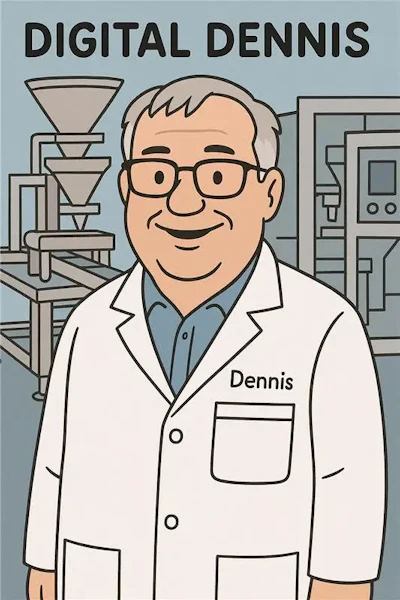
Digital Dennis is an AI-powered knowledge platform that captures and preserves tribal expertise by documenting machine setup procedures, troubleshooting insights, and service knowledge in a searchable system. Spee-Dee Packaging built it using existing tools like SharePoint and Power Apps to prevent valuable employee knowledge from disappearing.
- Core purpose: Preserve tribal knowledge from experienced employees through structured documentation and AI-powered search before expertise is lost
- Implementation approach: Uses SharePoint, Power Apps, and Copilot with voice recordings transcribed into searchable records covering 150+ machines
- Key use cases: Machine setup documentation, field service baseline tracking, service report searching, and automated service quoting estimates
- Adoption strategy: Integrated into existing workflows without forcing major process changes; different teams contribute to relevant sections
- Investment: Power App frontend developed in 2.5 weeks for under $15,000, demonstrating practical, cost-effective implementation
For many manufacturers, artificial intelligence still feels easier to talk about than to implement. The possibilities are wide-ranging, but the first step is often unclear. At Spee-Dee Packaging Machinery, that uncertainty did not lead to a sweeping AI strategy. It led to a much narrower question: how do you capture tribal knowledge before it disappears?
That question became the foundation for Digital Dennis, an internal knowledge platform that began as a way to document machine setup expertise, preserve application know-how, and make service insights easier to find. What started as a focused effort to keep valuable knowledge from living only in people’s heads has since grown into a broader, practical AI initiative touching tribal knowledge, troubleshooting, and service quoting.
Dave Navin, president and CEO of Spee-Dee, said the company did not begin by asking how to “do AI.” Instead, it focused on a business problem that had become increasingly hard to ignore. Years of machine information were spread across files, reports, and internal records, with much of the most valuable expertise still sitting with experienced employees. Finding the right answer often meant digging through folders, searching old service documents, or relying on someone’s memory.
“We were scared to death of [AI],” Navin said. “So, we just decided to do something simple.”
Starting with tribal knowledge
That simple starting point was tribal knowledge documentation. Navin described it as Spee-Dee’s first and most important goal. The company built Digital Dennis on SharePoint lists, added a Power App front end, and created a structured way to store machine records, setup settings, and product-specific details in a searchable format. Navin said the database now includes roughly 150 machines and continues to grow each week.
 Built on SharePoint lists and a Power App, Digital Dennis created a structured way to store machine records, setup settings, and product-specific details in a searchable format. Spee-Dee
In one example Navin shared, Dennis recorded guidance on filling five-pound bags of rice. That short recording produced a detailed setup guide covering critical setup items, preferred machine configurations, and cup-sizing philosophy—information that would otherwise have been difficult to capture in a consistent, reusable way.
“This is what he dictated in about 12 minutes,” Navin said. “It’s good information for the engineer to look up.”
That distinction matters. Digital Dennis was not built as an AI showcase. It was built as a documentation and retrieval system, with AI layered in to make the information easier to use. Navin put it plainly: “The goal right now was to document tribal knowledge, not to leverage AI. But AI is a great tool to leverage the tribal knowledge.”
Outcomes over tools
That mindset helped Spee-Dee avoid a common trap: chasing tools instead of outcomes. Rather than jumping between platforms, the company chose to work within Microsoft’s ecosystem, using tools it already had and trusted. “We did say we were going to stay with Copilot because it’s internal,” Navin said. “We’re looking at the outcomes we’re trying to get rather than the tool itself.”
The practical nature of the project also shaped how it was adopted internally. Spee-Dee did not try to force a major process change all at once. Instead, it began assigning different parts of the record to the people who already owned those workflows. Sales engineering enters basic order information. Machine builders log the details of product runs. Service technicians are beginning to use and contribute field information. Adoption is still evolving, but Navin said the value is becoming clearer as the volume of records grows.
“It’s difficult to get people to change the way they’ve done it,” he said. “But they see the value in it.”
Beyond the first use case
Once Spee-Dee had that entry point, the effort began to expand naturally. One application is in field service. The company uses the system to log baseline settings during factory acceptance testing, then compare those settings with what technicians find when they return to a machine months later. Over time, that creates a searchable record of what worked, what changed, and what settings performed best for a specific customer or product.
Another use case emerged in service support. Navin cited a member of the The database now includes roughly 150 machines and continues to grow weekly as employees add to the logs.Spee-Dee
Navin pointed to one example that highlighted the value. A search for a servo drive error code first returned a generic manufacturer explanation. But within the service reports, the system found a prior technician note identifying the issue as a cable shielding problem and recommending that the cable ends be regrounded.
“It took 35 seconds to find that answer,” Navin said.
Spee-Dee also extended AI into service quoting. The company now uses an app to estimate service trip costs based on variables such as time on site, travel origin and destination, and shift length, then checks travel sources to create more realistic customer estimates.
Just as important, the effort did not require a massive investment. Navin said the Power App front end was developed by a contractor in roughly two and a half weeks, with the total cost coming in under $15,000.
For other OEMs still trying to find their own way into AI, Spee-Dee’s path offers a useful reminder. The company did not begin with a moonshot or a machine-level AI strategy. It began with a simple operational need, used familiar tools, and was built around a practical first use case. Digital Dennis created that opening. From there, AI became less of an abstract technology conversation and more of a working system for preserving expertise, improving service response, and supporting better decisions.