Extended Producer Responsibility laws are shifting glass collection costs from governments to producers, creating incentives to improve material quality and collection systems that could reverse stagnant U.S. glass recycling rates currently stuck around 30%.
- U.S. glass recycling rates have stalled at approximately 30% of available material, with some states like Colorado historically achieving only 10-11% collection rates.
- Extended Producer Responsibility (EPR) laws shift financial responsibility for glass collection from governments to producers, incentivizing quality improvements and higher recovery rates.
- Material Recycling Facilities (MRFs) struggle with non-glass residue (NGR) contamination—small plastics, metals, and paper mixed into glass streams—which increases processing costs and reduces recycled content levels.
- Recycled glass reduces energy usage by lowering dependence on virgin raw materials like sand, soda ash, and limestone, making quality collection economically and environmentally valuable.
- Industry collaboration to separate recoverable small-format packaging from glass streams presents an opportunity to improve material quality and unlock new end markets.
Glass recycling in the U.S. has stalled at roughly 30% of available material. But new Extended Producer Responsibility (EPR) laws, higher recycled-content targets, and investments in glass processing are changing the conversation.
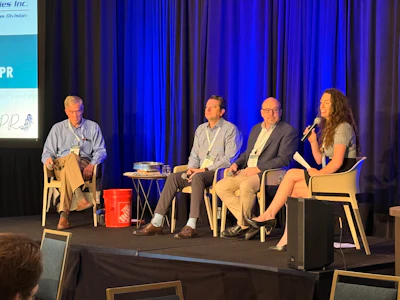
During a panel at the Plastics Recycling Conference in San Diego this week, industry leaders explained how policy shifts, cleaner MRF glass, and tighter collaboration are shaping the future of glass recovery in the U.S. and moving more furnace-ready glass back into production.
For Scott DeFife, President of Glass Packaging Institute (GPI), EPR looked like an opportunity for investment. He said it changed the status quo by shifting the responsibility of paying for glass collection from governments to producers.
“We saw EPR as an opportunity to work on quality and improvement of the material streams,” DeFife said. “I hope that it would lead to upwards movement in the recovery rate, and then the recycling rate for glass.”
Robert Hippert, Sustainability Strategy Leader—Manufacturing, OI Glass, said Oregon already has a robust bottle bill deposit program capturing a majority of glass beverage containers, while some glass containers such as food jars return through curbside collection and the EPR system.
However, Colorado’s glass collection has historically been about 10% to 11%, with about 90% going to landfill. As Colorado rolls out its EPR laws, many stakeholders are looking to the state to prove successful glass collection is possible, Hippert said.
Better collection and investment in glass processing is essential.
“This material is very important because it helps us reduce our gas usage,” Hippert said. “It helps reduce our dependence on virgin raw materials like sand, soda ash, and limestone.”
When it comes to current collection processes, MRFs rely on mechanical screening by size, with glass falling into the smallest fraction alongside other small materials. According to Dan Domonoske, Executive Vice President at Potential Industries, glass beneficiators are seeking material with fewer contaminants, or “non-glass residue” (NGR).
The quality of glass coming out of MRFs affects processing costs, yield, recycled content levels, and energy savings. Under EPR, shifting financial responsibility to producers creates an opportunity to improve material quality and system performance, which panelists said could help move recovery and recycling rates upward
These NGRs often include small-format materials—small plastics, metals, and paper—that end up in the glass fractions at MRFs. According to DeFife, small-format packaging is considered non-recoverable in California and often appears on a “do not recycle” list.
Collaboration can be the key to help recover some of these materials. DeFife points out that companies that purposely have small packaging are looking for a path of recovery and those materials are in the glass stream.
“There is an opportunity to recover the small material that is not glass and get that to end markets for studying volumes, studying composition, giving it over to end markets who may be able to do something with it,” DeFife said.