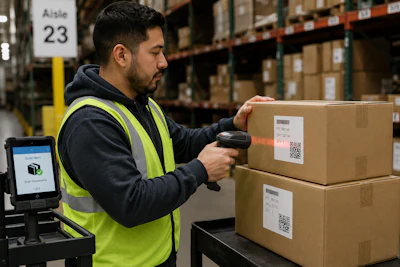
New research commissioned by GS1 US and conducted by VDC Research shows that organizations implementing two-dimensional (2D) barcodes in warehouse and distribution environments can reduce operational costs by more than 60%, representing annual savings of more than $500,000 per facility. The report, “Advancing Intelligent Data Capture in Modern Logistics Operations,” provides data-driven benchmarks and modeled projections comparing traditional one-dimensional (1D) barcodes with 2D barcode workflows, which during the research resulted in fewer scan failures, a reduced need for relabeling and lower shipment error rates among mid- to large-scale distribution centers.
To help companies evaluate the potential return-on-investment by transitioning from 1D to 2D barcodes within their own operations, GS1 US is introducing an interactive online cost-benefit calculator. The tool allows users to input operational variables – including labor costs, scan volumes, and error rates – to estimate the financial benefit.
“Organizations are recognizing that 2D barcodes address long-standing scanning inefficiencies associated with traditional 1D barcodes, unlocking measurable improvements in speed, accuracy, and operational cost savings while also enabling richer product transparency,” says Gena Morgan, vice president, Global Standards, GS1 US. “As this research shows, these efficiencies create a more reliable data foundation that supports better inventory management, traceability, and supply chain visibility as the industry continues to move toward more connected, data-driven operations.”
The research highlights persistent challenges with 1D barcodes, including readability issues, inconsistent labeling, and limited ability to capture attribute-level data – often leading to manual workarounds and reduced visibility in inventory and fulfillment processes.
Organizations relying primarily on 1D barcodes report a 7% first-pass scan failure rate and a 1.5% relabeling rate, increasing labor time, operation disruptions and shipment errors. VDC estimates that facilities operating with 1D barcode workflows can incur more than $800,000 annually due to cost drivers such as shipment errors and labor from rescanning and relabeling.
In contrast, a 2D barcode – such as a GS1 DataMatrix or a QR code powered by GS1 Standards – can encode product identification and key attributes, including lot number, expiration date and serial number, within a single machine-readable symbol. This enables more accurate and consistent data capture across supply chain operations while overcoming the data limitations of traditional 1D barcodes.
Industry initiatives such as Sunrise 2027 are accelerating adoption by advancing acceptance of 2D barcodes at retail point-of-sale. While consumers will gain access to richer product information, organizations are also increasingly focused on back-end benefits, including improved inventory management, traceability, fulfillment, and data synchronization across supply chain systems.
The research is based on a survey of 400 U.S.-based organizations and in-depth interviews with supply chain leaders across retail, manufacturing, logistics and healthcare sectors. To access the report, “Advancing Intelligent Data Capture in Modern Logistics Operations” and explore the ROI calculator, visit www.gs1us.org/2D-ROI.