Industrial automation projects fail when design flaws aren't caught before installation, but simulation, digital twins, and virtual commissioning—now made more accessible by AI—allow engineers to test and refine systems digitally first, ensuring automation works correctly on day one without costly rework.
- Root cause of failures: Automation projects miss requirements, miscalculate reach and cycle times, and underestimate real-world input variations that photos and spec sheets don't capture.
- Three-step solution: Simulation predicts behavior using digital models, digital twins create realistic models calibrated to actual hardware, and virtual commissioning runs real robot controls and PLC code against the twin before deployment.
- AI breakthrough: AI agents using Model Context Protocol (MCP) can now automate rigging work that previously required extensive manual configuration or specialized video game engineers.
- Real-world results: Companies using virtual commissioning achieved first-day success on complex systems like eight-zone vacuum pickers and custom palletizers with tight reach margins.
- Cost reality: The expense of simulation and digital twinning continues to drop while the cost of skipping these steps—rework, downtime, lost ROI—keeps rising.
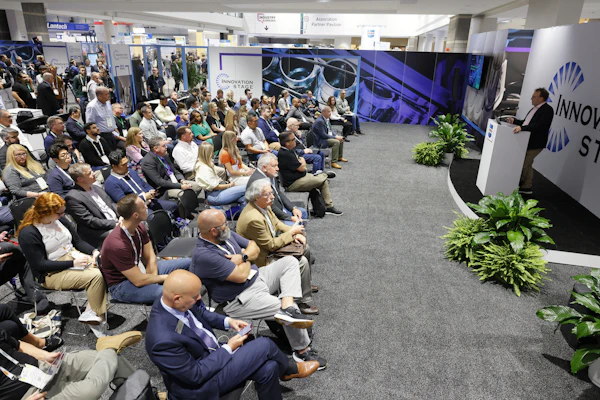
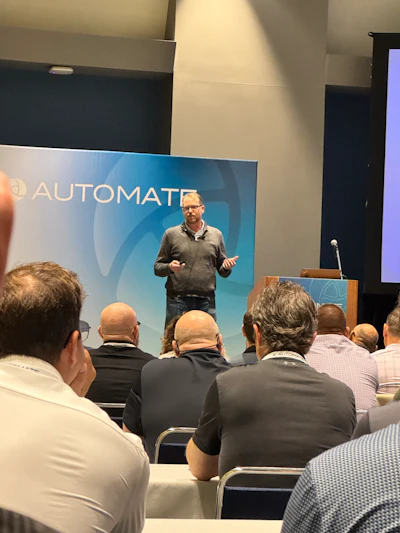
For OEMs and end users, an automation project that limps across the finish line still counts as a failure if rework, retooling, and downtime have erased the ROI. That was the framing Brendan Sterne, chief product officer at Vention, used in his address at Automate in Chicago, and it's why Sterne is pushing the industry toward simulation, digital twins, and virtual commissioning as the standard first step.
Why automation projects miss the mark
Sterne pointed to a familiar set of culprits behind projects that have to be re-engineered after install. Humans, he noted, are “amazing” at quietly fixing the inputs automation depends on—a twisted box, a misaligned flap, a part that drifted on the conveyor. “Automation frequently requires cleaner inputs if you want to be successful,” he said. That's why Vention's application engineers routinely ask customers for video of the process being automated. Photos and spec sheets miss the small, occasional anomalies that ultimately tank cycle times or cause faults.
Late or missed requirements are another perennial issue, as are robot reach and cycle-time miscalculations that look fine on paper but break down once a cell is built. “What you don't want to do is design something on paper, commission it, and then find out any of these things are problematic,” Sterne said.
Simulation, digital twin, virtual commissioning
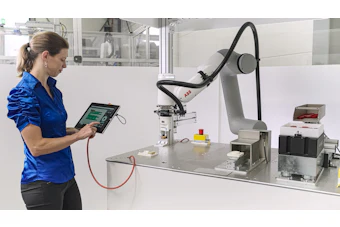
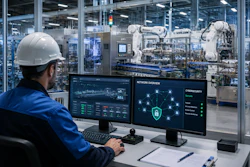
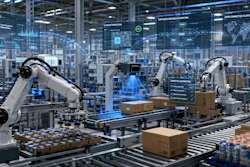
Sterne walked through three commonly conflated terms. A simulation uses a digital model to predict the behavior of a machine or process — usually at the level of rigid-body physics for industrial automation. A digital twin is a model realistic enough that simulations done on it apply to the real cell, often calibrated against scans or touch-offs of the assembled hardware. Virtual commissioning adds another layer: running the actual robot controls and PLC code against the digital twin, so the same code that proves out in sim is what runs on the line.
The catch is that rigging a simulation has historically been expensive and slow. Designing a cell in SolidWorks gives you geometry and a bill of materials, but not the degrees of freedom, sensor behaviors, gripper dynamics, friction, or inertia that a simulation needs. Sterne pointed to a 25-minute YouTube tutorial on rigging a single linear actuator as evidence of the learning curve. Some integrators, he noted, have hired video game engineers to handle rigging work, since the skill sets overlap.
AI starts to close the gap
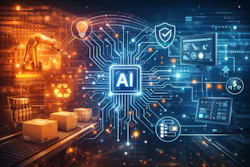
The breakthrough, Sterne argued, is AI — both as copilots embedded inside tools like Siemens NX and ABB RobotStudio, and as agents working outside the tools through a new interoperability standard called Model Context Protocol (MCP). With an MCP server, an external AI agent can read an RFQ, ingest custom actuator specs, and drive the simulation tool to do the rigging work.
Sterne shared a demo: with no prior experience in RealVirtual IO, he connected Anthropic's Claude through MCP, imported a custom conveyor, and asked the AI to rig the motion. Claude instantiated the transport surfaces and dependent objects with their properties — work that would otherwise require studying the tool's proprietary terminology. In another example, RoboDK didn't yet have an MCP server, so Claude wrote one in about 10 minutes and used it to rig the cell.
“I think AI is going to make digital twins and simulation a lot more accessible,” he said.
Real-world payoff
Sterne walked through several Vention deployments where virtual commissioning paid off: an eight-zone vacuum pick-and-place for a beverage pasteurizing operation that worked on the first day of on-site calibration; a custom bucket palletizer with tight reach margins that ran in production after a one-day commissioning in Texas; and a space-industry application that started as a robot and pivoted to a gantry once digital iteration revealed it was the better fit. In each case, the rework occurred in the digital twin rather than on the floor.
The takeaway
Whether the project lands in a Vention cell, a Fanuc cell, or anywhere else, Sterne argued the underlying lesson is the same: the cost of simulation, digital twinning, and virtual commissioning is dropping fast, and the cost of skipping those steps isn't. The OEMs and end users who get there first will be the ones whose automation works the day it's plugged in.