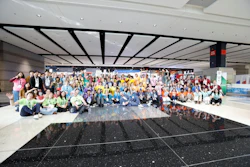
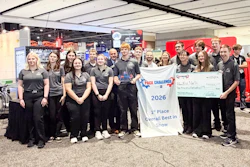
Now in its ninth year, the PMMI On the Rise Awards recognize young packaging and processing professionals who demonstrate exemplary leadership at PMMI member companies. In keeping with tradition, winners who could attend were flown to PMMI’s Annual Meeting in Montreal, Quebec, where they were unveiled during the Chairperson’s Dinner.
As you’ll read, this year’s diverse array provides a fresh, forward-thinking perspective on the industry. OEM Magazine was fortunate to speak with each one and offer a glimpse into these outstanding rising stars in the industry.
Building a department while learning to lead at Huapaq
Diana Castro has built a logistics and import operation from scratch and cut customs clearance times from two weeks to two days.
Diana Castro remembers the moment she saw the job posting at Huapaq with unusual clarity. "From the moment I saw it, I thought, 'I want to work there. That job is for me,'" she recalls. That instinct proved correct, though the career that followed looked nothing like what she might have planned. Castro joined the company in 2022 in an administrative role, and through curiosity and proximity to the technical side of the business, gradually found herself drawn deeper into projects, machinery, and eventually After Sales. The packaging industry, she says, wasn't a destination she had mapped out. She discovered it by moving toward what interested her.
The work she has done since has been anything but incidental. As After Sales Manager, Castro built Huapaq's logistics and import department from the ground up, developing partnerships with logistics providers, engineering more efficient customs processes, and reducing import costs by 15%. The most concrete measure of that work: Huapaq can now clear machinery imports in two to three days. End users and competitors typically wait up to two weeks. That gap didn't exist when she started. She created it.
The path to success required Castro to develop expertise she didn't have. When import operations expanded and the company needed someone to manage the process, the decision was made to build that capability internally rather than hire from outside.
"Little by little, I made the process more efficient," she says. A similar evolution happened with spare parts. She took it upon herself to develop an inventory analysis that clarified what quantities the company needed, reduced import-related costs, and improved planning in ways that also drove sales growth.
Alongside that operational learning came the more personal challenge of leading a team of electromechanical technicians as an Industrial and Systems Engineer. Castro's background gave her strong tools for process analysis and operational thinking, but it didn't include hands-on repair experience. Early on, that gap created uncertainty.
"At first, I felt somewhat insecure about leading people with extensive hands-on experience and highly specialized technical knowledge," she says.
Her perspective shifted when she reframed what her role actually required. Her job wasn't to repair machines, but to make sure they had the organization, tools, information, and support they needed to do their jobs. That clarity led her to engage more directly with the team by listening, asking questions, learning from their technical expertise, and establishing clearer processes. "There was no specific moment when everything changed; it was a constant adaptation on both sides," she says.
It's a philosophy she now carries into how she thinks about leadership more broadly. "A leader does not have to know everything," she says. "I have learned that it is also important to listen, ask questions, and surround yourself with people who have different knowledge and experiences." The willingness to adapt—to let the way you lead evolve as teams and circumstances change—is, in her view, what separates leaders who sustain momentum from those who stall.
Castro's proudest accomplishment isn't a single project but the arc of the department itself. "After Sales has evolved with me, and I have evolved with it," she says. "I feel much more confident in my ability to make decisions and lead, while also knowing that I still have a lot to learn. I think that is one of the things I value most about my journey so far."
Looking ahead, she has her eye on AI's role in manufacturing—specifically how machine data and production patterns could enable predictive maintenance, reduce downtime, and minimize waste before problems occur. "I imagine a future where a machine could learn from production and maintenance patterns, identify unusual behavior, anticipate the wear of certain components, and help make decisions before a failure occurs," she says.
Her longer-term ambition is to one day become a General Manager so she can understand the business completely and develop the leaders who will grow it. For now, she's focused on the next challenge at Huapaq, whatever form it takes.
Where IT meets the plant floor at Sneed Coding Solutions
Samuel Cediel traded airport infrastructure for packaging machinery—and discovered that the skills he built managing networks translate directly to keeping production lines running.
Some career pivots are calculated. Samuel Cediel's was driven by something simpler: the feeling that he hadn't yet found the room where his technical abilities could be fully tested. Working as an IT technician managing infrastructure for food concession companies at an airport, Cediel recognized a ceiling.
"I was eager to transition into a role that was more heavily focused on complex technical challenges," he says.
What Cediel found as CX Specialist & L2 Technician at Sneed Coding Solutions was a challenge bigger than he anticipated—and exactly what he was looking for. Adapting traditional IT support skills to the physical world of packaging and processing equipment required him to fundamentally rethink how he diagnosed and solved problems. High-stakes moments, like a customer facing critical downtime on a production line, demanded a composure and creative methodology that no airport IT role could have prepared him for. His solution was rooted not in technical shortcuts but in mindset.
"I rely on patience, empathy, and stepping back to look at problems from a different perspective rather than just following conventional diagnostic methods," he says.
That philosophy has become his professional signature. What fascinates Cediel most about his work is the intersection he now occupies: traditional mechanical equipment increasingly running on modern IT networks. As packaging machinery becomes more connected, his ability to apply IT and networking knowledge on the plant floor has become a genuine differentiator for his customers, his colleagues, and Sneed Coding Solutions as a whole.
The clearest demonstration of that value came during one of the highest-pressure moments of his career. A customer experiencing intermittent failures with automated case erectors was within their 30-day return window and ready to send the equipment back. Cediel stayed on-site, set aside conventional diagnostics, and worked systematically to find the root cause. He identified the issue and fixed it permanently.
"It prevented a costly return and turned a potentially failed installation into a long-term success story for Sneed Coding Solutions," he says.
Beyond his work with customers, Cediel has invested equally in the people around him. He mentors newly hired technicians, serves as a resource for colleagues navigating difficult service calls, and has worked to build out an internal Knowledge Base designed to help the entire team work more efficiently.
"Leadership isn't always about having a formal title," he says. "It's about sharing your knowledge, stepping up to help your team, and building trust with customers."
His commitment to continuous growth extends to the classroom. Cediel is currently balancing full-time work with an academic program that aligns with where he sees the industry heading, pursuing his bachelor’s degree in cybersecurity and information assurance at Western Governors University. The convergence of operational technology (OT) and information technology (IT) security is a trend he's watching closely, convinced that as smart manufacturing and IoT integration expand across packaging machinery, the need for professionals who can fluently navigate both worlds will only intensify.
"As industrial networks and smart manufacturing technologies continue to grow, I want to blend my hands-on packaging equipment experience with advanced cybersecurity knowledge," he says. "My goal is to lead the charge in securing and supporting the next generation of connected processing equipment."
For other emerging professionals, his advice is both practical and principled: "Never underestimate the power of patience, empathy, and a calm approach to problem-solving. Also, never stop learning. The industry is always evolving, and investing time in your own education and continuous improvement will always pay off."
Writing the code that runs the shop floor at Morrison
Ryan Frederick came to Morrison Container Handling Solutions as an IT Programmer and spent his first year building the tools, integrations, and automated workflows that now touch every corner of the business.
Morrison Container Handling Solutions was ok with Ryan Frederick not knowing the ins and outs of the packaging industry when they hired him. Instead, they needed someone who could look at how a manufacturing business actually operates and build technology that makes it run better.
"I had a lot to learn about the packaging industry when I started," he says. "But working closely with people throughout the company helped me understand both the equipment we build and the processes behind it."
That combination—industry knowledge earned through relationships, applied through software—has defined his first year at Morrison in ways that reach well beyond a single project.
The most visible example is the OrderQueue Web App, a production TypeScript/Node.js application that didn't exist in any mature form when Frederick arrived. He built and deployed it: Redis-backed sessions, a containerized setup on Azure, and a clean promotion from staging to production. It now runs as a daily tool for manufacturing and scheduling teams, surfacing live production percentage breakdowns, supporting endpoint visibility, and providing shop-floor quick links. It's the kind of capability expansion that typically requires a team. Frederick delivered it almost entirely himself.
He also built the integration that connects Morrison's HubSpot CRM to its internal sales hub—syncing OEM and Retail data automatically across systems that previously didn't speak to each other. The result: manual reconciliation eliminated, cleaner data for the sales side, and a cross-departmental contribution that moves the business forward rather than simply maintaining it.
What ties those projects together is a philosophy Frederick developed through hard-won experience. Early in his career, he defaulted to what many programmers do: focus on the technical elegance of the solution. The larger challenge, he discovered, was building something the right people would actually use.
"A solution can be technically impressive, but if it doesn't solve the right problem or makes someone's job more difficult, it isn't really a good solution," he says.
The adjustment required more listening, more time spent understanding why a process exists before deciding whether to change it, and more investment in relationships outside his own department.
That same curiosity shapes how he approaches his own development. Frederick proactively submitted an Individual Development Plan outlining a path toward Senior Programmer, with a focused skill-building program in front-end development depth and project management fundamentals. He's incorporated AI development tools into his workflow to accelerate output and treat each new build as reusable learning.
For other emerging professionals, his advice cuts through the noise: "Don't limit yourself to what is written in your job description," he says. "Be curious about how other parts of the business work and look for problems you can help solve. Some of the best opportunities I've had come from seeing something that could be improved and taking the initiative to work on it."
Looking ahead, Frederick is focused on growing beyond software development into something more strategic, identifying where technology will have the greatest impact on the organization and turning those opportunities into practical solutions. He's watching AI and automation closely, but with a specific lens. "I'm interested in how AI can make company knowledge easier to access, reduce repetitive administrative work, and help employees make better decisions," he says. "The companies that can turn data into useful, actionable information will have a significant advantage."
Rebuilding Septimatech's marketing engine
Jonathan Hodge has doubled website traffic, tripled monthly leads, and transformed how Septimatech converts trade show floors into sales pipelines.
Jonathan Hodge grew up watching the television documentary show How It's Made. The details of manufacturing—how things come together and what happens behind the products people use every day—held a fascination he never quite shook. So, when a job search coming out of the pandemic led him to a marketing posting at Septimatech Group Inc., something clicked.
"I was fascinated by this corner of the manufacturing world and became even more interested as I learned about it during the interview process," he recalls. When the job offer came, he didn’t hesitate and accepted it the same day.
What followed has been a methodical reimagining of how Septimatech markets itself. With Hodge’s steady hand, it has been rebuilt on clear objectives, cross-functional coordination, and a commitment to measuring what actually matters.
The most visible expression of that work is Septimatech's website relaunch. Hodge led the initiative end-to-end, coordinating internal teams across Engineering, Sales, and Finance alongside external developers and creative partners. Before launch, he set performance benchmarks for traffic, lead generation, and revenue attribution, projecting when the new site would outperform its predecessor. After one year, those projections held as website traffic doubled, monthly leads increased 130%, and website-attributed revenue grew 30%. The platform was also designed with forward flexibility in mind, built to incorporate emerging technologies and AI capabilities as they become practical.
He applied the same rigor to Septimatech's trade show presence. When Hodge joined the company, PACK EXPO represented a significant investment, with room to improve how that investment converted into the sales pipeline. He overhauled the logistics of how displays are shipped and deployed, cutting setup and teardown time and freeing the team to spend more time in front of customers. He redesigned how leads are captured, classified, and distributed by implementing an AI-powered process that feeds prospects directly into the CRM and enables same-day follow-up and meeting scheduling. Both PACK EXPO Las Vegas and PACK EXPO International have since posted year-over-year growth in lead volume and conversion rates.
Behind the results is a marketing philosophy grounded in organizational curiosity. Hodge's role is in marketing, but he argues that effective marketing requires understanding how salespeople qualify opportunities, what information engineering teams need to evaluate a deal, and what challenges customers are trying to solve.
"Learning how your colleagues work helps you ask better questions, respect their responsibilities, and see how different decisions affect the organization more broadly," he says. "Leadership begins when you look beyond your daily tasks and start thinking strategically about how the entire business succeeds."
That orientation shows up in how he spends his development time. Hodge has attended every PACK EXPO since his hire, participates actively in PMMI Young Professionals events and regional dinners, and is a member of PMMI's MAX Marketing Group. He has completed training in Microsoft AI productivity tools, Dynamics 365, and Power Platform. More importantly, he consistently brings what he learns back into Septimatech's processes rather than treating certifications as personal trophies.
One initiative that reflects his approach particularly well is Septimatech's early investment in answer engine optimization, positioning the company's content for AI-powered research and purchasing platforms before most competitors recognized the shift was coming. But he also recognizes human oversight is needed.
“AI is changing how we can create and organize information, but it is also massively increasing the importance of accurate, relevant, and personalized technical content,” he says. “The human element has never been more important.”
For other emerging professionals, his advice is disarmingly practical: admit what you don't know, learn from people who do, and expand your line of sight beyond your own job description. "Asking thoughtful questions and learning from others is not a weakness," he says. "It is one of the fastest ways to grow."
Looking ahead, Hodge is focused on experiential marketing and finding ways to turn ideas into programs that create tangible value, for Septimatech and for the customers it serves. The packaging industry, he discovered by accident. The career he's building within it is anything but.
From field technician to service architect at PAC Machinery
Since joining, RaeDon Lee has transitioned from the technician who solves every problem to the leader who builds the team and systems that prevent problems from recurring.
When RaeDon Lee joined PAC Machinery as a Field Service Technician in 2021, he independently studied machine functionality, troubleshooting methods, and customer applications, going beyond what formal onboarding covered until he became one of the company's leading technical experts. Response times improved, customer downtime dropped, and sales and support teams grew more confident. The results were hard to miss.
But the move that defines his trajectory wasn't a technical achievement. It was a shift in orientation.
"I started out focused on solving the problem in front of me," Lee says. "Over time, my focus shifted toward building the people, processes, and systems that prevent the same problems from happening again."
That shift earned him a promotion to Product Support Manager in 2023, where he now leads PAC Machinery's Aftermarket team: overseeing service, technical support, and preventive maintenance initiatives for a growing installed base. Under his direction, the team has built proactive maintenance programs that improve equipment reliability, extend machine lifespan, and reduce unplanned downtime. The commercial results have followed with stronger customer retention, higher consumables revenue, and relationships built on consistent follow-through rather than reactive problem-solving.
He has also become the organization's primary trainer for new technicians, assemblers, and technicians at distributor partners worldwide. His ability to make complex technical concepts approachable has accelerated how quickly new team members become productive and extended PAC Machinery's service quality well beyond its internal headcount.
The leadership challenge that has tested him most, Lee says, is one familiar to anyone who rises through technical ranks. "When you know how to solve a problem yourself, it can be tempting to simply handle everything," he says. "But that does not build a strong team or a scalable organization." He has learned to create space for his team to think, troubleshoot, and develop confidence, while staying close enough to support them when it matters.
He has also learned to look past the surface of technical problems. "Some of the hardest technical problems are not purely technical," he says. "Communication, documentation, ownership, training, and cross-functional alignment can determine whether a problem gets solved once or continues to happen." That systems-level thinking now shapes how he approaches every issue that comes his way.
For other emerging leaders, Lee's advice cuts through the noise: don't chase the title before you've developed the person capable of carrying it. "Learn as much as you can outside of your immediate job description,” he says. “Understand what the technicians see, what the customer experiences, what engineering needs, what operations is dealing with, and what the business is ultimately trying to accomplish. Leadership is building a team that becomes more capable because you were there."
Lee's proudest moments aren't machine repairs or individual wins—they're the technicians who no longer need to escalate, the processes that prevent failures before they reach the field, the service organization that looks different than it did when he arrived. Winning the PMMI On the Rise Award this year carries particular weight as he was nominated for three consecutive years before receiving the recognition. "Winning it this year feels like recognition not only of what I have accomplished, but also of the direction I am heading," he says.
That direction points toward a bigger stage. Lee envisions service having a stronger strategic voice within manufacturing organizations, one that feeds what technicians and customers experience in the field back into engineering, product development, training, and sales expectations. "The customer experience does not end when the machine ships," he says. "In many ways, that is where it begins."
Family legacy leads to sales leadership at BW Packaging
Joe Leonard's path into the packaging industry began with a family connection and has since taken him through engineering, marketing, and product line leadership, culminating in rebuilding a sales team.
Joe Leonard, Director of Sales at Barry-Wehmiller Packaging, didn’t need to “discover” the packaging industry. His uncle spent nearly 40 years at Barry-Wehmiller Packaging, and an early exposure to what the company's automation equipment could accomplish at high speed left a lasting impression.
"I was immediately hooked," Leonard says.
That fascination turned into an engineering internship with the organization, which turned into a full-time marketing role after college, which turned into something neither a job posting nor a family connection could have predicted: a career defined by learning how to lead.
Leonard's rise through Barry-Wehmiller has been deliberate and cross-functional. He earned his footing as an individual contributor, sought out training across multiple product lines, and leaned heavily on experienced colleagues to build the subject-matter foundation that technical credibility requires. The pivotal chapter came during his time as Product Line Leader for the company's Converting product line. In this role, he was forced to develop a leadership style rooted in influence rather than authority. "Continually learning through experiences while building trust with team members across the organization was critically important," he says.
That foundation was put to the test when Leonard took on the challenge of rebuilding Barry-Wehmiller Packaging's North American Bag Filling & Palletizing sales team. The results have been hard to argue with: greater than 25% pipeline growth in the first nine months, with momentum to surpass the prior year's sales results inside that same window. The achievement reflects both his individual drive and his commitment to extending success across a team.
"It was incredibly rewarding to achieve sales targets as an individual contributor," he says, "and having the opportunity to extend that to my team to help them achieve their sales targets and career goals has taken things to the next level."
The work itself keeps him engaged in ways that a purely transactional sales role never could. Every customer brings a different configuration of challenges, and Leonard finds genuine energy in developing solutions tailored to complex needs. That problem-solving orientation, combined with an investment in his team's personal and professional development, shapes how he shows up every day.
Leonard has sharpened his approach through structured development as well, completing Barry-Wehmiller's Top Gun Sales Training and the company's Communication and Culture program, both of which have informed how he leads and coaches the people around him. His advice for other emerging professionals reflects the same philosophy that has guided his own path: "Stay hungry, continually pursue new challenges, and find a mentor or two. Learning from those that have gone before you can be a great way to shorten the learning curve."
Looking ahead, Leonard is watching two trends with particular attention: automation and sustainability. As customers demand smarter, more flexible equipment, he sees the two forces converging rather than competing. "We need to make sure that sustainable materials can run effectively on our equipment without sacrificing performance," he says.
From the machine shop to operations leadership at Norwalt
Matt Seitel started as a machinist fifteen years ago, worked his way through every department in the building, and has since built a lean manufacturing operation, launched a facility from an empty warehouse, and designed a global purchasing system.
Matt Seitel didn’t come up through a management track. He came up through the shop. Fifteen years ago, he joined Norwalt Automation Group as a machinist and spent the years that followed moving through assembly, engineering, purchasing, and plant management—accumulating the kind of cross-functional perspective that can’t be taught in a classroom. What kept pulling him forward was the nature of the work itself. “What intrigued me the most was the focus on taking on the design and building of machinery that was a level of complexity no one wanted to touch,” he says. “That made the job exciting every single day.”
As Operations Director, Seitel now oversees operations across all Norwalt Automation Group locations—and the scope of what he has built in that role reflects the ambitions of someone who has seen the business from every angle.
His implementation of S5 lean manufacturing principles across Norwalt’s facilities, with particular impact at the Florida location, produced the kind of results that take years of disciplined effort: improved throughput, reduced downtime, and a measurably more organized shop floor. The work wasn’t a single initiative—it was a sustained transformation driven by process rigor, waste elimination, and the patience to bring teams along through genuine culture change rather than mandate.
His most technically audacious achievement is a fully automated bulk purchasing system he designed for non-commercial components sourced from suppliers around the world. The system independently monitors inventory levels, triggers purchase orders, manages international supplier relationships, and ensures parts availability—with zero manual intervention required. No one places an order. The system does it, continuously, at scale. The cost savings have been significant: reduced procurement overhead and smarter bulk buying have lowered component costs in ways that compound over time. It’s the kind of operational thinking most companies discuss and few attempt. Seitel delivered it.
He also leads project management for some of Norwalt’s most demanding clients—Fortune 500 pharmaceutical companies where on-time delivery, documentation quality, and regulatory-level reporting carry real consequences for drug production. His most recent engagement involved a large-scale drug assembly system managed from inception through delivery, with zero missed milestones. The client’s senior manufacturing engineers offered exemplary feedback, citing his communication, precision, and professionalism throughout. Managing capital equipment projects at that level requires strict change control, meticulous documentation, and the composure to operate under scrutiny without losing forward momentum.
That composure was forged in a harder crucible. When Seitel was handed responsibility for launching Norwalt’s Tampa facility, he walked into an empty warehouse with a single employee and the full weight of building something from nothing. “Day one, I remember walking into an empty warehouse with only one worker hired,” he recalls. “Learning to grow a facility where everyone also needed to be trained from scratch was challenging.” He worked 80 to 90 hours a week that first year, with a philosophy that guided him through the inevitable mistakes: work through your backup plans before you leave, no matter how long it takes. The facility stands today as his proudest professional accomplishment.
The lesson he took from that experience shapes how he leads now. “Growing the culture by growing the people” is how he frames it. “If you do not have the right people and if the people working for you are not happy, you’ll never succeed.” His advice to other emerging leaders follows the same logic: learn to engage with each person differently, recognize their individual strengths and weaknesses, and focus on what you can do to help them succeed in their role.
The work that excites him most remains the same as it always has: problems no one has solved before. “We are working on projects no one has ever done before,” he says, “and some we have patented—others have thought we were crazy for coming up with.” For Seitel, that’s not a warning. It’s the point.
Computer vision to collaborative robotics at FANUC America
Haochun Yu joined FANUC America's R&D team fresh out of college with a background in computer vision and quickly found himself at the leading edge of palletizing automation.
A May 2023 computer science graduate with a focus on computer vision, Haochun Yu joined FANUC America's R&D team as a Research and Development Engineer expecting one kind of technical challenge and found another entirely: an assignment to develop a new feature for FANUC PalletTool, the company's palletizing software platform. That pivot—encouraged by his former manager, Dr. Ganesh Kalbavi, who urged him not to limit himself too early—became the defining turn of his career.
"His advice led me to take on opportunities in palletizing and packaging automation," Yu says, "ultimately introducing me to an industry that I now find both technically challenging and highly rewarding."
The learning curve was steep. FANUC PalletTool is built on FANUC Teach Pendant Program and KAREL, proprietary programming languages Yu had never encountered. Beyond the languages, he had to absorb the fundamentals of robot operation, palletizing applications, and robotic work cell integration—simultaneously. His approach was methodical: dedicated study, hands-on validation work, and a deliberate effort to learn from the experienced engineers around him. "I proactively sought opportunities to perform validation work and resolve smaller software issues, which helped me gain a deeper understanding of the development lifecycle," he says.
That foundation paid off. As a contributor to FANUC PalletTool 3—released in 2024—Yu grew from someone learning the codebase to leading the development of one of the platform's most technically ambitious features: Automatic Payload Setting.
The problem the feature addresses has frustrated collaborative robot palletizing deployments for years. Accurately determining the weight of boxes during operation typically requires complex customer programming and manual configuration. Yu's solution leverages the built-in force sensing technology of FANUC CRX collaborative robots to automatically identify each box's payload during palletizing—without additional hardware, without increasing cycle time, and without requiring customers to program it themselves. The practical result is that PalletTool 3 can now support multi-case palletizing, handling boxes of varying weights with no manual payload setup. "This capability increases operational flexibility, simplifies system deployment, and improves overall productivity," Yu says.
Seeing that feature move from concept to customer factory floor is what he finds most rewarding about the work. Trade shows like PACK EXPO offer a particular window into that journey. "It is exciting to watch customers interact with a feature for the first time and see how it can address their operational needs," he says.
Yu credits FANUC's collaborative culture—and its global reach—as central to what makes the work possible. Engineers are encouraged to propose ideas and draw on expertise across disciplines. His work on PalletTool has contributed to features supporting key customer applications in Europe and Asia, a scope that has broadened his understanding of how automation challenges vary across regions. "This open exchange of ideas across disciplines, teams, and countries is one of the key reasons FANUC continues to develop innovative solutions," he says.
His advice for other emerging engineers is simple and earned: embrace collaboration. "Innovation rarely happens in isolation," he says. "The most successful projects I have been part of were driven by strong teamwork, open communication, and a willingness to learn from colleagues with different perspectives."
Looking ahead, Yu is watching the rise of physical AI with close attention—particularly how large language models, vision-language models, and advances in collaborative robotics are enabling more adaptive, intelligent automation. FANUC's partnerships with Google and NVIDIA, along with the growing ROS 2 open-source driver ecosystem, represent a foundation he's eager to build on. "I believe we are entering one of the most exciting periods in the history of robotics," he says, "and I am enthusiastic about contributing to the innovations that will shape the industry's future."