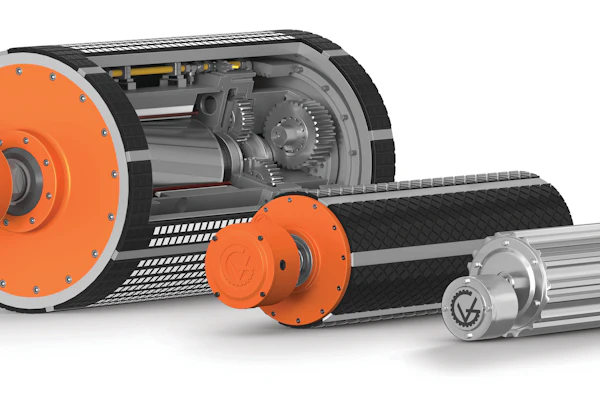
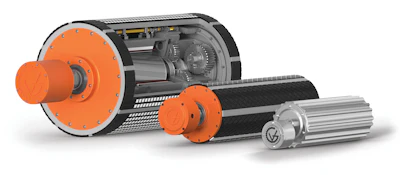
When Alexander Kanaris founded Van der Graaf (VDG) in Ontario in 1985, the drum motor did not have any industrial capabilities. Compact and self-contained, with the motor, gears, and shaft housed inside the drum, it had been designed for light-duty applications like grocery checkout conveyors. Kanaris, an electrical engineer, saw it differently. He saw a drive system that could, with the right engineering, handle the loads and power demands of heavy industrial conveyors. The hard part was making the internal motor, gears, and shaft stiff and precise enough that the drum would not deflect under belt tension. From a 3,500-square-foot facility, Kanaris redesigned those internals and set out to prove the concept.
Four decades later, VDG remains exclusively a drum motor company, but its product line now reaches up to 42-inch diameters and 500 horsepower.
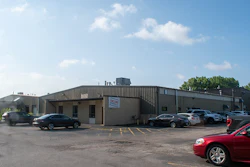
Ontario, Canada FacilityProving ground: baggage and automotive
The first VDG Drum Motors went into Air Canada's baggage-handling systems at Toronto Pearson International Airport, followed shortly by Ford's stamping plant in Sterling, Michigan. Both environments were exactly the kind of demanding duty cycles the company had designed for, and both performed. That success opened the door to a stainless-steel SSV Series designed for food-processing sanitary applications. With food, VDG could lean on the drum motor concept's inherent advantage of no external belts, chains, or gearboxes exposed to the production environment.
Hygiene has been a continuous innovation vein. SSV Drum Motors evolved from machined-on belt profiles to removable profiled drive sleeves and, most recently, to CleanFlow sprockets. Each iteration aimed to eliminate the gaps and crevices that external drive systems introduce. Alongside the sanitary line, MSHA and USDA certifications have let VDG push the same platform into mining, aggregate, warehousing, and parcel handling. The drum motor concept went further than its originators imagined, not because VDG tried to be more than one thing, but because it kept getting better at being one.
In-house, end to end
Ask VDG what sets it apart and the answer comes back to in-house. Every drum motor component—the electric motor, the gears, and the gear housing—is designed and manufactured in the company's own plants, with no outsourcing to third-party vendors. Engineering, R&D, machining, assembly, and testing all live under the same roofs in Ontario, Michigan, and Arkansas.
That vertical approach shapes how the company operates. R&D investment runs around $5 million a year and is driven by field feedback and application challenges rather than roadmap theory. New concepts are engineered and validated under demanding operating conditions before they ship. One of the most consequential outputs of that cycle is the low-thermal-output electric motor that anchors VDG's latest generation of drum motors. The design is engineered to run 80,000 hours of continuous operation before requiring maintenance. In a product category where the drive sits inside the drum and is harder to service than an exposed gearbox, maintenance intervals are not a marketing stat but a business case.
The vertical integration also lets VDG move faster when a customer needs something off standard. Standardized configurations cover most applications, but in-house engineering and manufacturing allow customization without the lead-time penalty that outsourced supply chains typically impose.
From inquiry to out the door An interior shot of the Van der Graaf facility.VDG
VDG's sales process starts with the application, just as the product's engineering does. A VDG sales engineer or customer support representative works with the customer through a defined list of application variables, including calculated horsepower, belt speed, operating voltage, belt width, the type of product being conveyed, ambient temperature, conveyor length, and whether the conveyor is horizontal or inclined. The team also captures the belt type, whether the application involves frequent starts and stops (indexing), and whether a variable frequency drive will be used. Only then does VDG propose a drum motor configuration. The goal, the company says, is to make sure the proposed solution is properly matched to the customer's operating conditions.
Internally, VDG organizes each project around a team rather than a single account manager, pulling together sales, engineering, manufacturing, and service support as the project requires. That structure keeps communication direct and decisions quick, and it means a customer talking to a sales engineer is one call away from the people who will actually build the unit.
When a purchase order lands, it is entered into VDG's ERP and released to production. The customer gets a sales order confirmation with a promised ship date and, when the unit ships, an automated tracking notification. Turnaround time varies with the drum motor's size, configuration, and level of customization, but having engineering and manufacturing under the same roof lets VDG move from application review and design through manufacturing, testing, and shipment on what the company says are the shortest lead times in the industry, with one to two weeks as standard.
Every drum motor is factory-tested before shipment. Electrical testing covers current, voltage, insulation resistance, dielectric strength, winding integrity, and Corona Inception Voltage. Mechanical checks cover speed, rotation, vibration, noise, temperature, sealing, and overall performance. Units are verified against UL, CSA, and other applicable industry standards, with final testing confirming performance against the specified nameplate ratings.
Service and training as part of the product
VDG runs dedicated Service & Tech Centers in Shelby Township, Michigan, and Russellville, Arkansas, staffed by VDG service engineers and technicians. Shelby Township serves the northern and southeastern U.S. while Russellville covers the central and western regions. The centers handle inspections, diagnostic testing, failure analysis, and training. Training consists of lunch-and-learn sessions, hands-on workshops, and interactive demonstrations.
Field service personnel are multilingual and travel with demonstration kits and specially equipped trailers that carry industry-specific drum motors and related products. The point of the trailers is to let a customer handle the equipment, see available options, and reason through what fits their application. Sales representatives, meanwhile, work closely with the in-house engineering team to provide application-engineering assistance and ongoing technical consultation.
A cutaway of the drum on a conveyor.VDGCulture and the people side
For a specialized manufacturer, the hardest problem is often not the next drum motor; it is the next drum motor engineer. VDG recruits through online platforms, employee referrals, and industry networks, looking for people with manufacturing, mechanical and electrical engineering, machining, and technical-service backgrounds. Technical knowledge, hands-on experience, and problem-solving matter, but so do work ethic, adaptability, teamwork, and willingness to learn.
VDG’s workplace is described in terms of fairness, mutual respect, accountability, and inclusiveness, with professional development a visible part of the employment deal. The goal is to create an environment where employees take pride in their work and have the opportunity to build long-term careers.
Looking ahead
Like many specialized manufacturers, VDG sees skilled-personnel availability as the industry's defining medium-term challenge. As experienced workers retire, preserving valuable institutional knowledge while developing the next generation of skilled workers becomes increasingly important. Technological change compounds the pressure; workforce skills have to develop fast enough to keep pace with evolving production technology, which requires ongoing investment in training, knowledge transfer, and succession planning.
Customer expectations are moving in parallel. Buyers want higher product quality, greater reliability, greater efficiency, and faster response, all against a backdrop of rising operational costs and uncertain supply chains. VDG's answer, four decades in, is the same formula that has carried it this far: specialize, keep it in-house, invest in people, and build for the long haul. The company has facility expansion in its near-term plans—a continuation of a pattern that has taken it from 3,500 square feet to 250,000—and remains, in its own words, optimistic about what the next chapter looks like.
Van der Graaf at a Glance
Shelby Township, Michigan FacilityVDGFounded: 1985
Product focus: Drum motors for belt conveyors (exclusively)
Headquarters/plants: Ontario, Canada; Shelby Township, Michigan; Russellville, Arkansas
Facility footprint: 250,000 sq. ft.
Employees: 167 (Six field service)
Annual revenue: $50M+
R&D investment: ~$5M annually
Sales/support territory: North & South America
Executive team: Alexander Kanaris, President; Pinder Saini, Vice President; Dimitrios Pavlidis, Vice President, Manufacturing; Rick Zander, Director, Business Development
 Ontario, Canada Facility
 Ontario, Canada Facility

 An interior shot of the Van der Graaf facility.VDG

 A cutaway of the drum on a conveyor.VDG