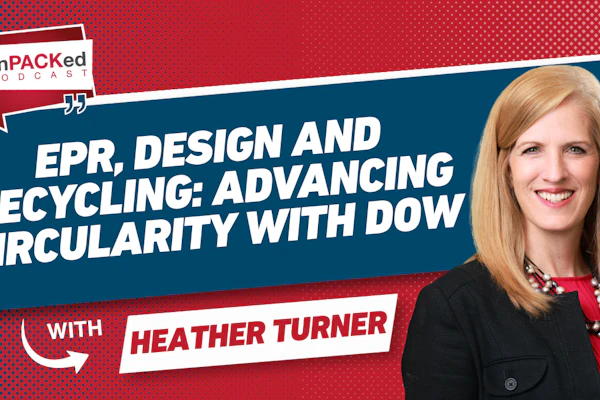
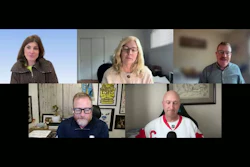
Heather Turner from Dow joins unPACKed to talk about circularity as an alignment challenge rather than an invention challenge, and the outsized role California plays in EPR. We also get into how design for recyclability, mechanical recycling, and advanced recycling fit together instead of competing. And with Dow returning as the official Sustainability Partner of PACK EXPO International this year, Heather shares the conversations she's most looking forward to having at the show.
Sean Riley: So, with all the fancy introductions out of the way, welcome to our podcast.
Heather Turner: Great. Thanks for having me.
Sean Riley: Oh, the pleasure is all ours. So innovation doesn't always mean inventing something new, and sometimes it's about rethinking the way an industry operates, which I think is how we have to think about something like circularity. So, where do you think the biggest opportunities for innovation exist today when it comes to advancing circularity?
Heather Turner: We've been working on this for a while, and you definitely need to bring the whole value chain together, for sure. It's not just a material. But I think, really, it's bringing everyone together. We map out the whole system. We're really good at certain parts of it. And even when I was at Climate Week last week, and in some of the investor discussions, it's like everyone wants to cherry-pick and invest in the most profitable sections of the ecosystem, but we really have to think of it as fully aligned. So it's really an alignment, and not always invention, that needs to happen. And I do feel like there is more work for us to be collaborative earlier in the design process and ensure that the packaging that's being designed is also collected and has end markets.
And so, still, we've been doing this, but I think we can continue. We know more now. We can be more innovative. We can also use a lot of the data and the tools that have come along, and then also lifecycle assessments and traceability. All of these tools are making us more and more effective, and we can leverage those learnings to really build out. The next wave of innovation is really going to be making our circular systems easier. Obviously, you need it more economically, but really working together. And so it's coming. It's really coming, but it is a lot of work.
Sean Riley: Yeah. I feel like it's another one of those terms, like sustainability before that, and now circularity as part of sustainability. It's something that's been coming for a while, and we keep waiting for that big breakthrough, if that makes sense.
Heather Turner: Right. Yes. But I think it's also, you have to just keep at it.
Sean Riley: Okay.
Heather Turner: And so, really appreciate those companies that are staying committed, that are bringing their skills to the table, and then leveraging those other skills. Don't try to do it all. That's too hard.
Sean Riley: Right. And you mentioned that there are a lot of stakeholders in it. There are brand owners, there are machine builders, there are recyclers, there are resin suppliers, the whole... Is there any link in the chain that's hardest to get linked up with everybody else right now? Not because of resistance on their part, but just because it's a difficult thing to line up?
Heather Turner: That's a great question. I don't think there's resistance by any means, like you said.
Sean Riley: No, me either.
Heather Turner: It's just more of making sure you connect the dots. I think the other thing that's interesting here is that it can be regionally focused.
Sean Riley: Exactly.
Heather Turner: Some things are very state-focused.
Sean Riley: Perfect.
Heather Turner: And so it's like, what is the infrastructure in that state? We have a lot of eyes on California right now. And so, does it have enough collection, especially for some packaging types like films and flexibles? And so I think it's really identifying the gaps, which a lot of work has happened. We've worked closely through a lot of the industry associations and trade associations, as well as, obviously, CAA and CalRecycle for California, as an example, are very engaged there. And so it's identifying those gaps and then the willingness to, "Okay, then let's go invest."
Sean Riley: And when you say... I know... I'll just touch on it right now, but I know extended producer responsibility, or EPR, laws are rolling out state by state. And that's a big thing that's going to... I guess my first thought, before I ask that, is: we're waiting to see what California does, just because California's so big and everybody's going to follow, or have to follow?
Heather Turner: It is. Oregon's already underway. We have seven states in the US that have EPR laws in place. Some have started, and some have yet to start. California is 10% to 15% of our economy.
Sean Riley: Exactly.
Heather Turner: And so they really do lead. And so that's why a lot of effort and focus is on that state, just because of what you implement there, hopefully it will be transferable. And so brands also recognize that it's hard to have a regional strategy for a lot of your production, especially if you go through distribution channels and things like that. Will it always just go to the one location? And so we're seeing that compliance has definitely been a big driver. Many of the retailers and brands had voluntary goals up to 2025, some to 2030, but now they've pivoted, because compliance is critical, and we need them to comply because, through that, with the EPR payments and such, will actually help develop this infrastructure that we need to really drive the circularity. And so it's a good thing; it's just a lot of effort, and making sure they're in compliance, making sure they have the right packaging types. And at Dow, we use this as an opportunity, like, "How can we support you?"
Sean Riley: Yeah, exactly.
Heather Turner: One of my team members focuses on understanding it very closely, as well as modeling it, and, "Hey, using this package design can help lower your fees," or incorporating recycled content, or if you're going to do lightweighting and different things, that we have these technologies in our portfolio and that we can take to our customers, and we've been very active sharing those. And will be at PACK EXPO, and even last year at PACK EXPO, on the Innovation Stage, talked about how we can help you be compliant with our offerings. And so it definitely has helped the story pivot, but I feel like it's a stronger story—
Sean Riley: Yeah, exactly.
Heather Turner: —because now you're developing and designing packaging that is meaningful, but that will and can be recycled, and that's critical for true circularity.
Sean Riley: Beautiful. Okay. We often hear about the different aspects, the mechanical recycling, advanced recycling, designing for recyclability, but we hear them as separate conversations, not really intertwined. So how do you see those pieces coming together to create this circularity, a more complete circular system? Or is it possible at this point?
Heather Turner: No, you're exactly right. In fact, often when we talk about what our sustainability pillars or offerings are, we have them in silos as well.
Sean Riley: Right.
Heather Turner: So I know exactly what you're saying there, but you know what? They're very complementary. So, first and foremost, you need to start with design. I was at the Recycling Partnership meetings a couple of weeks ago, and a very large brand was very adamant about, "We need to be more consistent on design at the start." And so, really thinking about what the package is, how it will be collected, and what the materials are. And so focusing on things like monomaterials, so they can be recycled. If it's flexible, even rigid, you need to ensure that the monomaterial will help the closure and the bottle. And so you need to start there. But then, with that, you can add the attributes of recycled content. And so mechanical recycling and advanced recycling really complement each other.
And so there are opportunities for mechanical recycling. When you can use it, you should. It's very effective. We have a proven recycling system, especially in high-density and recycled PET, especially on the rigid side. And then, on the flexibles and the film side, you can incorporate recycled content, whether it has FDA LNO compliance, if you need it to have food contact, or if it's non-food contact and it can go into stretch film and shrink, and in heavy-duty shipping sacks and other applications as you're developing your package.
And then, advanced recycling has a really critical need as well. For those packaging types, a lot of flexibles that are printed, that maybe don't have a quick mechanical recycling market, they're a perfect feedstock for advanced recycling. The advanced recycling market is quite fragile in North America right now, but I'm still quite bullish that we need it. It's a great way to really finish out the recycling technologies and offerings to divert as much as we can from the landfill. As well as, when you do run this into pyrolysis oil and bring it back into the virgin resin, you have that food-grade, virgin-like performance. And so there are a lot of attributes where you can put an advanced recycled resin into a flexible pouch that's monomaterial.
And so, once again, you've got food contact, you've got virgin-like performance, you've got a package that can be recycled. And then, as the ecosystem develops and builds out, especially where it lacks, maybe, on the film side, that it will get recycled and have viable end markets.
Sean Riley: Okay, beautiful. So it's coming together.
Heather Turner: It is.
Sean Riley: It's like we were saying with circularity: it's coming, it's just we have to be patient, is the best word.
Heather Turner: We do. Patient and consistent.
Sean Riley: So you did touch on Dow at PACK EXPO, and we're happy to say that Dow is returning to PACK EXPO as the official sustainability partner. What conversations do you hope move from this, like you and I are having right now, a discussion, to the action phase? And where do you see you guys at Dow helping lead that progress?
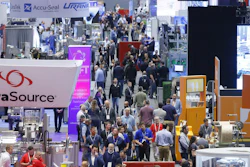
Heather Turner: PACK EXPO is definitely one of my favorite events annually. I've been with Dow for 25 years, and I have probably been going to PACK EXPO for at least 20 of those, if not more. And so it is such a great way to bring all the components of the value chain. And usually, as you walk the show floor, the OEMs, and you see the converters, but everyone still comes. It's a magnet for the whole industry and the value chain to come together. And all the material types are there too. It's so great to see the trends. Our theme this year is "Solving Today's Challenges to Prepare for Tomorrow." And a lot of it is design, compliance, all the things we just talked about. Those will be the critical discussions we'll have.
We'll be talking to our customers about how we scale circular solutions without compromising performance and affordability. How can we grow together? How do we bring our material science innovation to the table, and then how do we collaborate? We love to take the whole value chain to our Pack Studios, where we have commercial-scale lines that we can run most packaging types, and we can do innovation testing, as well as secondary and tertiary packaging testing. And so that's been really awesome, to be able to have that innovation center.
And then, really, it's also: how do we help you be compliant and meet the goals that you have as either a converter or as a brand? So that'll be really critical, is that we want to be able to validate with you, and faster turnarounds, fail fast if we need to, get the right innovation, but make sure that we can be compliant and really meet these challenges we have of the compliance, especially with some of the targets we have for some of these states. And so we're really excited to bring the team together. We can't do it on our own, so you have to collaborate, and so PACK EXPO's always got such a fun energy to be able to do that.
Sean Riley: That's perfect. That's a perfect button, I think, to put on our little discussion here today. I want to thank you again for taking time out of your day to come on here and educate our listeners a little bit more on circularity and the things that Dow is doing to push that forward.
Heather Turner: Thanks for having me. It's been a pleasure.