Industrial AI success requires a digital-enterprise foundation built on three pillars: predictability through digital twins, safety through fail-safe validation against simulations, and orchestration through edge computing that enables real-time decision-making without compromising control systems.
- The Challenge: 2.1 million unfilled manufacturing jobs by 2030, skill half-life shrinking to under 2.5 years, and 90% of global data created in the last two years sitting unused in dashboards.
- Predictability: Digital twins enable companies like PepsiCo to design entire plants virtually, identify 90% of potential issues before production, and achieve 20% throughput increases.
- Safety: AI suggestions must be validated through simulation or policy gates before reaching the control layer, similar to fail-safe I/O modules that protect against single-point failures.
- Orchestration: Edge industrial PCs deployed at the PLC level enable real-time AI feedback loops, allowing companies like P&G to catch manufacturing defects in milliseconds rather than minutes.
- Proof of Concept: Siemens' Fort Worth facility demonstrates full digital-thread implementation, compressing engineering timelines from months to weeks using agent-to-agent workflows.
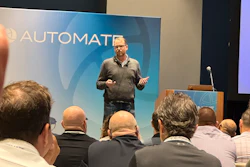
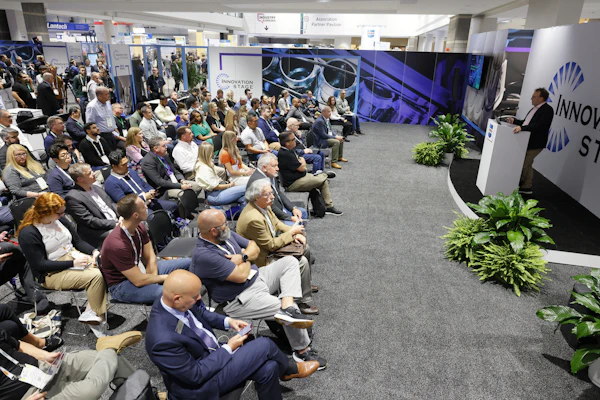
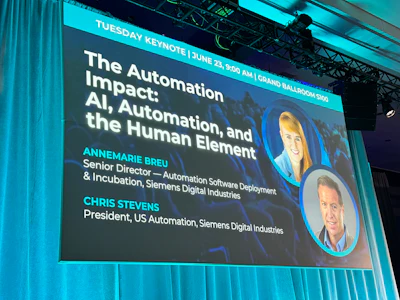
For all the hype around industrial AI, bolting it onto an existing control system is more likely to add complexity than subtract it. That was the through-line of the Day 2 keynote at Automate 2026, delivered by Chris Stevens, president of US Automation for Siemens Digital Industries, and Annemarie Breu, senior director of automation software development and incubation.
Stevens opened with the macro picture. Manufacturing contributes about $3 trillion to the U.S. economy, but the pressures are accelerating: 2.1 million unfilled manufacturing jobs by 2030, the half-life of skills down to under 2.5 years (from seven), and 90% of the world's data created in the last two years, much of it sitting in dashboards that don't drive actual insights. Data centers, he noted, are projected to consume 12% of U.S. energy in the coming years. A bill of this size has to be paid in productivity if the math is going to work, according to Stevens.
The framing for the rest of the hour was that AI can either compound those pressures or solve them—but only on top of a digital-enterprise foundation. “AI should love automation,” Breu argued, and the keynote was organized around three roots of predictability, safety, and orchestration to make that relationship work.
Predictability: digital twins as proving ground
Stevens anchored predictability in virtual manufacturing — the digital twin of production. He pointed to a CES appearance by PepsiCo's Athena Peppes, who described designing plants entirely in the virtual world before spending a dollar on physical construction and using AI-powered simulation to explore “hundreds or thousands” of layout options. The headline numbers: a 20% increase in throughput and 90% of potential issues identified before they reach the shop floor.
Breu added the engineer's counterpart, a first-principles simulation built on math, physics, and chemistry that can take an AI's suggestion, simulate a few steps ahead, and either accept or reject the change before it reaches the control layer. Same digital twin idea, different level of reliability. And a way to teach AI when to write back and when to wait.
Safety: borrowing from fail-safe I/O
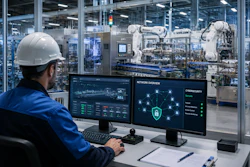
For safety, Breu drew an analogy to fail-safe I/O modules, which evaluate emergency-stop signals across two independent channels so a single wire break can't compromise the machine. “AI on the control layer needs the same two-channel discipline,” she said, “every AI suggestion needs to be validated against a simulation or policy gate before it is allowed to act.”
Stevens widened the definition to include psychological safety on the floor. He cited Siemens' Fort Worth facility, which staffed up with roughly 800 workers from non-traditional backgrounds using workflow tools, training, and hackathons to turn anxiety about new technology into engagement. Retention there is 75%.
Orchestration: the conductor
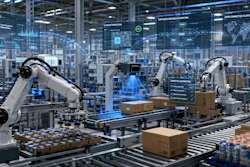
For the third scene, Stevens called Roland Joseph, senior technical director at Procter & Gamble, onstage. Joseph described a lesson that P&G learned the hard way. It thought it was a big-data company, but its MES and automation historians were sampling at one-minute and one-second intervals, respectively, which was useless for catching transformations like the five-millisecond friction weld on a Febreze nozzle. The cloud was too slow and unreliable; the PLC couldn't host the model. P&G's “aha moment” was an edge industrial PC sitting alongside the PLC at the same Purdue level, with high-speed bidirectional communication. In partnership with Siemens, P&G has deployed hundreds of those edges globally, closing the loop on AI models in real time and catching, for example, the previously mentioned underperforming nozzle the moment the data shows it.
Breu walked through what the orchestration layer does mechanically: leasing write-back rights so only one AI is master at a time, retrieving context from the control layer, validating proposals against policies and simulations, and presenting decisions to a human operator.
From strategy to execution
Closing the loop, Stevens pointed to Siemens' Fort Worth site as “customer zero” proof. It is a fully digital-thread plant that came together in under 15 months, using the same digital twin, contextualized data, orchestration layer, and integrated workflows that are offered to customers. Internally, the company is now replacing serial engineering with simultaneous “agent-to-agent” workflows, compressing time-to-value from months to weeks. Stevens said he recently challenged his team to take that down to a single week.
“Strategy without execution is merely a dream,” he said. “Execution without results is what we call a science project.”
Finally, he left the audience with this takeaway. “AI can be the problem or the solution,” he said, adding that the OEMs and end users in the room get to decide.