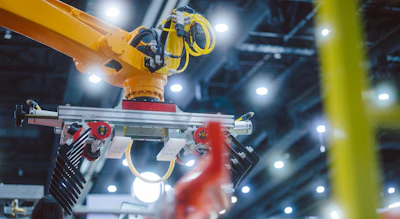
Most industrial robot deployments fail not because of hardware limitations but because engineers skip fundamental knowledge about kinematics, payload calculations, tooling selection, and physics. Understanding these underlying mechanics—including Denavit-Hartenberg parameters, singularities, and inertial loads—is essential for successful integration and troubleshooting.
- Denavit-Hartenberg parameters define how each motor offsets and rotates relative to the next, forming the foundation for payload calculations, acceleration limits, and fault behavior
- Tooling selection determines whether a robot is useful or useless; gripper vs. vacuum choice depends on part type, and incorrect selection can create dangerous lever-arm loads
- Singularities occur in three types—wrist, elbow, and shoulder—causing acceleration spikes and faults, though newer hardware may be developing workarounds
- Mobile robots (AMRs) operate with centimeter-level repeatability using SLAM, while fixed arms achieve sub-millimeter precision; combining them requires fiducial-based positioning
- Humanoids remain limited to controlled environments like warehouses for simple tasks; they lack the adaptability needed for dynamic production floor unpredictability
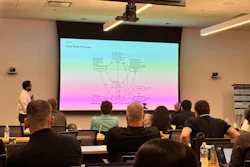
It’s not a stretch to opine that most people working with industrial robots today are not robot designers. More often than not, they are applications engineers who take an existing arm off a shelf, drop it into a cell, write a program, and solve whatever problems emerge. Courtney Fernandez of Fast One Solutions thinks that framing matters. At OT SCADA CON in July, she argued that understanding at least some of the underlying mechanics—the math, the geometry, and the physics—is what separates successful deployments from costly ones.
"Most of the robotics that we do in the US is applications engineering," Fernandez said. Her presentation, titled Industrial Robotics and End of Arm Tooling, covered kinematics, tooling selection, singularities, mobile robots, vision, and the emerging conversation around humanoids.
The math behind the motion
Fernandez opened with Denavit-Hartenberg parameters—the framework that defines how each motor in a robot arm is offset from and rotated relative to the next. A four-axis robot requires four matrix transformations to determine where the tool tip is in space. A six-axis robot requires six. "If you have six axes, you have to transform one to the next to the next," she said. It is unglamorous mathematics, but it is the foundation for everything else: payload calculations, acceleration limits, and fault behavior all flow from it.
Forces and accelerations translate into maximum current draw per motor. On a collaborative arm—Fernandez used Universal Robots as the most recognizable example—exceeding the current tolerance on any individual motor triggers a fault that most operators read as a collision detection.
"All it did was move really fast. It never detected a collision because the current went outside of the tolerance window," she said, explaining that knowing that distinction matters when troubleshooting. A faulting cobot that has not touched anything is not necessarily oversensitive; it is more than likely overloaded.
Tooling is the application
The end-of-arm tool, Fernandez said, is what makes a robot useful or useless for a given task. Gripper selection and vacuum selection each have their domain: Grippers for grouped parts where contact marks are acceptable and vacuum for flat or small parts that need a clean surface. Getting it wrong does not just produce bad outcomes; it can produce dangerous ones.
Payload and inertia are the two calculations most often skipped. An oblong part creates a lever-arm load the robot wasn't expecting, and that load can overturn the arm even if the part itself is within the rated weight limit.
"If you're picking up an oblong part, you've got things leveraged way out there," Fernandez said. "The robot calculates what's happening and it's going to fault."
Understanding the inertial envelope of a part—not just its mass—is prerequisite work that belongs in planning, not in commissioning.
Singularities: Scary math, manageable problem
Singularities get treated as mysterious or dangerous in a lot of robot training. Fernandez's take was more practical: They are hard math with real physical consequences, but they are not unmanageable once you understand what is actually happening.
Three types of singularities matter in practice. The wrist singularity occurs when two concentric motors create too many valid solutions simultaneously, driving acceleration toward infinity as the controller tries to resolve them. The elbow singularity occurs when the arm is fully extended. This causes a zero to appear in the denominator of the inverse kinematics calculation, and acceleration again ramps to a fault. The shoulder singularity is purely physical: The robot cannot move linearly through itself any more than a person can touch their right ear by moving their finger in a straight line across their face.
On newer hardware, at least one of these is becoming less of a hard limit. Fernandez said she recently observed a UR20 drive through a singularity into a new position, something that is not supposed to be possible. Her best hypothesis is that Universal Robots is using a near-zero approximation to sidestep the division-by-zero condition. "Normally you can't do that," she noted, suggesting the industry is quietly solving problems practitioners have long worked around.
Mobile robots and the limits of SLAM
AMRs use LiDAR and simultaneous localization and mapping (SLAM) to navigate. The robot fires light pulses outward, measures return times, builds a map of its environment, and localizes itself within that map as it moves. It avoids unexpected obstacles and handles people walking through its path. Fernandez described it as mature-enough technology, but one with a precision ceiling that fixed arms do not share: AMR repeatability runs in the centimeter range, while a fixed industrial arm operates in the sub-millimeter range.
The gap can be closed, but it requires a specific approach. A camera on the robot arm can locate a fiducial or known feature mark within the facility. Once that reference is found, the arm treats itself as stationary for the duration of the task and operates at its native precision. "Whatever that code is, you're just doing stationary robotics now," she said. Coordinated motion, where the arm and vehicle move together through a continuous operation, remains largely theoretical in production environments, though Fernandez said the use case is being actively explored for tasks like working along a very long continuous workpiece.
Humanoids: Controlled environments only, for now
The audience wanted to talk about humanoids. Fernandez obliged, though she was careful to frame that her bias is toward purpose-built industrial robots. She sees the humanoid form factor as a solution looking for the right problem rather than the obvious next step in factory automation.
Her most grounded example was Digit, the humanoid robot from Agility Robotics, which she said is currently working in warehouses performing a simple task: picking up a box and placing it on a conveyor. "Simple tasks like that in a controlled environment are a possibility right now," she said. But she drew a clear line between a relatively structured environment like a warehouse and a dynamic production floor. She sees humanoids as purposeful in the right setting, but handling the full unpredictability of a live industrial environment requires a level of adaptability and self-recovery that current systems do not reliably have.
On robot longevity, Fernandez closed with a practical note often left out of procurement conversations: joint wear. Some are greaseable; some are not. Around the five-year mark, control system replacement becomes likely even if the arm itself is structurally sound. Early warning signs include elevated heat and dropped communications packets, i.e., the robot telling you it is struggling before it tells you it has failed.
The throughline of the session: Most robot deployments fail not because the hardware is not capable, but because the engineers integrating it did not go deep enough on the fundamentals before they started. Payload math, tooling selection, kinematics, and coordinate frame transformations aren’t glamorous, but all of it matters.