At PMMI's Annual Meeting, CPG leaders revealed that equipment flexibility, changeover ease, and uptime have replaced speed as the top priorities for packaging line decisions, driven by increased SKU complexity, workforce constraints, and longer investment horizons.
- Flexibility over speed: While speed remains important, changeover performance and uptime are now the biggest priorities for CPGs operating complex production environments.
- Tribal knowledge crisis: Long-tenured employees retiring is causing institutional knowledge loss, making troubleshooting harder and employee ramp-up longer for new hires in automated facilities.
- Automation ROI shift: Automation is now viewed as essential business infrastructure rather than an efficiency project, with payback windows extending to 30-60 months.
- OEM blind spots: Equipment manufacturers often fail to understand individual plant operations and treat customers as one-size-fits-all, missing opportunities for customized solutions.
- Emerging pressures: Recyclable packaging materials behave differently than traditional films, sustainability regulations are fragmenting by region, and IT/cybersecurity integration is becoming critical for plant operations.
In what may be a first, the word "speed" barely came up at PMMI’s Annual Meeting during a CPG panel on what they want from OEMs.
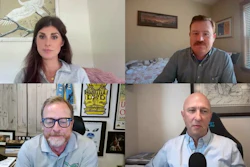
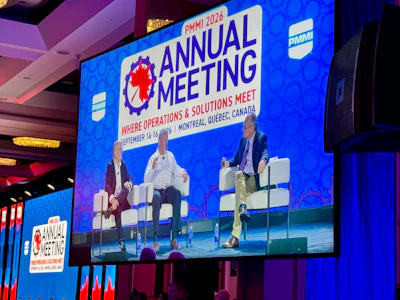
Jean Bigaouette, President, Achtran Inc. (consultant, former Chief Procurement Officer of AgriCoop, former CEO of Canon North America), and Dave Brunel, Plant Manager at Old Dutch Foods' Calgary facility, told an audience of OEMs and industry peers exactly what's driving equipment decisions inside their operations. And while speed, once the crown jewel of a line spec, is still important, flexibility, uptime, and changeover performance have become the biggest wants/needs.
"We've gone from where speed used to be everything," Brunel said. "And now it's about flexibility. You can go as fast as you want, but if you have to stop in five seconds, that's the problem."
Old Dutch runs 170 SKUs out of its Calgary plant in a production environment that, as Brunel described it, is forever changing. Bag sizes range from 16 grams to 905 grams. Flavors rotate. Major retail customers keep pushing new pack formats. And every change means a changeover. When PMMI research placed changeover ease near the bottom of a priority list it shared with the panel, both speakers moved it immediately to the top.
"Quicker, easier changeovers, that would be number one," Brunel said.
Bigaouette backed him up without hesitation. "Changeovers are everyone's nightmare," he said. "I once consulted in a place that said, if only you could [changeover] faster, it would transform us."
The Knowledge cliff nobody budgeted for
Before the conversation got to equipment specs, it focused on the age-old problem of the workforce and specifically tribal knowledge. Both panelists are watching decades of institutional knowledge walk out the door as long-tenured employees retire, and neither sees a clean solution.
"We have a lot of long-term employees, and they're starting to retire now, so we're losing that skill set," Brunel said. "I don't see 40-, 45-year employees anymore."
Veteran operators understood why a bagger behaves a certain way; they watched the process before it was automated. New hires step into an automated environment with no frame of reference for the underlying mechanics, which makes troubleshooting harder and ramp-up longer.
Automation: No longer an ROI project
Automation has topped priority lists at PMMI's Top to Top research for years, according to panel moderator Jorge Izquierdo, PMMI vice president, market development. What's shifting isn't the ranking but the justification.
"Automation is not a business or economic project anymore," Bigaouette said. "It's a sustainability of the business project."
That reframing matters for anyone selling capital equipment. The payback window is lengthening—30-month paybacks on standard CapEx and 60-month windows on green CapEx are increasingly the norm, and buyers are evaluating automation as essential infrastructure rather than a discretionary efficiency play.
For Old Dutch, the clearest targets for automation are end-of-line case packing. "We manually pack bags into boxes, and that's where we're eliminating one or two workers per shift, per line,” Brunel said.
What OEMs keep getting wrong
Asked directly where OEMs fall short, both panelists went to the same place: a failure to actually understand the plant they're selling into.
"I think one important thing would be if manufacturers wouldn't treat us like a one-size-fits-all," Brunel said. "They could actually come to our facilities first, to see firsthand what we're dealing with. Not every plant is the same; even all the Old Dutch plants are different from each other."
Bigaouette placed the gap in a relationship and trust context. "You need to develop a relationship so you can talk at the functional level with the OEM and help them bring their expertise to build a solution that really works for you,” he said. “Most often, what I see instead is people deciding in the plant what the system is going to do, and then going to buy it. Whether it integrates well or not is left to chance."
On services, both panelists said the value is there, and the willingness to pay is real, but availability is still inconsistent. Old Dutch runs 24 hours, five to six days a week. "That support has to be 24-hour," Brunel said. "And their technical people have to be available to come in. You can't do everything online all the time."
Sustainability pressure is already on the line
Recyclable and compostable packaging films are no longer a future consideration; they're running on lines right now, and they don't behave like the materials they replaced.
"Equipment we had that would run a certain film for making bags, now they've switched to recyclable material, and it runs differently," Brunel said. "Marketing departments think one material is the same as another. Well, it's not."
Bigaouette flagged the regulatory dimension. Extended producer responsibility programs are creating upstream pressure that reaches the packaging line. In the U.S., those programs are already impacting operations state by state. The next question is whether Canada will see similar fragmentation by province and when.
The IT problem the plant floor can't ignore
Cybersecurity and IT/OT convergence showed up late in the conversation, but both sides of the table need to address it. As equipment becomes more connected, the vulnerability surface expands, and the lifecycle of software components is shorter than the lifecycle of the machines they run on.
"IT is the next best partner—the second driver after mechanical engineering," Bigaouette said. "Because IT can shut down your plant if it's not running really well."
Brunel described a pragmatic approach calling for regular software updates from suppliers, close tracking of component lifecycles, and tighter coordination with OEM technical teams. But Bigaouette's broader point—that IT needs to be embedded in OT strategy rather than bolted on after the fact—reflects a shift that most manufacturers are still in the middle of navigating.
The takeaway for OEMs
The through-line from Montreal was that things are much different than they were five years ago. CPGs are operating under more complexity, with thinner workforces, more SKUs, tighter film specifications, and longer investment horizons. They want equipment that's flexible before it's fast, maintainable before it's feature-rich, and backed by service relationships that treat their plant as a specific environment, not an industry vertical.