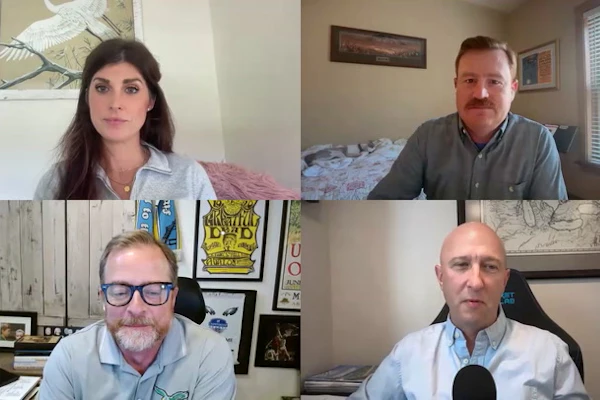
Derrick: Hello, and welcome to End of the Line, the podcast where the editors of PMMI Media Group get together and talk about stuff.
Actually, a podcast or a video. I think we're now officially a podcast, in fact.
I am the Editor-in-Chief of ProFood World, Derrick Teal, and I'm joined by Editor-in-Chief of Healthcare Packaging, Liz Cuneo; Chief Editor of Packaging World, Matt Reynolds; and Editor-in-Chief of OEM Magazine, Sean Riley.
Let's kick things off with you, Matt. You had something interesting to share, olfactory-wise, I believe.
Matt: Yeah. I've been covering a lot lately on legislation and regulations with EPR and stuff, so it was good to have a fun, slightly lighthearted packaging design story.
We all remember scratch-and-sniff stickers. I think we're all children of the '80s, or children who lived through some of the '80s. Do you guys remember scratch-and-sniff stickers?
Sean: Sure, yeah. On your Trapper Keeper. They would work for about two to three days, and then they would just be stickers thereafter.
Matt: They'd get completely scratched off.
Well, the technology is back and better than ever. This was actually Icy Hot. We're familiar with Icy Hot; it's a topical analgesic. I'm getting more familiar with it as I need it more frequently.
One of the knocks on the whole topical pain relief category is that it frequently smells like a medicine cabinet. One way to avoid that is Icy Hot came up with three new fragrances.
I'm holding Energizing Citrus. The idea is to avoid that whole medicine-y smell. This actually has a little bit less menthol, so it's a slightly different product, but you won't smell like a medicine cabinet.
This comes with a set of problems for the packaging because when consumers are introduced to a brand-new concept or scent after they've been using Icy Hot all their lives, they wonder: What does Energizing Citrus smell like, and what am I going to smell like?
What ends up happening is that, right there in CVS or Walgreens or wherever in the retail aisle, people are opening up the carton to try to get a whiff. They won't be able to because this is a sealed roll-on inside, so those who commit that sin aren't going to get the payoff anyway.
Regardless, what that means for CVS or whatever retailer is that this is now a product that can no longer be sold.
Flash forward to our discussion of '80s scratch-and-sniff. What's old is new again.
There's a new scratch-and-sniff capability on the carton. A company called Scentisphere worked with Icy Hot—whose brand owner is Opella—to encapsulate the fragrance oil that's used in the product. It's the exact same fragrance oil, not an approximation of it.
The encapsulation is added to a spot varnish, so this is a traditional carton. They didn't have to change the carton. It's embossed, and there's some spot varnish here and there to make it pop on the shelf, but the encapsulated scratch-and-sniff area is right here.
It lasts up to a year, so it can sit on the shelf for some time, and there's a lot of it on here. That was one of their learnings with Scentisphere. We're used to those Trapper Keeper-sized stickers where you get two or three uses out of them and then they don't work anymore.
This is designed for many different consumers who might be selecting between Energizing Citrus and the other varieties. You need multiple uses before somebody finally takes it off the shelf.
There were a lot of interesting learnings there, and the best part for Icy Hot and Opella is that it didn't require a whole lot of tweaks. This is the same cartoning equipment they've always used.
The encapsulated spheres are extremely robust. They just had to be careful about the embossing because, in the converting process, the embossing intentionally creates a raised surface. This little embossed area is right beneath the scratch-and-sniff.
Anyway, this is coming soon, if it's not already on retail shelves. Go catch a whiff next time you're at Walgreens.
Derrick Teal: Ripping open a package just to test the product inside—the eighth deadly sin.
Liz, I was asking Matt earlier if that package has an NDC code. You had something new about that?
Liz Cuneo: Yeah. I had three interviews this week about the National Drug Code, NDC-12, which is a new format the FDA is putting into effect in 2033.
Last week was the Healthcare Distribution Alliance Traceability Seminar in D.C., and the conversation there was really about NDC-12.
It's a huge changeover that companies are going to have to make from the existing 10-digit drug code on packages to 12 digits. It sounds kind of simple, but of course there are implications when we talk about what that looks like. It's your printing and vision systems, your barcodes, your software, inventory management—it's far-reaching.
Yes, Matt, thank you. It does have an NDC code, so the segue was successful.
Matt Reynolds: Well done.
Liz Cuneo: If you think about it, Icy Hot has to change its products to that 12-digit code and phase out the 10-digit format by 2033. Then distributors have to be able to scan it, pharmacists and the CVSs of the world have to be able to input the new product, and everyone's barcode and label readers have to be able to read it.
It's a big, overall systems undertaking. The industry has some time to do it, but what I'm hearing is that the time to start is really now because it's going to take that time.
But I wanted to share something that was really interesting. I interviewed Kayla Shankel from the Healthcare Distribution Alliance. She's the VP of Regulatory Affairs, and she talked about how someone from the FDA presented the real "why" behind this. Why are we doing this? Is it just something else the FDA wants us to do?
The answer is no. We're really going to run out of drug codes.
The FDA estimates we burn through about 1,000 new National Drug Codes a year. The last estimate was that there are about 10,000 unique codes left. So, you do the math—that's about 10 years of new codes.
But the pushing force to get this moving is what happened during COVID. The industry went through about 6,000 or 7,000 NDCs during the peak COVID period, and one of the reasons was that everyone started making hand sanitizer, as random as that is.
Remember, all these companies were doing it, and everything had a unique drug code.
Derrick Teal: The distilleries switched over almost exclusively because they were totally prepared for that. Even some breweries had all the right equipment and switched over in a matter of days. Sorry, I digress.
Liz Cuneo: Typically, you wouldn't have a brewery using an NDC. But because of COVID and the pandemic, suddenly we're using all these different drug codes.
If something like that happens again at scale, we're going to run out of NDCs well before that 10-year mark. That's kind of why there's this push to do it now.
I thought that was pretty interesting. The good thing is, once it's done, we won't have this issue again for 900 years. So we're in good shape.
But the "why" behind it is interesting. If you really dig into it, we really will run out of numbers.
The consensus is: Start now. Evaluate where the NDC exists in your company, who owns that, and bring in all the different parties at your company. It's not going to happen in isolation. Everyone really has to work together on this one.
We'll be covering this topic for the next seven years. We even have a webinar series next year about it. It's pretty interesting stuff, but the why behind it is pretty compelling.
Matt Reynolds: Yeah, 900 years. I don't know if we'll be around.
Liz Cuneo: I guess that's sort of a segue to your topic, Sean, and AI. Is that going to take over? Will we be around, or will we be serving our AI overlords?
Sean Riley: We're going to upload our consciousnesses in such a way that we'll be around to worry about the 13-digit NDC code in 900 years.
Liz Cuneo: That should buy us another 900 years.
Matt Reynolds: Yeah, why not?
Derrick Teal: We'd probably go to 14, right?
Sean Riley: Exactly. That's the goal.
I had this study come across my desk from Deloitte and the Manufacturing Institute. The Manufacturing Institute is a pretty big deal in our world in terms of research and advocating for manufacturing.
The study was about expanding the skilled manufacturing workforce with AI. Manufacturing technician employment—the people who work on the machines—is expected to grow significantly faster than employment in production occupations. They think that's due to retirements or people moving up to new or different skill levels.
The story isn't the typical one where you hear AI and think it's going to swoop in and solve a labor problem.
The way they framed it was that the next wave of technicians could come from adjacent industries. The study found that there are a lot of workers in industries like construction, retail, and warehousing who have skill sets that could transfer over to manufacturing.
At first, you think, maybe, maybe not. But through this study, they came up with ways that workers could transfer from those careers to higher-paid careers in manufacturing using AI as a bridge.
It kind of throws back to our "digital dentist" that we talked about a couple of months ago.
You could have a new manufacturing maintenance technician who doesn't know anything about a particular piece of equipment capture a video of that unfamiliar equipment. AI analyzes it and provides recommended troubleshooting steps within minutes.
That lowers the barrier to entry for less experienced workers, but it also frees experienced technicians to focus on higher-value tasks.
I think the bigger point of the study was how they're going to add AI fluency almost as part of the technician's job description. By doing that, they think it's going to make it a more appealing job, especially to Gen Z or millennials.
Everybody's talking about how the world is being taken over by AI, and now you're tying these technician jobs—which most people aren't associating with AI—to the idea that, "If I get this job, they're going to teach me how to become AI fluent."
You're going to have a job that's "safe," but you're also going to be working in a sector that's new, advancing, and high-tech. It's a way of framing the industry differently and making it sound more skilled and technologically advanced.
It could bring in workers with the idea that they're going to be trained up. I thought that was an interesting way of presenting AI as a tool beyond what it can teach you, but also in the marketing of the job itself.
Matt Reynolds: It's an upskilling device.
Sean Riley: Yeah, exactly. Saying, "I'm going to take this job and become AI fluent" is a pretty big deal for somebody who might not know much about AI or the level at which they can function with it.
Derrick Teal: And given the typical fight for laborers to begin with, having that advantage of being able to bring in people and say, "You have rudimentary skills, but through AI we can bring you into this," is pretty compelling.
Sean Riley: Exactly. And you're going to become a quote-unquote AI expert, which is a very marketable way of positioning the industry.
Matt Reynolds: Historically, one of the biggest hurdles has been the requirement to learn ladder logic, coding, and PLCs. That's often the difference between a skilled and unskilled operator.
You're kind of breaking down those barriers through AI. AI becomes the common-language democratizer.
I can imagine it works both ways. People no longer necessarily have to know ladder logic, PLCs, or various different languages because the AI speaks that. They just need to be able to work with the AI to get the outcomes they want.
It's an interesting way of going about it.
Derrick Teal: I suppose I could have used any segue for what I was going to talk about today, so I'll go with this one: You were talking about the citrus.
There's a plant that just broke ground in São Paulo, Brazil, that's going to use citrus residue from orange juice products to create biogas and generate power.
It's going to be a huge site—about 2 million square feet—next door to a juice processing hub. When it's complete, it'll be the world's biggest plant of its kind. It's going to use that raw organic effluent and turn it into power.
That was interesting to see because, at the same time, we just sent Casey, our absent associate editor, to tour a plant in Wisconsin, Klondike Cheese. He just got back, so he gets a day off.
What they're doing isn't quite the same, but it's very circular. I'll let him talk about it more in the future, but the idea is that they're taking a lot of the washdown water from cleaning, treating it, and then using that water to grow alfalfa.
That alfalfa feeds the cows, which in turn generate the milk, which in turn generates the cheese. It's a very circular operation.
It was interesting to see a couple of sustainability stories. I know Matt has sort of had the market cornered regarding sustainability and packaging. We haven't seen that quite as much on the manufacturing side, mostly because sustainability has sometimes been viewed as a luxury.
But given rising costs for everything, particularly utilities, I think we're going to see plants turning to more sustainable and circular options.
Matt Reynolds: To save money, ironically.
Derrick Teal: Exactly. Usually, these options would be viewed as a luxury because it can be costly to install some of these systems. But if the cost of power in general goes up, this becomes a good alternative.
That's always been the problem with a lot of sustainable options: the upfront cost. It might cost a lot initially, but in the long term, it pays off. As the cost of utilities rises, the ROI on these systems becomes quicker.
I thought it was interesting. I don't know if we're going to start seeing a trend there, but I thought I'd bring it up.
Matt Reynolds: I like it.
Now, Derrick, when you say Klondike, my brain goes to the Klondike Bar. Is that not the same company?
Derrick Teal: It is not the same company. It's cheese. They do yogurt as well, but it's not the same company.
Matt Reynolds: But it is behind the cheddar curtain.
Derrick Teal: It is behind the cheddar curtain.
Casey was actually telling me that he went to a restaurant the day before, and they served a slab of meat with a slab of cheese encompassed by rye.
That was it. No condiments whatsoever. They did give him some mustard on the side, apparently, but basically said, "This is what you're going to get. You're not going to need anything else."
Matt Reynolds: He was also dangerously close to the New Glarus brewery up there in Wisconsin, so maybe that's why he's taking the day off. He might be nursing something here.
Derrick Teal: Maybe. I don't know what he did on the way home or how long he took to get home, but yeah, maybe.
Anyway, I think that's going to do it. Everybody, thanks for talking and sharing your stories today. Appreciate it.
And thanks for putting up with, for those on video, our special guest Janie the dog over my right shoulder here. Luckily, she didn't do anything too embarrassing.
Liz Cuneo: Oh, she's comfy.
Derrick Teal: Thanks to everyone in the audience. Appreciate it, and we'll catch you next time on End of the Line.