CPGs and OEMs are adopting standardized data frameworks like i3X and SM Profiles to eliminate custom integration work and enable machines from different suppliers to communicate seamlessly, reducing costs and complexity in smart manufacturing.
- Most packaging lines contain machines from multiple OEMs that report data differently, requiring CPGs to manually map registers, convert units, and rebuild context before data becomes useful.
- CESMII's i3X open API allows applications to discover machine data objects and relationships, with 67 vendors already building it into platforms since its June launch.
- Standardized data profiles eliminate customer-by-customer integration work, letting OEMs focus engineering resources on product innovation rather than one-off data outputs.
- Past standardization efforts failed because they created new data silos for each use case; i3X can be added on top of existing systems without cost to impose structure across legacy equipment.
- Large manufacturers are forming executive councils to tell suppliers that closed systems and proprietary data access won't be acceptable, driving industry-wide adoption of open standards.
Most packaging lines in today’s plants include machines from multiple OEMs and different component suppliers, each reporting data differently. On the other side of the table, that leaves CPGs mapping registers, converting units of measure, and rebuilding context before the data is useful.
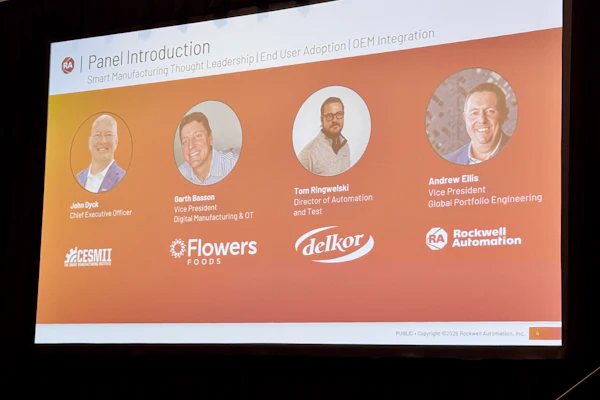
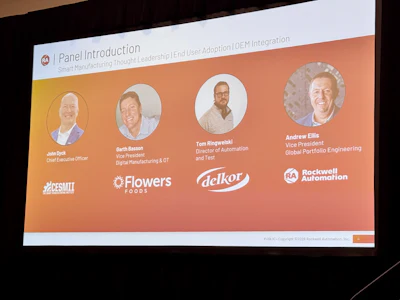
A Customer Voices panel at Automation Fair took on that problem from both sides, with CESMII working to harmonize the players. The panel included John Dyck, CEO of CESMII, the Smart Manufacturing Institute; Garth Basson, vice president of Digital Manufacturing & OT at Flowers Foods; and Tom Ringwelski, director of automation and test at Delkor Systems.
CESMII was founded in 2017 with Department of Energy backing and has about 250 member companies. Its goal is to cut the cost and complexity of smart manufacturing in half, and its approach has three parts. The first is SM Profiles, which are standardized information models that describe a machine. The second is platforms that can import those profiles intact. The third is i3X, an open API that lets any application discover a machine’s data objects and how they relate to each other. Dyck said 67 vendors have built or are building i3X into their platforms since it launched in June.
CESMII is now working with companies like Flowers Foods and Delkor to bring this approach to packaging. The plan is to teach machine builders how to model and connect both new and installed equipment, and then get manufacturers to put the standards in their specs.
What changes when every new machine arrives ready to connect?
Basson compared it to plugging a device like a mouse into a USB port. A new machine arrives, connects to the network, gets an IP address, and its data is available right away.
Unfortunately, he quickly pointed out that it doesn’t work that way today. Instead, the end user writes a spec listing the data it wants and the OEM programs it. Then someone has to map it, either a systems integrator or plant staff, and align units of measure so the application interprets it correctly. “You’re spending valuable time doing that versus trying to extract the value,” he said.
As a baseline, he wants PackML machine states, PMMI’s standard data framework, and i3X capability built in. (Basson is a member of PMMI’s OpX Leadership Network, which has established common data definitions, core machine parameters, and industry frameworks so OEMs and CPGs share consistent operational metrics.)
He also wants end users to ask for this together. Flowers, which has 44 bakeries in 19 states and $5.3 billion in 2025 sales, can push one supplier, but a shared industry requirement is what changes builders’ behavior.
Ringwelski said the demand is increasing from the OEM side as well. In his six years at Delkor, customer requests for machine data have grown every year, and each new customer brings its own learning curve.
Dyck described the scale of the problem at a typical plant. Twelve to 20 applications may each be pulling data from the same machine, with quality, MES, and historian systems each maintaining a separate copy. “You have a mess today, if I can be blunt,” he said. i3X gives applications one endpoint to query, and it works for equipment that’s already installed as well as new machines. He added that agentic AI on the plant floor “will never happen” without that kind of foundation or some other form of standardization.
How does a machine builder still win if everyone uses the same standards?
This question matters most to OEMs, and Ringwelski said standards help builders. Delkor already runs a single FactoryTalk Optix HMI application on about 20 machine models. A standard data profile would let it stop doing the customer-by-customer integration work he called one of the company’s “Achilles’ heels.” Engineers could spend that time on products like Delkor’s Smart Lock changeover system. He said Delkor built Smart Lock because customer operators kept misreading changeover scales, for example, setting 35.5 when the scale read 36.5.
He also pointed to performance comparisons. If uptime, downtime, and time-to-failure are reported the same way from every machine, a builder can no longer make its numbers look better by choosing its own definitions. “Good manufacturers will start jumping ahead,” he said, because they’ll have consistent data to prove their machines perform.
Basson agreed, citing the workforce crisis as another reason for standardization. With skilled engineers in short supply, he would rather his OEMs spend their hours improving machines than building one-off data outputs.
Standards have existed for decades. What’s different now?
Dyck said past efforts failed because plants solved problems one use case at a time, building another data silo for each one. Even a plant that standardized one system still had 49 others that didn’t match. i3X can be added on top of existing systems to impose structure where there wasn’t any, and neither i3X nor the information models cost anything to use. “The very next machine you want to pay for, you might as well buy something that’s conformant,” he said.
Ringwelski said the technology is easier to use now, too. Builders used to work through two or three layers of standards to get data off a machine.
An integrator in the audience raised a harder problem, citing equipment suppliers that lock down machine data, charge separately for an OPC UA server, or make data access an annual subscription. Dyck described two ways that CEMII is fighting that very problem.
First, CESMII formed an executive council of 36 manufacturers, mostly Fortune 500 companies, to tell suppliers as a group that closed systems won’t be acceptable in a few years. Second, he gave the example of a large automaker that wrapped i3X around 12 proprietary systems in a couple of weeks. That automaker now has one endpoint that exposes 900 data objects, which its own electricians and welders use to build apps.
As a component supplier, what role should Rockwell play?
Basson and Ringwelski each asked Rockwell for help with adoption. Ringwelski asked Rockwell to make the case to end users, since builders will follow what their customers require in specs. Basson pointed out that Rockwell works with end users, integrators, and OEMs at once. He asked Rockwell to make conformance as easy as possible in its tools and to avoid making it another proprietary layer.
For OEMs and CPGs, this approach would reduce the custom integration work both sides deal with today and let them compete on how well their machines and plants perform.