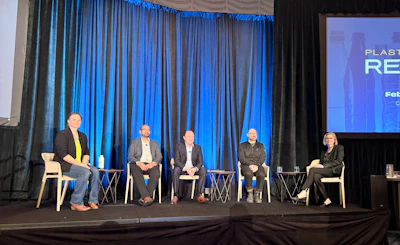
As Extended Producer Responsibility (EPR) deadlines approach, companies are reexamining flexible packaging design to ensure it can be processed by today’s recycling infrastructure. The message from industry leaders at the Plastics Recycling Conference last week is increasingly pragmatic: if packaging is meant to be recycled, it must be designed for what the system can actually handle.
For California, EPR targets are lofty. The state’s SB 54 law requires a 30% recycling rate by 2028 and 65% by 2032. According to moderator Kate Davenport, Chief Impact Officer at The Recycling Partnership, film and flexible packaging recycling rates are currently nowhere near those levels.
The SB 54 law includes both commercial and residential packaging streams. According to Neil Menezes, VP of Material Services at Circular Action Alliance (CAA), commercial material can act as a “gateway” because it can be cleaner and help stabilize markets.
“We view the commercial as what will help us stabilize the markets, make sure that are appropriate homes and then use that as a runway to develop appropriate end markets to manage more residential films either being collected separately or being collected through the curbside program,” Menezes said.
However, he acknowledged concerns from waste management companies and said the goal isn’t to force curbside film collection before systems are ready.
Teo Medellin—Director, Corporate/Global Packaging Sustainability, Procter & Gamble—said CalFlex estimates about 500 kilotons per year of residential flexible material in California. He said flexible recycling is “less than 5%” based on published recycling rates.
This means there is a significant way to go to reach the 30% and 65% targets.
For Patrick Keenan, General Mills Packaging Engineer R&D, the best way to meet these recycling targets is to focus on subsidizing the cost of sorted film by paying a cost-per-pound incentive to material recovery facilities (MRFs) and end markets to move material that is already being sorted but often landfilled.
“When you subsidize the cost of recycled content, the circle gets bigger,” Keenan said.
One way CPGs like P&G and General Mills are working to meet these targets is design shifts towards polyethylene (PE). According to Medellin, P&G is transitioning wrappers and
One way CPGs are working to meet these targets is design shifts towards polyethylene (PE). According to Medellin, P&G is transitioning flexible films to continue “pushing the envelope.”
Keenan said designing packaging to fit the market that exists is a strategy, adding that a more streamlined material mix can lower recycling costs. He also referenced the paper industry as an example of how virgin and recycled markets can function dynamically.
But, even perfect packaging won’t automatically deliver the 65% recycling rate goal.
Neil Menezes explained recycling performance is the product of multiple system variables—access, capture, sortation, and yield.
He said even if a company has 90% in each category, it will barely hit the 65% target. Highly efficient mechanical systems will lose material to contamination, degradation, or incompatible structures.
To close that gap, Menezes said chemical recycling could play a supporting role by managing material lost during mechanical processing, particularly yield losses that fall out of the system. Mechanical recycling remains the priority, he noted, but additional technologies may be necessary to recover more material as California pushes toward aggressive EPR targets.
Panelists also cautioned that chemical recycling is not a universal solution and is limited to certain material streams, reinforcing that multiple tools will be needed to approach the state’s recycling goals.