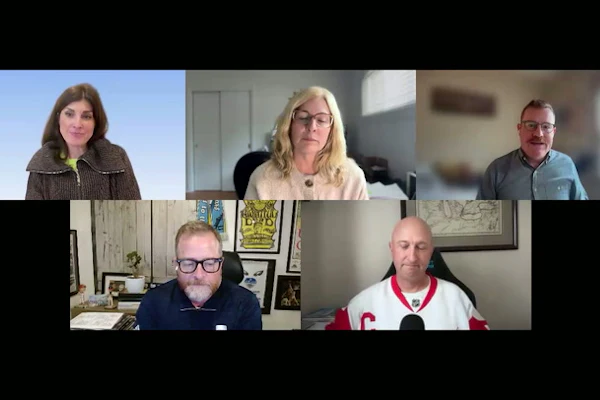
Matt Reynolds: Hi, I'm Matt Reynolds, editor of Packaging World magazine, and I'm here with my four colleagues this week. We've got a special guest for our End of the Line podcast, or video podcast, depending on how you're consuming it.
I've got with me, as usual, Sean Riley, editor of OEM Magazine, among many other things; Derrick Teal, editor of ProFood World; Liz Cuneo, editor of Healthcare Packaging; and this week, my partner in crime, Anne Marie Mohan, who is with me at Packaging World magazine.
The reason we brought in Anne Marie this week was because we had a slow week overall, but Anne Marie is fresh off a trip to the West Coast, San Diego, where the Sustainable Packaging Coalition (SPC) held one of its big biannual events.
They've got a few events, Impact and Advance. Which one was this, Anne Marie?
Anne Marie Mohan: This was SPC Advance.
Matt: Good. Give us the 30,000-foot view of what you saw there. I know I've been to a few myself. There's always good information, and they're always very heavy on the brand owner side and the NGO side. Give us the big picture.
Anne Marie: Sure, absolutely. Overall, looking at the agenda for this event, it was very similar to what you would find at a lot of sustainable packaging events today. It was very heavy on EPR subjects, flexible packaging, and PCR.
But what was really big at this event was not just EPR in general, but a real focus on California's EPR, which is SB 54. It was no coincidence that the show was in San Diego.
Producers, which are the users and brand owners using this packaging, are very focused on SB 54 right now because the first real deadline for source reduction is in January. They've had to start reporting their data, but they're really scrambling to start making changes.
There are a lot of questions about SB 54 because the plan hasn't been completely finalized yet with the implementation group, which is the Circular Action Alliance. They're the PRO, or Producer Responsibility Organization. Lots of acronyms.
There was a lot of interest around that. In fact, the first session on the first day was on source reduction, and it was packed, standing room only. One of the speakers commented that it really shows how much interest there is in this topic when a session is standing room only at 9 a.m. on a Monday morning.
It was a good event, with a lot of information on SB 54 and what's required, especially regarding source reduction and plastic materials.
Matt: I know we've been focusing a lot on Oregon because there's been a lot of movement on the objection to EPR there.
But really, California is the tail that wags the dog because we always talk about it as the world's sixth-largest economy in and of itself.
SB 54, correct me if I'm wrong, Anne Marie, is one of the more difficult, or aspirational, let's put a positive spin on it, EPR regulations to comply with, particularly some of the source reduction requirements.
Are there any details on how brands are approaching it? People have been lightweighting for years, but is there still runway to continue taking material out of packaging and maintaining shelf life?
Anne Marie: Sure. Just to confirm, yes, SB 54 is one of the most stringent EPR regulations right now, so that's what's causing a lot of this anxiety.
I understand more clearly now, from sitting in on these sessions, that the source reduction requirement is going to be 10% in 2027 and then 25% in 2032.
Ten percent of that can come from reuse, refill, or elimination, and then 15% can come from things like lightweighting, right-sizing, and switching materials. Eight percent of that 15% can come from recycled content.
That was the through line of the event. They talked about many different pathways to source reduction.
One we've seen a lot of is paperization. We've seen many companies switching from plastic to paper. There was a session where they discussed some of the more advanced fiber-based packaging technologies coming out right now, especially barrier coatings.
We know that's crucial in order to give paper the same properties as plastic for moisture resistance and grease resistance, while still hopefully being recyclable.
There was also a discussion on rPET, which has come up a lot lately at different conferences because, over the last year or so, maybe half of the PET recyclers in the U.S. have gone under. I think there were only six or seven to begin with, so it's a pretty big issue.
Matt: How are people trying to replace virgin PET with rPET to meet these goals? Are they going to be able to find it?
Anne Marie: It's not even that. The fact is that they're finding it through imports, which they think are not always recycled materials. They're actually buying virgin materials because they're cheaper right now.
The thrust of that discussion was that we need to support U.S.-based PET recyclers in order to have what we need in the future.
Matt: That's to create that pull market and get the engine running.
You mentioned paperization. Here's a quick shameless plug. I just got an email today from another one of our speakers. We've got Mars, Henkel Consumer Brands, and a couple of academic folks from NC State University who are on the leading edge of these new barrier properties and coatings that give paper packaging qualities like moisture resistance and oxygen ingress prevention, things that have been the domain of plastic for many years.
That'll be a Packaging World webinar coming up in November, I believe, so mark your calendars.
But you mentioned one other interesting thing that's on our radar. All of those pathways toward sustainability, or toward compliance with SB 54, have been things like lightweighting that people have been doing for years. They're known pathways, but they need to make more progress.
The big one that seems to have the most runway in front of it is reuse, refill programs, durable packaging that's used over and over again, or take-back programs.
Did you see any of that? You mentioned it, so it must have come up at SPC.
Anne Marie: I saw more sessions on reuse and refill than I think I've ever seen. In the past, there might have been one or two, but there were a lot of sessions.
There are different models for reuse and refill, but the one that really seems to be gaining the most traction right now is return on the go.
For example, we've done a lot of reporting on music venues or stadiums where the consumer uses a cup and then returns it right there. We saw some really good examples of that at the conference.
One was Revino. I did an interview with the co-founder and COO, Adam Rack, of Revino. They're in Oregon, and they're doing refillable wine bottles.
They're doing the bottle washing, but they also just got a really big grant from CalRecycle in California to build a bottle-washing facility there.
It's moving into California now. Wineries use the same bottle, but with a different label. The consumer buys the wine, uses it, and returns the bottle.
They've set up partnerships with different retailers where people can drop the bottles off. They've got 90 brands participating right now and about 2 million bottles in circulation.
There were several examples like that. There was one with a nonprofit called Perpetual that's doing a returnable foodservice program in Hawaii. There's one at Marks & Spencer.
A lot of what we're seeing is more of that return-on-the-go model. It requires the infrastructure to clean and return the packaging, but those systems are starting to be built out. It was exciting to see.
Matt: Interesting, because I remember for years we've been talking about the Ellen MacArthur Foundation's quadrants of reuse, and one of them is return on the go.
I forget the others, Anne Marie, you'll have to fill me in. But this seems to be the one that has the most momentum behind it at the moment.
Anne Marie: That's at least what I'm seeing.
Liz Cuneo: Refill and take-back programs seem to be more popular in Europe. Have you noticed that? Maybe we're slower to adopt them here, but it's an interesting thought.
I love the wine bottle example. I don't see why we couldn't do that.
Matt: Germany does it with brown beer bottles, and they have for years.
We were at Interpack earlier this year, and outside the restaurants there would be crates stacked up with brown beer bottles. They get washed and filled again. It's an extremely hygienic process.
The breweries themselves have take-back programs and the hygienic infrastructure to support them.
Germany is a smaller place. It's a big country, but it's still smaller and more homogeneous compared to the United States, which has 50 individual states with 50 individual rules.
But if you're seeing it in California, there's no better place in the United States than California when it comes to wine, I would say.
Again, that's the tail that wags the dog. When California moves, that can create movement elsewhere.
Speaking of webinars and sustainability, Sean, you had an all-hands-on-deck webinar at the last minute this week, but it led to some conversations about sustainability, I understand.
Sean Riley: It was interesting. Before I even get to that, I was thinking that wine works because the bottles are similar anyway. For the most part, the label is what stands out.
At first, I was thinking that wouldn't work with wine, but it makes sense because the label is really doing the design and marketing.
I had to do this webinar. We have this little show coming up called PACK EXPO, and it was actually about the Sustainability Central stage that Packaging World is helping put together.
I was talking to Joe Grib from EFP, one of the sponsors. He's been in the sustainability sector for 20 years, which, for our purposes, is about as long as sustainability has been a buzzword.
He comes more from the fiber-based side of packaging, but he was saying how surprised he was that EPS packaging had come off the Plastics Pact's problematic materials list.
Matt: EPS is expanded polystyrene, just to clarify. And yes, it was the problematic materials list.
Sean: He was as surprised as you were when we talked about it. It made me think about how we had discussed that on the End of the Line podcast.
I told him our people at Packaging World were just as surprised. He was noting how far EPS and materials like that have come.
He even referenced the same things you did about buying an appliance from Best Buy and how they're taking all the packaging back. There's a system in place for it.
I thought it was interesting that not only had you reported on it and talked about it, but it was being viewed the same way out in the industry.
If something like that can move the needle a little bit, I guess there's hope for sustainability after all.
Matt: The big thing with EPS was that they created this market where they needed to get the material back, and there was a use for it.
That's what circularity is. You've got to create this engine that's self-sustaining.
EPS has long been thought of as the red-headed stepchild of materials like PET, which is the star of the show because it can be recycled so many times.
EPS was the little engine that could. It got off that list, and now there's an actual circular market. I don't know if it's self-sustaining, but there are systems in place to make that happen.
Maybe the gold-star student, PET, could take a few lessons from polystyrene.
Good. What about the healthcare side of the world? Anything new that you've been following, Liz?
Liz: I've been following what's coming up at PACK EXPO, of course, as we get ready for the show.
I've also been talking to some interesting CPGs in the industry that have won awards from PMMI. It's the CPG NextGen Award.
These are the inaugural award winners, and they're delivering measurable advances in automation, productivity, sustainability, and packaging to transform how products are being made at their companies.
There are 10 award winners. I've been reaching out to them to get their stories, and I'm going to connect with them at PACK EXPO, which is exciting.
It's interesting to see how people are incorporating new ideas. Speaking of sustainability, what they're doing may be different from what was even thought about 20 years ago.
Someone has been doing cool things with AI, really implementing it and showing real results.
I had an interview this week about AI and how it can be hype if you don't do it right, if you don't have the process in place and the right data.
We have to be thoughtful about how we're using AI.
It's been fun connecting with these award winners and hearing about how they're changing their industries for the better.
I have a call next week with Charlotte Ashcroft from Just Born, which makes my personal favorite candy.
I was talking to my kids yesterday about our favorite candies, and Peeps might literally be my number one year-round.
Sean: That's a hot take.
Liz: I bought the Frankenstein little heads from Dollar Tree yesterday. They're so good. Halloween Peeps are almost number one.
Matt: That's breaking news.
Liz: That's absolutely breaking news. I've talked to Charlotte and Kim about how I really want to get in there and see them being made. They don't do public tours, and I missed my chance when there was a PMMI meeting there because I wasn't able to attend.
I would love to see Peeps on the line. That would be my dream. So if anyone has a chance, please invite me. I'll just take photos.
Matt: I can direct you to search Just Born and Peeps on Packaging World, and you'll find an in-depth article from about six years ago.
It's probably outdated at this point, but they had a lot of great new equipment in the facility at the time. I think the article covers both the processing and packaging sides.
It's been covered, but you're right. We like to get back to these places every once in a while.
Liz: They've been making Peeps since the 1950s. Not to go on a Peeps tangent, because I really dove into it, but they've been around a long time. They know what they're doing.
There's a reason they've been making them since the '50s.
Matt: Good. And shout-out to Charlotte, too.
She was at our Packaging Recycling Summit a few months ago, and she's one of those people on the leading edge, I know I'm using that term frequently, in terms of being able to wrestle with EPR and create systems within her own company.
Just Born isn't Nestlé or Mondelēz. They don't have a team. They just have Charlotte, who's wearing five other hats.
But she was still able to navigate their EPR exposure as an obligated party in the states they sell into. California and Oregon, Peeps are everywhere.
Charlotte had a good story about that, and Anne-Marie, I think you wrote the story, too. Again, it's on PackagingWorld.com.
We've all been on pins and needles because I think Derrick has some big news out of the big brand-owner space.
Come on, it's a cliffhanger. Let us know what's going on.
Derrick Teal: First, Liz's background has been bothering me, and I finally figured it out.
I'm waiting for a Muppet to pop up next to her and start telling me "A is for Apple" or "C is for Cookie." She looks like she's in a background from Sesame Street.
But Pepsi came out with its third-quarter results yesterday, and a couple of lines struck me. I had to get out the reading glasses here.
I had a bag over my head earlier, a Red Wings jersey, but I couldn't put the glasses on with the bag.
A couple of lines struck me. One was:
"We continue to operate with a high sense of urgency to sustainably improve the company's financial and marketplace performance," most notably in North America.
And then this line:
"We expect North America's core operating margin performance to remain under pressure in the fourth quarter. We aim to partially mitigate this pressure through productivity savings, operational excellence, and tightly managing costs."
Now, if you were a manager of one of these plants, what would you be thinking right now?
Matt: I'd be getting on LinkedIn.
Derrick: It does not sound good. Pepsi is one of the largest manufacturers of food and beverage products by revenue, and they serve as a bellwether for other large manufacturers.
Hearing that, they say sweet and salty snacks are up, other beverages like Gatorade are up, but overall, performance is lagging.
I know we've talked about this before. Larger manufacturers have to appease shareholders, which isn't quite the same situation as a smaller, privately held manufacturer that doesn't have those same financial burdens.
But it does indicate a couple of things for people employed by these larger manufacturers.
Start looking at LinkedIn, or recognize that we've already been talking about this at ProFood World for nearly two years.
Our whole editorial premise this year was doing more with less, and I feel like it's just getting worse and worse.
Hearing Pepsi say in the third quarter that they're going to address fourth-quarter pressures by tightening their belts even more sounds tough.
Matt: Is there a space here for automation, though?
Is this an automation play where, in the age of AI, everything from warehouse automation through the packaging line and even into processing could provide a savings route?
Derrick: That's a very difficult question.
I think we've talked about this offline. Automation comes with a couple of caveats, especially for a company like Pepsi that has probably already invested heavily in automation.
How much more can you automate?
Automation also has other costs that might not be easily recognizable in terms of production capabilities because it is specialized equipment.
We've talked about what happens when something goes down. You're going to need a specialist to come in. Can you get a specialist? How long will that machine stay down before you can get it up and running again?
Whereas with mechanical equipment, it might not take quite as long, assuming you have somebody in-house who's qualified to fix it.
I don't know that automation can come in and solve the problem.
I think it's probably more along the lines of consolidation, to be honest.
If you have a couple of smaller plants operating on thin margins, you might bring those operations into another plant or expand another plant's operations.
You might lay off a few workers and bring others into the consolidated plant, so you're not paying quite as many people but still have the operations running.
It's not painting a good picture.
I feel like every time I talk, I say weird things, but then I also say things that aren't particularly good for the industry because it doesn't look particularly good.
And it's not just food and beverage. I feel like manufacturing in general is getting tougher and tougher based on a whole lot of things that I don't want to get into right now.
It's just difficult.
A lot of what we've been covering in ProFood World is how to do more with less.
And a lot of it, as we've talked about before, is going through your operations and asking whether you have a leak somewhere. Just fix the leak.
These little things add up, especially over time.
Water costs are another example. That's something we're going to be covering later because, among other things, the cost of water is going up.
You've got to find additional ways to conserve water.
A few episodes back, we talked about whether sustainability is now worth the investment.
There may be a cost premium for machines that can reuse or recirculate water, or for something like a heat pump.
Maybe those expenses are worth it now because the ROI could be quicker than it was before.
Matt: Nothing sparks a movement toward sustainability like being able to save money while doing it.
It's the impact on the bottom line. If it keeps companies in the black, nobody will move faster than brands to find ways to help their margins, even in minor ways.
Good. Have we covered everything, Derrick?
I know you've got your sports. Sorry about the Detroit sports situation.
I've got one more chance on Saturday night to beat Cleveland. When this airs, we'll know whether the White Sox have made it to the ALCS. Wish me luck over the weekend.
Group: Good luck.
Derrick: At least the Detroit teams have time. It's the beginning of the season for them, not the end.
Matt: It's now or never for the White Sox. Anything beats a 100-loss season, which was the last two years.
Well, that's about all the time we have for this week's edition of the End of the Line podcast and video podcast. I got it right that time.
We'll see you next week, and we'll be leaning into PACK EXPO very soon, if we aren't already. Thanks, everybody.