Artificial intelligence was hard to miss on the opening day of Automate 2026. The more useful conversations were the ones that separated marketing language from working hardware.
The show opened June 22 at McCormick Place in Chicago, running through June 25. Produced by A3 – Association for Advancing Automation, this year’s event is expected to draw more than 50,000 attendees across a floor packed with over 1,000 exhibitors. The term AI was nearly impossible to avoid on the floor, which made the booths worth visiting the ones where vendors could explain what their machines actually do.
A note for packaging professionals walking the floor. Much of what vendors described as “packaging” automation leaned toward e-commerce order fulfillment, warehouse logistics, and third-party logistics work rather than primary or secondary packaging on a CPG line. The capabilities still translate, particularly for high-mix handling, but the demonstrated use cases skewed toward the parcel and case-handling end of the operation.
Defining a buzzword
The term “physical AI” was everywhere on the floor, often without much explanation, which makes a working definition worth pinning down. Alexandre Boffi, manager – general industries sales at Kawasaki Robotics offered one of the cleaner explanations, pointing to machines that act in the world rather than just compute. “Imagine a humanoid. That thing’s making decisions on its own and it’s moving. That’s a form of physical AI. Autonomous cars are a form of physical AI,” he said. He distilled it further. “It’s the mechanical manifestation of artificial intelligence.”
Boffi was also candid about the noise around the term. The risk for buyers, he said, is treating AI as a feature in itself rather than asking what a machine actually does. “AI is a buzzword that five, 10 years ago, everybody was saying, cobot this, cobot that, and now it’s AI and we see it in our daily lives,” he said.
Sarah Andrzejewski, product manager – software solutions, at Yaskawa America, drew the same boundary in her conference session. She separated generative AI, the chatbot-style tools that create text and images, from agentic AI that reasons through multi-step goals, and finally physical AI. “You can think of physical AI as AI that operates within the world,” Andrzejewski said. “So any kind of robotic system that uses AI to reason and then actually moves.”
Kawasaki builds for the camera, not the teach pendant
Kawasaki used the show to introduce the RL030N, an eight-axis robot with a 30-kg payload and 1,925 mm reach, built from scratch for high-speed packaging and parcel handling. The company calls it the industry’s first eight-axis robot designed specifically for physical AI applications. The configuration is unusual, with a rotating “diving board” joint and a sub-segment in the lower arm that most robots lack.
The design started with a customer problem that existing robots could not solve. “The design criteria that was needed for certain packaging applications didn’t exist,” Boffi explained. “So rather than trying to shoehorn an existing solution into what they needed, we started from scratch.”
The robot is built around real-time control, meaning a camera, PLC, or sensor array tells the arm where to go rather than the arm following a pre-taught routine. Kawasaki runs this through its open KRNX control API, which lets external AI software, ROS environments, and vision platforms drive the robot directly. That matters for fast-moving operations where programming time kills the business case. As Boffi described it, the old model of an engineer spending two days at a teach pendant no longer fits high-mix, low-volume work. Speed of instruction matters more than millimeter precision. “What’s more important is that the robot’s able to move from point A to point B very quickly, and it’s able to receive instructions quickly,” fast enough that the package has not moved between the camera’s read and the arm’s motion, he explained.
The unusual geometry also solves a specific failure mode. Six-axis robots can hit singularity, a lockup point where the arm cannot decide which way to move, and that becomes a serious problem when commands stream in continuously. The RL030N’s kinematics avoid it. Boffi was clear about where this fits. “This particular robot is really driving our growth in logistics, warehousing, e-commerce, and 3PLs,” he said. He also drew a line that buyers should hear. “This is not an AI robot. What it is is a robot that’s really well suited to AI technologies.”
Kassow brings seven axes and an integrated controller to palletizing
Danish cobot maker Kassow Robots, majority-owned by Bosch Rexroth since 2022, showed two new models. The headliner for packaging is the KR 1824, a seven-axis cobot reaching 1.8 meters with a 24-kg payload, aimed squarely at palletizing. Dieter Pletscher walked through why a seventh axis earns its added complexity and cost on a pallet cell.
“Of course, as all our robots with seven axis, it gives you much more flexibility,” Pletscher said. “You can grip around the corner.” The extra joint lets the operator control where the elbow sits, which prevents collisions with tall pallets and large boxes that trip up six-axis arms. The company’s founder, Kristian Kassow, helped develop Universal Robots‘ original UR5 before starting Kassow, and the new arms carry that lineage in an all-aluminum, compact build with stacked first and second joints that save floor space in tight brownfield lines.
The palletizing cell on display worked with a Bosch Rexroth conveyor and a self-contained suction gripper that generates vacuum at the tool, eliminating the need for compressed air. Setup runs off a simple recipe. The operator defines box size, pallet size, and the desired stacking pattern, and the Bosch software generates the program automatically.
The second new model, the KR 1240, reaches 1.2 meters with a 40-kg payload, suited to heavier conveyor-to-station transfer work. Kassow also showed its Edge edition, which integrates the controller directly into the robot base. The idea came from a U.S. textile project where the company mounted an arm on an automated guided vehicle (AGV) and ran into the problem of where to put a bulky controller box. “We can see where now we get more and more combination of this AGV with a robot arm,” Pletscher said. A two-armed mobile unit with a 3D camera, combining Kassow’s arm with Bosch Rexroth’s AGV, is already sold in Europe for internal logistics and packing, and made its U.S. debut at the show.
On whether AGVs and AMRs will land in packaging operations, Pletscher was optimistic but measured. He sees forklift automation and mobile picking arriving steadily, particularly for the repetitive transport work between processes. His advice to cautious adopters was to start small. “Don’t start with the most complex job. Start with the simplest, learn it, get some inspiration, find out what is working, what is not working,” he said. He also sees packaging as one piece of a bigger picture. “Packaging for me is just a part of the whole logistics,” he said, arguing that operations should look at the full material flow rather than isolated steps.
Yaskawa’s Motoman NEXT targets the messy middle
Yaskawa Motoman used a conference session to introduce Motoman NEXT, its physical AI platform built for semi-structured and unstructured work that traditional robots avoid. Tasks like random bin picking, variable assembly, and high-mix material handling stay manual because the environments are too unpredictable for conventional automation; those are the jobs the platform is meant to take on.
 Yaskawa America product manager Sarah Andrzejewski walks through Motoman NEXT, the company's physical AI platform built around an embedded NVIDIA Jetson Orin, during her Automate 2026 session.PMMI Media Group
The platform pairs new dedicated manipulators, the industrial NEX series spanning the NEX4, NEX7, NEX10, NEX20, and NEX35 at payloads from 4 to 35 kg, with a YNX1000 controller that embeds an NVIDIA Jetson Orin GPU directly inside for native AI processing. A path-planning service generates collision-free motion on-the-fly, a machine vision service runs on a licensed Halcon library, and a force control service gives the robot a sense of touch. Programming moves to an Android tablet, and operators can use natural language and icon-driven interfaces rather than proprietary robot code. “We’re trying to democratize automation, so we’re trying to eliminate the skills gap,” Andrzejewski said.
The industrial manipulators release this month, with collaborative versions, the NHC12 and NHC30, following in the coming months. Yaskawa is also opening a new robot factory in Franklin, Wis., to build robots in the U.S.
The cobots carry built-in RGBD body cameras, force-limiting sensors, and rounded edges that let them work inches from people without a cage. Building the safety into the hardware shapes how the AI operates. “This inherent safety provides a way for physical AI to experiment and adapt in real time while working inches away from the human,” Andrzejewski said. “Because it can stop itself, it’s able to be a bit more aggressive in its learning.”
The demonstrations stayed close to packaging and fulfillment work. One recreated a grocery bagger that used overhead cameras to identify items in a bin and sequence the pack dynamically. Another depalletized mixed stacks of bags and boxes, with a second arm using a knife to open rice bags and dump the contents A loading demo handled transparent cups that had been stacked and squished out of shape in a cluttered box, with the robot adapting its grip to each deformed cup. A dual-arm unit, trained through imitation learning in NVIDIA Isaac Sim, wrapped products in bubble wrap, boxed them, taped the box shut, and smoothed the tape “kind of like a human,” she said.
Pressed during Q&A on whether the demos were truly unstructured, Andrzejewski did not overstate it. Most fell into the semi-structured category, she acknowledged, and fully unstructured work often calls for a humanoid rather than an industrial arm.
Festo attacks air waste at the end of the arm
Festo’s contribution sat further down the bill of materials but speaks directly to operating cost. The VTUX valve terminal integrates pneumatic control, vacuum generation, and I/O into a single lightweight platform mounted at the point of actuation. Two new eco functions go after compressed air consumption at the end of arm.
 A Festo demonstration lets visitors select a fieldbus protocol, EtherCAT, PROFINET, or EtherNet/IP, and connect it to different PLC brands, illustrating the multi-protocol integration behind the company’s automation platform.PMMI Media Group
On the vacuum side, threshold-based control generates vacuum only when grip levels drift outside defined limits, which the company says cuts compressed air use by 20 to 30% while holding a stable grip. On the pressure side, the system learns the minimum pressure needed for each motion after a short learning phase, delivering up to a 40% reduction in air consumption. Sensors built into the terminal report pressure and vacuum data at the point of use, giving operators visibility into grip loss before a part drops.
Festo paired the VTUX with a new CTED module, a low-cost way to expand valve terminal networks without re-engineering the host control system. The CTED configures to major fieldbus protocols including EtherNet/IP, PROFINET, EtherCAT, CC-Link, and Modbus TCP, which means OEMs no longer need to stock separate communication modules for each control architecture. A serial interface, rather than a parallel bridge, carries diagnostic and sensor data straight through the terminal. The VTUX terminals are assembled and tested at Festo’s Regional Service Center in Mason, Ohio.
The Humanoid Robot Pavilion was the floor’s best entertainment
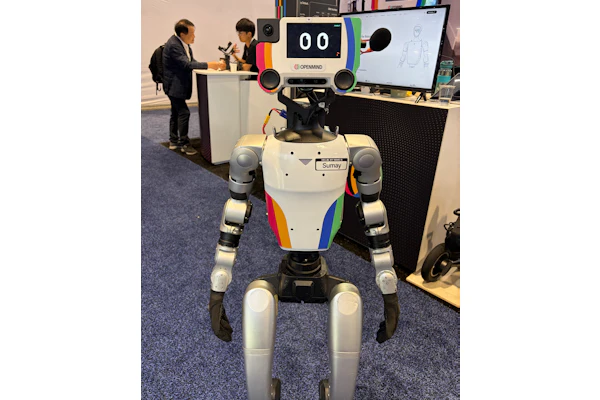
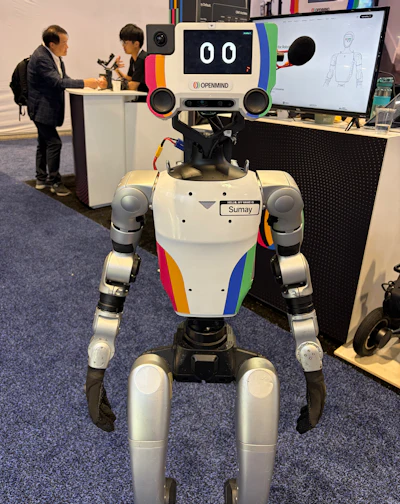
The NVIDIA-sponsored Humanoid Robot Pavilion drew steady crowds, and for good reason. One booth ran Richtech Robotics’ ADAM, a two-armed barista whose nameplate read “Accelerated by NVIDIA,” pulling coffee from a station on the counter. At the Unitree Robotics booth, a four-legged quadruped, a robot dog, drew its own crowd doing backflips off the carpet, with a row of identical units lined up behind it. A third robot, running OpenMind’s software and wearing a “Sumay” nameplate, fielded questions in multiple languages from a steady line of onlookers.
 Richtech Robotics’ ADAM, a two-armed barista accelerated by NVIDIA, serves coffee at the Humanoid Robot Pavilion during Automate 2026 in Chicago.PMMI Media Group
It made for a genuinely fun stretch of the floor, and the engineering on display was impressive. For packaging operations evaluating where to spend a capital budget this year, though, the honest read is that bipedal humanoids and four-legged robots are not yet suited to production packaging lines. The arms, vision systems, and AI behind them are advancing quickly, and several of those subsystems are showing up in the industrial robots that are ready to deploy. The walking machines themselves remain a few cycles away from earning a spot on a CPG line.
That gap between spectacle and shipping product ran through the whole day. The most useful conversations were the ones where vendors drew clear lines around what their machines actually do. Boffi put the distinction plainly when describing the RL030N. “This is us actually doing it and we’ve done it and we continue to do it, and we have been doing it for years,” he said. PW