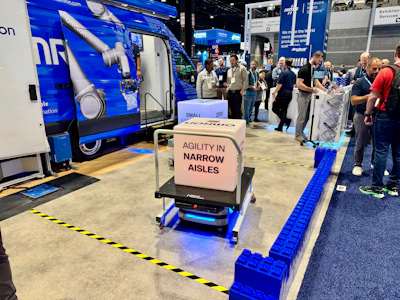
OMRON Robotics unveiled its next-generation LD-150 and LD-300 autonomous mobile robots at Automate 2026 to address manufacturing labor shortages by automating material transport tasks and freeing workers for higher-value activities, featuring enhanced payload capacity, faster speeds, advanced safety capabilities, and compatibility with existing OMRON fleet systems.
- 400,000 unfilled manufacturing jobs are driving demand for AMRs that can take over manual transport and replenishment tasks
- New 360-degree safety rating allows the robots to operate at full speed in both forward and reverse, reaching more than two meters per second in either direction.
- LiDAR-based dynamic navigation enables robots to navigate autonomously around humans, forklifts, and changing layouts without fixed paths or factory infrastructure changes
- OMRON FLOW Core integration enables mixed-fleet management and compatibility with legacy LD-series robots and other OMRON mobile robots
- Modular topper solutions from partners like ROEQ and NORD Modules allow integrators to deploy cart-transport applications without custom mechanical work on the AMR
OMRON Robotics used its Automate 2026 floor space at McCormick Place to debut the next generation of its flagship LD Series autonomous mobile robots — the LD-150 and LD-300.
The LD Series has been on the market for more than a decade and remains OMRON's highest-volume AMR family. The new units are pitched at the same core use cases — cart transport, line-side replenishment, and work-in-process movement between cells — but with significant gains across payload, speed, footprint, charging, and safety.
The labor-shortage frame
Justin King, vice president of product management, marketing, and business development at OMRON Robotics, framed the launch against the manufacturing-labor backdrop that has dominated Automate conversations this week. “We have, you know, 400,000 jobs or whatever it is that are unfilled in manufacturing,” he said. “It's really a structural issue that I think these robots really have to fill.” The pattern he sees among OMRON customers is AMRs taking over manual transport tasks and freeing workers to be redeployed to higher-value activities.
“Manufacturers are under pressure to move materials faster while adapting to labor constraints, changing layouts and rising throughput demands,” King said in a statement accompanying the launch. “The LD-150 and LD-300 give customers a more flexible AMR platform for heavier transport tasks in tighter spaces, with fast wireless charging and OMRON FLOW Core integration to simplify deployment and mixed-fleet management.”
The safety story
King said the practical effect of the safety package is what shows up on the floor.
“If you have this 360 safety, you can operate completely in a functionally safe way in both directions,” King said. “If it's not functionally safety-rated, then what will happen is you have to move much slower.” Non-safety-rated AMRs typically drop to about half a meter per second, he said. The LD scanners pick up obstacles out to 30 meters in general sensing, with a five-meter functional-safety range.
Both units use LiDAR-based mapping rather than fixed paths. Operators walk the robot through a facility to build the initial map; from there, the unit navigates dynamically, working around humans, forklifts, and changing layouts. “AMRs are designed to work completely autonomously,” King said. “If you have an existing brownfield factory you want to bring automation into, you want to improve how you're managing your flow of material without changing the factory. These are great solutions.”
Mixed fleets and partner toppers
The new robots run on the same OMRON FLOW Core fleet management stack and can operate in mixed fleets with legacy LD-series units and other OMRON mobile robots. That continuity is a deliberate pitch to customers with existing OMRON deployments.
OMRON's Automate booth paired the new AMRs with topper solutions from ROEQ and NORD Modules — modular accessories with built-in lift mechanisms that handle the dock and interface with the cart or load. The approach lets integrators stand up cart-transport applications without custom mechanical work on the AMR itself.