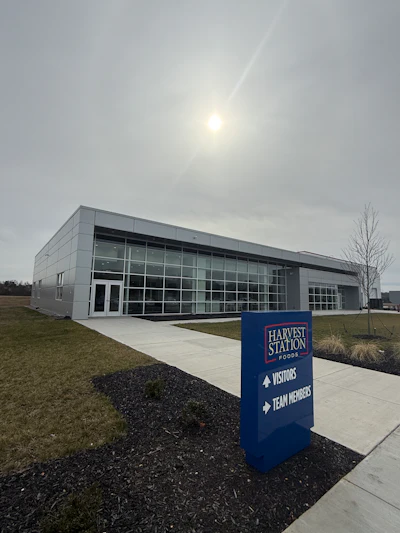
Historically, people have questioned the freshness of certain food products found in convenience stores. But with the global convenience market projected to reach $1,460.3 million by 2036 with a compound annual growth rate of 7.2%, it’s vital for C-stores that their customers are confident in the products they’re buying. In Loudon, Tenn., positioned deliberately on 60 acres, Harvest Station Foods is creating a new chapter in vertical integration to deliver on freshness.
| Name: | Harvest Station Foods |
| Location: | Loudon, Tenn. |
| Size: | 110,000 sq ft (approx) |
| Production: | Baked goods; prepared foods |
| Opened: | March 2025 |
While operating as its own entity, Harvest Station Foods was the venture of Weigel’s, mostly known as a chain of U.S. convenience stores primarily located in the South. That ownership structure is intentional—and strategic.
“We did make this a separate company, Harvest Station Foods, because we view Weigel's as a customer for us,” says Beth Hoffer, Weigel’s VP of Foodservice. She adds with a smile, “We did build a nice big facility. Weigel’s is helping us pay the bills right now. We appreciate that.”
A manufacturing legacy before retail
 Harvest Station Foods provides Weigel's C-stores with bakery and RTE products, and it was built with the expectation it will provide goods for others, too.CMC Design-Build
“Weigel's actually got their start in farming and manufacturing, beginning as a dairy company,” Hoffer says of the company that's been in business for 95 years. “We opened up one of the first dairies in East Tennessee. We still operate that dairy and have been in manufacturing longer than we've been in C-stores, actually.”
The pivot to retail came from necessity. “Mr. Weigel, having a farm that did milk home delivery, really put him in a bind because, all of a sudden, there was no one there to get milk. So, he opened up these tiny little bitty stores, and he called them Jug O’ Milk Stores,” Hoffer continues. “They were maybe 900 sq ft to start with, and you would just pull up and they would give you your milk out the window. We had a drive-through before I think people even knew what drive-throughs were.”
Over time, the assortment expanded. “He went to the second ever NACS (National Convenience Store Association)… and found out that he could sell candy, and chips, and crackers, and all the other staples in this little store, like having a little convenience store. So, he did that, and then we evolved from there.”
The push toward in-house food production
Fourteen years ago, Weigel’s began testing its ability to manufacture more of its own food.
“About 14 years ago, we thought we wanted to have our own bakery,” says Hoffer. “We had no idea what we were doing, but we made it work, and we built a bakery—we actually have a really good following—and it became kind of a staple in the community. We're known for milk, now we're known for bakery, and that's all good.”
But as store count grew, complexity grew with it.
“As we continue to grow those stores, we thought about food safety. How do we take away some of the noise out of the stores for our employees? Because food's really hard, and you're asking people to do a lot. And so how do we simplify some of those processes and get our employees back to taking care of our customers and doing the right thing there?” says Hoffer.
The answer was centralization.
 A second line was added to the new facility's bakery to complement the original line brought over from the previous, leased facility.CMC Design-Build
“I remember when we used to—I mean, I literally remember when we used to run thousands of donuts down that line,” she says. “Boy, this is so much better.”
“It was a big shift from how [Weigel’s] previously produced these products,” says Nate Larose, Director of Project Development at CMC Design-Build, which worked on the project. “Not only with the equipment but in the flow of the design of the facility. That was a big shift for them.”
In addition to the bakery, Harvest Station Foods also produces RTE foods, such as sandwiches and frozen pizzas.
High Care and USDA flexibility
The variety of products produced at the facility required attention to detail with regard to regulatory requirements. So, the project team built it to exceed the minimums.
 The pizza line is capable of quickly producing pizzas with a wide variety of toppings.CMC Design-Build
The plant includes a dedicated High Care space that was designed to meet USDA standards. It’s here where pizzas, salads, sandwiches, and other prepared foods are made.
Even in areas not directly governed by USDA oversight, the design anticipates future flexibility. For example, rooms were designed to meet USDA standards even though they may only currently be getting utilized for FDA-approved products. Following those design standards affords Harvest Station Foods the option should needs change.
 Once made, pizzas are run through a nitrogen tunnel freezer prior to packaging.CMC Design-Build
A data analysis kicked off the project to ensure that there was a properly sized storage component that could met the operational needs, which included the continued expansion of stores serviced by Harvest Station Foods.
“It’s a balancing act of maximizing the efficiency of the space,” says Larose.
Line design and labor efficiency
On the bakery floor, layout decisions reflect deliberate thinking about movement and labor.
“We run Revent, Baxter ovens,” Hoffer notes. “We have two mix rooms. In one mix room, we mix muffin batter, cookie batter, and cake batter—just a different kind of mix. And because those items are either going to go down this fryer or into one of these ovens, we wanted a separate room so we didn't have employees walk that extra 100 feet since it's not very useful, right?”
Sequencing is precise on the donut line, she says. “Everything comes down the line. The first things that come down the line are products that are going to receive icing or they're going to receive a filling on the donut side and then after that we turn on the glaze.”
Hoffer believes site visits matter. “I think a whole lot more today than probably 15 or 20 years ago, it's really important for an end customer to come and do visits because there are things that have happened over the last several years in manufacturing, especially in food manufacturing. Being that end user, we've gotten more proactive in going and doing site visits and making sure those HACCP plans are in place and everything is right for food safety.”
Having a client that knows the business and knows what’s needed can be helpful. In the case of Harvest Station Foods, much of the equipment for half of the building wasn’t really in doubt. “She spearheaded most everything for them, especially on the bakery side,” says CMC Design-Build Senior Project Manager Jake Seiden of Hoffer. “She knew exactly what they wanted, and then the other side was kind of a blank canvas because some things were known and some things weren’t. There were some modifications along the way to make it all fit.”
Designing for people
Efficiency at Harvest Station Foods extends beyond line design. It includes the workforce.
The challenges faced by F&B manufacturers to attract employees has meant taking a different tact when it comes to facility design. As Hoffer explains, “After having run the bakery for seven years, I was determined that we would have natural light.” She got it.
 Infusing break areas with light was a non-negotiable need for Harvest Station Foods. It was achieved by using large amounts of glass on the frontage.CMC Design-Build
“We always try to put glass in the break room because people spend so much time working in the cold, inside with white walls,” says CMC’s Pratt. “And when they go take their break, they need to get some sunlight.”
“We visit plants all the time that are older and maybe don’t have a nice employee amenities area,” adds Larose. “You'll see everybody leave the building and sit in their car for lunch or breaks. Having an employee amenity area like Harvest Station Foods is a nice change of scenery versus being in a refrigerated box.”
The facility includes locker rooms and a separate employee entrance. It also includes a dedicated nursing space that connects to the production restrooms and locker rooms. Again, the idea was to be employee focused so people wanted to be there. “I think that people have a choice nowadays, more than ever, to choose where they work and who they work for,” says Hoffer. “It's really important to treat people well.”
Looking ahead
Harvest Station Foods was built to serve Weigel’s—but not only Weigel’s.
“We will continue to grow the business and be able to service C-store chains or grocery stores or restaurants or broadline distributors that are wanting to distribute to them,” says Hoffer.
 Plenty of space is available for future expansion of the facility.CMC Design-Build
Expansion will likely happen sooner rather than later with a new product offering already on Hoffer’s mind. “I'm going to do kolaches out here,” Hoffer says jokingly—or not—having enjoyed the Czech and Slovak pastry while on a trip to…Texas.
It’s a small comment, but it underscores a larger reality: Harvest Station Foods was designed with flexibility in mind—USDA-compliant build standards, segregated heat zones, dual mix rooms, daily distribution, and a structure that treats even its parent company as a customer.
For Harvest Station Foods and Weigel’s, manufacturing isn’t a side business. It’s a return to form.