The Poly Coated Paper Alliance has demonstrated that polycoated paper can be recovered at scale through sortation testing showing 90% recovery potential, challenging misconceptions about mill acceptance and system capacity while advancing EPR policy discussions.
- 90% recovery rate achieved in sortation testing across multiple formats in Oregon, proving polycoated paper can be effectively separated from mixed paper streams
- The Poly Coated Paper Alliance unified fragmented industry efforts by bringing converters, brand owners, and recyclers together to gather consistent data on material performance
- Polycoated paper represents only small volumes in mixed paper bales, addressing concerns that widespread acceptance would overwhelm material recovery facilities
- Mills actively want the material due to high fiber yield value, contrary to long-standing industry assumptions that discouraged recovery efforts
- EPR policy classification remains complex, with California's SB 54 creating multiple covered material categories that don't always align with actual recycling performance data
At SPC Impact 2026 in Nashville, the panel “Finding the Onramps: Paving the Way for Poly Coated Paper in the EPR Landscape” addressed an issue that has become more pressing as a greater number of brands move toward fiber-based packaging. As interest in replacing plastic grows, materials like polycoated paper are getting more attention and more scrutiny around how they perform in recycling systems.
The discussion focused on the work of the recently formed Poly Coated Paper Alliance and the data the group has been building over the past few years. Panelists, who hailed from PCPA member companies, pointed to bale audits, mill conversations, and sortation testing as ways to better understand how much of this material is in the system and how it performs once it gets there.
At the same time, they acknowledged that the work is still ongoing. Questions remain around consistency across facilities, how different formats behave, and what conditions are needed to support recovery more broadly.
The genesis of the alliance
The idea behind PCPA came from a recognition that different parts of the industry were tackling the same problem separately. Work on cartons, cups, and other coated formats had been underway for years, often with similar goals but without a shared framework.
Scott Byrne, VP of global sustainability and industry affairs at PCPA member company Sonoco, said the group came together after realizing how much duplication was happening. “We basically were going to do the exact same work that the Carton Council had done for a decade, which was the exact same work that FPI [the Foodservice Packaging Institute] and Closed Loop Partners were doing on paper cups for probably a decade as well,” he said.
That fragmentation made it harder to communicate clearly about recyclability. “Messaging got very confusing,” Byrne added. “People didn’t really understand why is this recyclable, but not that.”
 From left, Scott Byrne of Sonoco and Teo Medellin of Procter & Gamble.Packaging World
The goal became bringing those efforts together under one umbrella. “We asked ourselves, can we build a bigger tent? Can we get all polycoated paper converters, brand owners, recyclers together and try to solve some of these problems before some of these big challenges like EPR tried to solve them for us,” he said.
For brands, the starting point was more basic. Teo Medellin, director of global packaging sustainability at PCPA member company Procter & Gamble, said the group began with a need to understand the material itself. “When we started, we didn’t know much, right? And we set up this effort to … go and talk to mills,” he said, describing early confusion around what different facilities would accept.
Building a clearer picture with data
A large part of PCPA’s work has focused on gathering information from across the system. That includes how materials move through sorting facilities, what shows up in mixed paper bales, and how the material performs at mills.
Jason Pelz, VP of sustainability US and Canada at Tetra Pak who represented PCPA founding partner the Carton Council, said the group started by trying to define the problem. “We needed to have a data workstream… what we needed to understand is what is in the pool,” he said. He added that details matter. “What type of fiber, what type of things that might be in the fiber, what type of polymer… all of those things matter if you’re going to try to figure out a way to get the material recycled.”
That work has helped clarify both volume and performance. Lena Zodda, senior manager of government affairs at PCPA member company Graphic Packaging International, said one of the biggest misconceptions has been scale. “If you break apart a mixed paper bale, the amount of polycoated is very small,” she said.
Sortation testing has added another layer. Medellin pointed to early results showing strong recovery potential under the right conditions. “We can recover 90%… on the sorting line of polycoated packages,” he said, noting that the study, conducted in Oregon, covered multiple formats.
Addressing common misconceptions
Several speakers spent time unpacking long-standing assumptions about polycoated paper.
One of the most persistent is that mills do not want the material. Medellin said that came up repeatedly in early conversations. “There was a notion that no, mills don’t want this type of material,” he said. The work since then has helped shift that view. “The truth is different,” he said, pointing to the value of the fiber and the need to demonstrate it through data.
Another concern is that polycoated materials would overwhelm the system if widely accepted by MRFs. Byrne said that perception does not match what the data shows. “Most of what’s out there is something that is a relatively high fiber yield. It’s already in a mixed paper bale, it’s already going to paper mills,” he said.
Zodda reinforced that point in more practical terms. “It’s not like they’re going to just open the back of the truck and it’s all going to be polycoated,” she said.
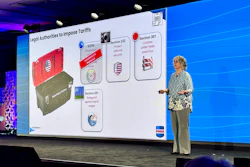
 Lena Zodda, Graphic Packaging International, and Jason Pelz, Tetra Pak.Packaging World
Even technical concerns around sorting have been part of the discussion. Pelz noted that no system is perfect, but technology is improving. “NIR does a great job. Is it perfect? No, but there are additional things now that do a better job,” he said, referencing AI-assisted sorting tools.
Connecting recovery to end markets
Speakers repeatedly came back to one point. Recovery only works if there is a viable end market.
Pelz said that lesson has been clear from earlier efforts. “If you have a MRF who’s got to sort it, they’ve got nowhere to sell it, it kills it right there,” he said.
That has shaped how the group approaches solutions. Rather than assuming a single pathway, the focus has been on multiple outlets depending on format. “It’s still a varied enough group of products. Maybe there are four solutions or six solutions,” Pelz said.
The broader context is also shifting. Byrne pointed to changes in the fiber stream itself. “Newspaper is going to go away, it’s decreased like 80% and it’s going to go to zero,” he said, describing how mills are already adapting.
That creates a different kind of pressure. “You’ve already done it once… the paper stream has changed, it will keep changing,” Byrne said.
Pelz framed that shift in similar terms. “It’s a challenge and it’s an opportunity,” he said, noting that disappearing grades create demand for new sources of fiber.
Recovery drives product innovation
The panel also connected recovery to how products and packaging are evolving. Medellin described how brands are rethinking formats in ways that change packaging needs. Using Tide Evo as an example, he explained the move from liquid to dry tablets. “Now we are going back to dry forms… we have tablets now,” he said.
That shift reduces the need to ship water but introduces new challenges. “If I distribute it, I need to make sure that it stays on the shelf for a decent amount of time,” he said. Polycoated paper provides a way to do that while still relying on a fiber-based structure.
The implications go beyond a single product. “It’s not just about changing the packaging but also how we deal with product,” Medellin said.
That shift is part of why materials like polycoated paper remain part of the conversation. “It just opens to innovation, to new ways of thinking of the products that we use today,” he said.
How EPR policy is shaping the future of polycoated paper
As EPR programs begin to take shape, much of the conversation is shifting toward how materials like polycoated paper will be classified and whether they meet recyclability criteria under state rules. California came up repeatedly during the session as an example of how complex that process can be.
Byrne said the current regulatory landscape leaves room for interpretation. “It’s likely that some polycoated paper will meet the requirements as they’re laid out today. Some probably doesn’t,” he said, noting that the way materials are categorized can create artificial distinctions. He added that part of the work ahead is helping regulators understand where those lines may not reflect how materials actually behave in the system.
That challenge is already playing out in how California defines covered material categories in its EPR legislation, SB 54. Teo Medellin pointed to the number of classifications and the difficulty in fitting polycoated formats neatly into them. “There’s complexity in getting there because it’s not very clearly defined,” he said. At the same time, he noted that progress is happening. “There was one particular CMC [covered material categories] that was defined as not recyclable, and we were able to turn it around,” he said, pointing to ongoing engagement between industry and regulators.
Even where there is alignment on performance, translating that into policy is not straightforward. Zodda said the challenge is not just technical, but also about trust in the data. “It’s hard from an advocacy standpoint. Who do you believe, and whose data do you trust?” she said, describing the range of inputs regulators are weighing.
For the panelists, this is where the work of PCPA becomes more critical. The studies and testing discussed throughout the session are starting to feed directly into those regulatory conversations. Byrne said the group is reaching a point where it can engage more confidently. “We’ve kind of always said it’s possible, but now we can say it’s possible because look at the RFID [Oregon tests sortation tests], look at the repulpability,” he said, referring to the growing body of evidence.
The outcome of those discussions will have a direct impact on how widely polycoated paper can be used going forward. As more states introduce EPR frameworks, decisions made in places like California are likely to influence how other programs treat similar materials. For companies working through those changes, the focus remains on aligning real-world performance with how materials are defined in policy. PW