The packaging machinery aftermarket is expanding beyond parts availability to include remote services and digital solutions, with 98% of end users expecting stable or growing aftermarket budgets. Key challenges include parts availability, lead times, and technician shortages, while emerging technologies like 3D printing and remote connectivity offer solutions.
- Budget expectations: 98% of end users anticipate aftermarket parts budgets will expand or remain steady, while 94% expect similar trends for service budgets
- OEM growth outlook: 96% of OEMs predict increased aftermarket parts volume and 94% forecast growth in service business
- Top challenges: Parts availability, lead times (cited by 45% of OEMs), and shortage of skilled technicians are critical pain points
- Digital adoption gap: While 67% of OEMs offer remote services, many end users require on-site work due to connectivity issues and cybersecurity concerns
- 3D printing opportunity: 37% of OEMs currently offer 3D printing services, which promises faster turnaround and cost savings but remains underutilized due to low awareness
The packaging machinery aftermarket is evolving, with OEMs and end users facing opportunities and challenges in parts availability, service, and maintenance strategies, according to the Evolution of Aftermarket Parts and Services Industry Speaks session at PACK EXPO Southeast. As presented by PMMI Director of Custom Research Rebecca Marquez, the session was a first glance at an upcoming Business Intelligence Report. Historically, Aftermarket Services focused on parts availability, but the landscape is now expanding to encompass a broader range of services. This shift is primarily attributed to the increasing need for remote connectivity, a trend accelerated by the restrictions of the COVID-19 pandemic.
A recent survey conducted by PMMI Business Intelligence, including original equipment manufacturers (OEMs) and end users, revealed that an overwhelming 98% of end users expect their budgets for aftermarket parts to either expand or remain steady. At a similar rate, 94% anticipate similar trends for service budgets. The demand for aftermarket services in OEMs mirrors this sentiment, with 96% predicting an increase in aftermarket parts volume and 94% foreseeing growth in their service business.
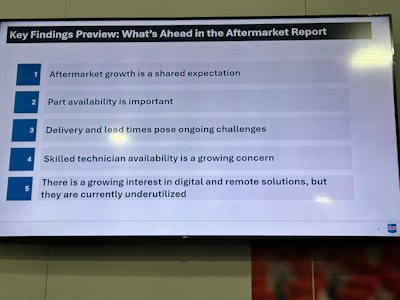
The survey highlighted several key challenges, with parts availability remaining a critical concern. End users often face emergencies when a part is needed to keep operations running smoothly, and the ability to quickly access necessary components is a decisive factor in choosing suppliers. While end users strive to stock critical parts, space limitations often necessitate reliance on suppliers for standard wear parts.
Lead times and delivery pose ongoing challenges, with 45% of OEMs citing them as a top concern. The pressure to meet end-user expectations is compounded by the scarcity of skilled technicians, a challenge shared by both OEMs and end users. The shortage of qualified personnel affects service delivery and complicates training efforts, which are becoming increasingly vital due to high turnover rates.
In response to these challenges, there is a growing interest in digital and remote solutions. However, these are underutilized due to connectivity issues and cybersecurity concerns. While 67% of OEMs offer remote services, many end users still require on-site interventions, often due to internal policies restricting remote access to machinery.
The potential of 3D printing is being explored to address issues with parts availability and lead time. While 37% of OEMs currently offer 3D printing services, many end users remain unaware of its benefits. The technology promises faster turnaround times, customization capabilities, and cost savings, presenting an opportunity for further integration into the aftermarket ecosystem.
Integrating digital solutions, improved training methods, and innovative technologies like 3D printing will be crucial in meeting the growing demands of the aftermarket sector. According to Marquez, the ongoing collaboration between OEMs and end users will be pivotal in navigating these changes, ensuring that the industry remains resilient and responsive to future challenges.
PMMI’s full aftermarket report will be available by the end of the month and can be accessed at pmmi.org.