North America has fallen behind in cobot and physical AI adoption, controlling only 6% of global robot installations compared to Asia's over 50%, making automation an urgent competitive necessity for manufacturers. While 87% of cobot users report significant productivity gains, 30-50% of automation projects fail due to poor planning, weak business cases, and lack of integrator partnerships.
- Market Gap: North America accounts for only 6% of global robot installations, while Asia leads with over 50% and China alone has more than 2 million robots.
- Success Metrics: 87% of cobot users report double-digit productivity gains, yet 30-50% of automation deployments fail due to missing business cases and weak execution.
- Business Leaders' Outlook: 90% of business leaders expect AI-driven robotics to positively impact their organization within five years, with 48% believing robotics will be most transformative by 2030.
- Fastest-Growing Applications: Quality inspection, assembly and insertion, and bin and dunnage picking—especially revolutionized by AI—are leading adoption areas.
- Critical Success Factors: Work with integrators, define automation goals before selecting technology, involve frontline workers early, and look beyond per-piece ROI to engagement and retention benefits.
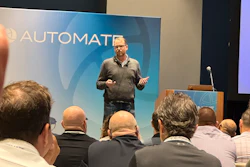
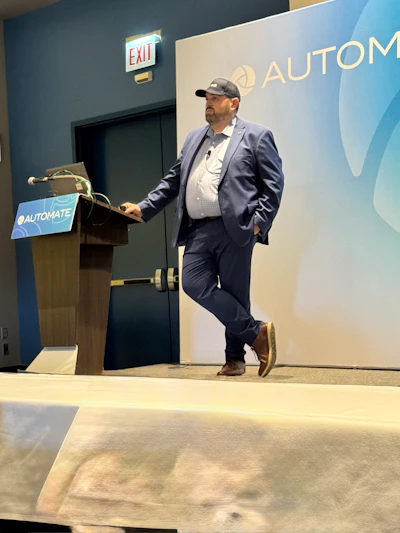
Will Healy, director of product and industry at Teradyne Robotics, used his Automate 2026 session, “The Evolution of the Collaborative Application: From Cobot to Advanced Robotics and Physical AI,” to make a case that manufacturers can no longer afford to sidestep. The line between collaborative and industrial robots has all but disappeared on the floor, machine vision and AI have transformed what's possible, and North America's share of global robot installations has slipped to about 6%.
“If you're competing globally, you have to automate. It's an imperative,” he told attendees. “You are behind right now.”
The pressures driving cobot adoption
Healy opened with the trends Teradyne is seeing in its annual State of the Industry research and the IFR data presented earlier in the week. North American robot installations are trending down. Asia has accounted for more than 50% of global installations for five straight years, with more than 2 million robots in China alone, or more than the entire installed base in the United States. On the plant floor, the structural drivers haven't changed: aging workforces, skilled-labor migration to urban areas, volatile markets, and what Healy called “persistent vacancies”—the positions where there's a new temp every week.
The investment case is there in the numbers. Teradyne's North American survey data showed 73% of business leaders cite productivity improvement as the top driver for automation, 48% believe robotics will be the most transformative technology by 2030, 90% expect AI-driven robotics to positively impact their organization within five years, and 87% of cobot users reported double-digit productivity gains.
The counteracting risk Healy highlighted came from an Ernst & Young white paper, “Get Ready for Robots,” that tagged 30 to 50% of automation deployments as failures, largely because of missing business cases, weak proofs of concept, no project champion, and a lack of attention to what happens upstream and downstream of the robot.
Past “cobot on a cart”
Healy framed the field in four phases — the traditional robot-arm era (40-plus years of low-mix, high-volume work), the cobot era that brought automation to the high-mix, low-volume jobs the big robots couldn't economically reach, today's “mixed deployment model” where cobots are running traditional industrial applications and industrial robots are running collaborative ones after proper risk assessment, and the advanced robotics and physical AI era that, he said, is already here.
A3 data he cited put collaborative robots at about 18% of all robots deployed in North America in Q1, but he emphasized that “I guarantee not all of them were doing collaborative applications.” Cobots are landing in screw driving and nut running (where shoulder repetitive-stress injuries make automation easy to justify), machine tending, and process applications such as welding, dispensing, and cutting. The applications growing fastest in his book: quality inspection, assembly and insertion, and bin and dunnage picking — the last of which, he said, has been “absolutely revolutionized by AI.”
He pushed attendees away from “cobot on a cart” thinking. He is seeing cobots deployed in work-cell retrofits, multi-robot cells, and full line builds. “Please, please, please do not try to do it yourself,” he said. Work with an integrator—internal or external—and don't end up among the 50% of projects that fail.
Machine vision, humanoids, and physical AI
Healy spent significant time on what AI has done to machine vision. “The machine vision of a year ago is not the machine vision of today,” he said, describing welding cells in China that scan a bin of unstructured parts, generate a path, and weld them with no setup.
On humanoids, Healy declined to pontificate. He cited a Schneider Electric line from the morning keynote — “the form factor doesn't matter, it's the application” — and argued that the same labor-shortage, unsafe-task, and flexible-automation problems humanoids promise to solve are already being addressed by mobile manipulators, AMR-plus-arm combinations, and mobile cobots. “Try it with a mobile manipulator first,” he said. “Then you're ready for humanoids when they're actually ready for you.”
Physical AI is where he sees the next wave landing. A March 2026 Deloitte industrial-sector report he cited found 62% of industrial businesses plan to deploy AI in their factory within two years — 25% through collaborative robots and 11% through autonomous mobile robots. The four application areas where it's already paying off, in his view: quality inspection, bin and dunnage picking, intralogistics, and dexterous manipulation. He pointed to partner demonstrations on Teradyne's Automate floor from ICA (gear fitting with dexterous manipulation) and General List (autonomous dual-arm work) as live examples.
Getting started — and not stalling
Healy closed with the practical advice that he said matters more than any technology choice. Know why you're automating before you pick a tool. “Tech is the last choice, not the first choice.” Talk to frontline workers as they know which jobs need to be automated, and involving them early cuts adoption resistance. Don't go it alone; work with an integrator. Don't nickel-and-dime the integrator on hardware; the knowledge is the value. Look past the per-piece ROI spreadsheet to engagement, ergonomics, and retention.
His parting line: “Hesitation comes at a cost.” Six percent of global robot installations, he argued, isn't a place to stay.