When an OEM ships a machine, it’s standard practice to ship the maintenance schedule with it. According to new research from Limble, about half of that schedule actually gets done.
Limble's first State of Maintenance Report surveyed 686 U.S. maintenance and operations professionals, split almost evenly between leaders (360) and frontline technicians (326). Leaders estimate their teams complete just 54% of scheduled preventive maintenance. That's measured against a schedule the teams wrote for themselves.
For the people who design and build packaging and processing equipment, that number is more than an end-user problem. It's the world your machines live in after the FAT is signed, and it should shape how you design, document and support them.
The cost of the skipped PM
Skipped PMs come back as breakdowns. Among leaders, 47% log 10 or more hours of unplanned downtime in a typical month, and 24% regularly go past 20 hours. Twenty hours a month is roughly 240 hours a year, or close to six weeks of production time for a single-shift operation. Four in 10 estimate annual downtime costs at $100,000 or more. Manufacturing respondents were 27% more likely than average to land in that bracket.
The three-hour shift
This is the stat machine builders should pin to the wall. More than 60% of both leaders and technicians say hands-on maintenance takes up three hours or less of a typical shift.
What do they do with the rest of the shift? Technicians name five obstacles:
Waiting on approvals (51%)
Incomplete or outdated equipment records (41%)
Parts they can't find (40%)
Hard-to-use software (35%)
Work orders without enough detail (28%)
Nearly half (48%) of technicians say they lose an hour or more per shift waiting on approvals or site access. Leaders put that figure at 37%, which understates it by about a third.
As the report points out, four of those five obstacles are information that exists somewhere but never reaches the person who needs it. Three of them fall squarely in the OEM's lane: equipment records, parts identification, and how clear the instructions are when they become work orders. Every manual buried in a PDF on a shared drive, every part number that doesn't match the spares list and every changeover procedure that lives in only one tech's head takes time away from hands-on work.
The knowledge walking out the door
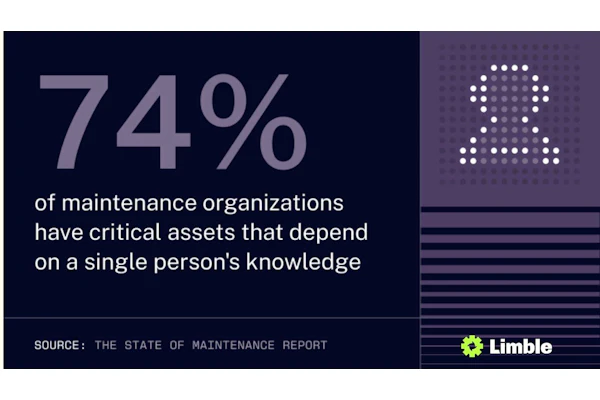
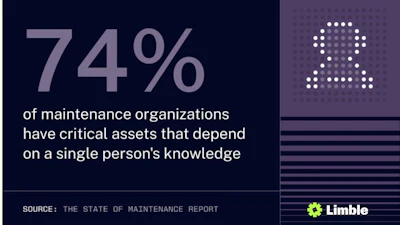
The workforce issue isn't new for the industry. The report says 74% of maintenance organizations said they have at least one critical asset that exactly one person knows how to fix. Sixty-seven percent hold knowledge about an asset or process that isn't recorded in any system. And 47% have already lost knowledge they couldn't recover when someone left.
To compound the issue, 46% of leaders say open maintenance roles take three months or longer to fill. Machine builders hold a lot of this knowledge themselves, but it usually lives with field service techs, not in the documentation package.
When technicians were asked what would make the job more attractive, the top answers were better pay (63%), more training (57%), and better tools and technology (53%). Training is the one an OEM can deliver directly.
Software they own vs. software they use
Most plants have already bought a system to fix this. Eighty-two percent of respondents say their organization owns a computerized maintenance management system (CMMS), but only 39% say the whole team uses it consistently. Seventy-one percent have asked a colleague for information their system already held.
Why does adoption stall? Technicians were never properly trained on it (47%), the system needs a desktop and doesn't work in the field (35%), and it takes longer than the workaround (26%). Technicians were also 116% more likely than leaders to say stale data drove them away. A record from eight months ago that just says "repaired" doesn't help anyone standing at a down machine.
"Most maintenance teams aren't short on technology. They're short on time and information they can trust," said Gary Specter, CEO of Limble. "Adding AI won't automatically solve the problems they face every day."
AI needs better records first
That point matters for every OEM putting "AI-enabled" on a spec sheet. Fifty-five percent of maintenance teams are using or piloting AI, but 92% agree it needs good, complete maintenance data to work. For now, AI mostly handles paperwork. Work order summarization leads at 65%, while failure prediction trails at 30% because it depends on asset history most plants don't have yet.
What it means for machine builders
The report concludes that maintenance maturity has little to do with size or budget and a lot to do with daily habits. More than a third of the teams that scored as predictive are small and midsize businesses. Leaders on predictive teams were 25% more likely to report technicians getting three to five hours of hands-on time per shift.