OEMs can significantly reduce machine build risk by using digital twins to simulate and debug machines before production, deploying distributed on-machine controls instead of centralized cabinets, and collecting structured machine data with context for real-time monitoring and remote troubleshooting.
- Digital twins let teams emulate and troubleshoot machines before shipping, catching design flaws like the palletizer crash that took six months to appear in the field
- Distributed control moves drives from cabinets onto machines, reducing shipping complexity and maintenance errors while simplifying design
- Structured machine data with context enables remote diagnostics and answers critical questions about production, uptime, downtime causes, and maintenance timing
- Virtual FAT (Factory Acceptance Testing) eliminates weeks of on-site testing by running all product recipes in simulation before customer delivery
- End users in automotive and life sciences already require digital twins; CPG companies are expected to follow soon
Justin Garski still remembers the Gantt chart for a refueling crane project from his time in nuclear power. The project was scheduled for 12 months. Mechanical engineering had four months, electrical had the next four, and Garski’s controls team had the last four to bring the machine to life.
“The Gantt chart never worked,” said Garski, who manages Rockwell Automation’s OEM packaging and converting business in North America. “Those mechanical guys always took five. Those electrical guys, they took five. And then my guys got to work 80-hour weeks for two months.”
The crane was essentially a large claw machine that moved forward, backward, left, right, up and down, movement not unlike that on a packaging or processing line. Garski said every bit of that motion could have been emulated and debugged before anyone cut metal. While the example isn't packaging- or processing-based, the crane represents any machine build and should still resonate for packaging and processing OEMs.
At his Automation Fair session, Garski described three ways OEMs can avoid repeating that experience via digital twins, distributed on-machine control, and structured machine data.
A model you can actually use
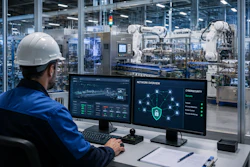
Garski said “digital twin” means different things to different people. He doesn’t mean the aerospace version, where sensors on 100,000 doors send data back to a model. He means building the machine and the factory digitally first, so a team can simulate, emulate, and troubleshoot before anything ships.
He also cautioned that “all models are wrong, but some are useful.” On a recent project for a large hygiene products company, Rockwell’s services team worried about modeling the elasticity of hook-and-loop fasteners on diapers. Garski told them to drop it. The converting process was already well understood. The real unknowns were downstream, in case packing, palletizing, and AMR traffic. For complicated sections, he suggested treating them as a black box with defined inputs and outputs. Rockwell’s tools won’t simulate candy or cheese flowing through a machine, he said, “but we’ll tell you if the box is going to fall over.”
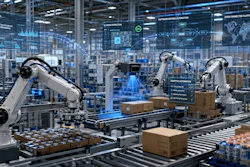
Simulation answers sizing questions early, such as how many robots or AMRs a line needs, before writing any PLC code. Emulation goes further by running real control code against the model, and that’s where Garski sees the biggest payoff.
He told a story about a colleague at Pearson Packaging Systems who shipped a palletizer to a customer, and it ran trouble-free for six months. The customer added a new recipe, and the machine started crashing on the top layer. Garski’s colleague loaded the recipe into his model and saw the same crash every time. He traveled to the site and fixed it. The job wasn’t finished yet as the customer then wanted three weeks of testing to confirm the other 12 products still ran.
“[He] has a family and doesn’t want to be on the road for three weeks watching boxes get stacked,” Garski said. He offered to run all 12 products in simulation instead and go home if they looked good. The customer agreed. “We talk about this virtual FAT as kind of the future,” Garski said. “That is now.”
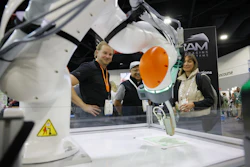
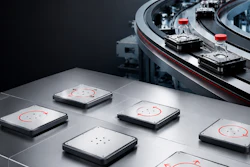
The same model can help sales. Garski compared it to a jewelry store, where getting a customer to try on a ring creates a sense of ownership. Mespack’s horizontal form/fill/seal machine, which was on the Automation Fair show floor, is a good example. Running twice as many products on a machine like that usually means making it twice as long, with a second set of stations. Mespack instead mounted the pouches on arms that extend from an iTRAK independent cart system, so two pouches travel together through the same stations. Rockwell took the engineering model and rendered it in NVIDIA Omniverse with no additional modeling work. The result looks like a video of the actual machine.
“If you’re in sales, here’s your jewelry store,” Garski said, while a rendered bag of peanuts moved through the machine. “Looks real. I want that in my factory.”
He addressed the usual objections head-on. Building a twin costs money, but “one crashed robot pays for itself real quick,” he said. Having to send service techs on a plane to fix something that could have been caught before it was built, costs money. Building a component library is real work, though Garski said Rockwell’s FactoryTalk Conductor agents are getting “dangerously close” to making that effort irrelevant. But teams have to commit to the tool. Someone who spends four hours a month on it won’t see much benefit.
End users are starting to require twins. In the automotive industry, companies already ask for them, sometimes simulating wiring and safety circuits as well. Life sciences companies are moving the same way because they want a plant producing on day one. “They don’t want to wait three days to start making $20 million a day,” Garski said. CPG companies are further behind, but he expects them to follow, and it could be sooner rather than later.
From electricians to technicians
Garski borrowed the second theme from his boss, who dubbed it electricians to technicians, saying that anyone who has crimped 26 wires into an encoder connector understands the problem.
Distributed control, which Rockwell offers through ArmorKinetix and ArmorPowerFlex, moves drives out of the cabinet and onto the machine. Garski said a machine that has to be split up for shipping usually gets built twice and taken apart once, with every cable pulled and rerun. With a bulkhead at the split point, the installer reconnects one cable instead of 12. The connectors are keyed, so they can’t be plugged in wrong. Garski once watched a machine keep running after someone hit the e-stop because a technician had left a stray wire strand bridging two terminals.
On a rotary filler with 20 servo heads, the old design put 20 amplifiers in a box spinning with the machine. “What could go wrong with all the electronics rotating at this speed for 20 years?” Garski asked. With drives mounted on the motors, short daisy-chained cables run around the turret and power and data pass through a slip ring. A 16-head or 22-head version uses the same design.
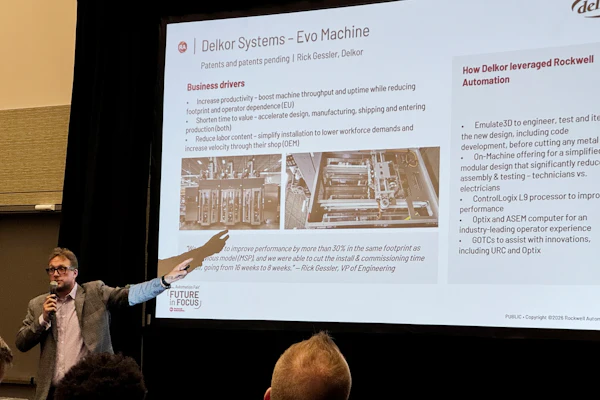
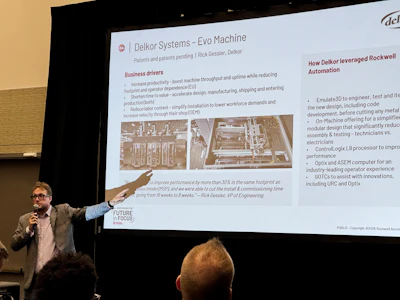
Delkor Systems took the idea further on the EVO Series Case Packer, which it has shown at PACK EXPO and at last year’s Automation Fair. Garski called it one of the coolest machines he has seen. He said loading a single blank into a packaging machine is easy, but feeding a variety pack with several inserts gets complicated quickly. Delkor replaced what would have been a safety door with a large, hinged module Garski described as a “bank vault door.” It carries six or eight servos, and operators open it to load a full supply of blanks. The module is optional, and it connects to the machine with one cable for power and communications.
“To do that any other way, you’re hiding more boxes full of amplifiers,” Garski said. He added that the design kept the machine simple and easy to debug.
Data with context
Garski opened his data section with four basic questions: Do you know your production? Your uptime? Why your machine stops? When is it due for maintenance?
He led with these questions because in his experience, many plants can’t answer them. The reason being that the data isn’t readily available. He recently visited a nonwovens plant where an employee walked to each machine with a clipboard, wrote down the counts, and typed them into a spreadsheet that fed a dashboard. That works, but is it the best use of the worker's time?
Rockwell’s approach uses smart objects that group each asset’s data together, such as speed, torque and runtime for a motor, so the data arrives structured and with context. That data feeds FactoryTalk Optix and standard dashboards for asset overview, OEE, top faults, maintenance events and energy use. An OEM with remote access can see why a line was inefficient and why. Then he can troubleshoot a solution, again without getting on a plane.
Remote access is still the main barrier to data in Garski’s eyes. He said many plants see only the risk of connecting, with “no one in IT ever got fired for refusing access.” He thinks the labor crisis could, no, will change that. When a machine goes down on a Monday, and nobody is available to put on a plane, the choice will be “connect or don’t produce for three days.”